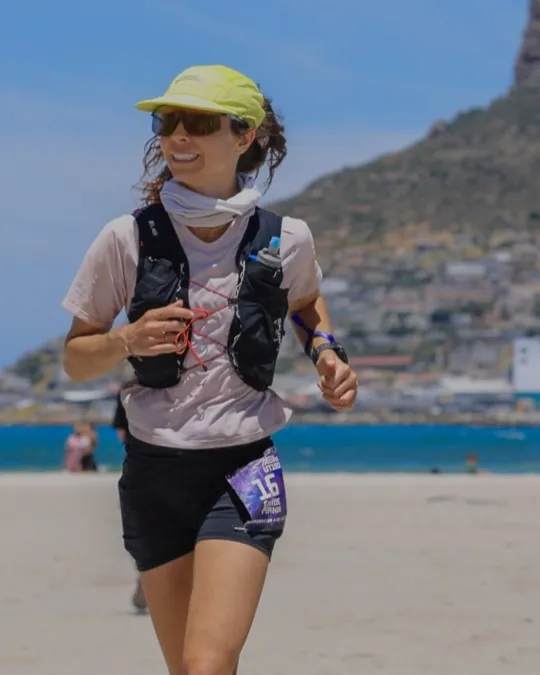
In this episode of the Outmap Podcast, we sit down with Emilie Mann, an ultrarunner whose approach to endurance is as much about mindset as it is about miles. Emilie shares what draws her to long days in the mountains, how she prepares for the physical and mental demands of ultrarunning, and why moving efficiently through wild terrain is both a skill and an art. We talk about pacing, resilience, and the quiet discipline required when the distances stretch far beyond what most people consider possible. Emilie also reflects on how running changes the way you see landscapes — reading terrain, managing effort, and learning to stay calm when things inevitably get difficult. It’s a conversation about endurance in its truest sense: patience, curiosity, and the deep satisfaction that comes from covering ground under your own power.
Key Takeaways & Insights
Emilie ran her first ultra, Vancouver's Buckin' Hell, when her relay partner was injured.
A lunchtime club, the Hill Hounds, got Emilie running in elementary school. She was due to run half of the relay, but her partner sprained an ankle days before, so she ran it all. She thinks she came second among the women.
Emilie competes mostly with herself, in a sport now raced at world level.
Emilie is curious how far she can go and how much quicker she can run. She says the sport has become more competitive: shortly before the episode, a Black Canyon race in Arizona had an Olympic medallist and a world record holder in it.
Emilie says long races teach non-attachment, except to finishing: let the perfect race go.
Emilie faces unknowns such as nutrition, her stomach and the temperature. A runner, she says, has to be ready to let go of other goals, such as a time or everything going smoothly, and pivot to a new one.
Emilie builds mental strength by repetition, sometimes going back up a trail she dreads.
Emilie says a lot of it is built in training. On one of her last training runs before a 100-kilometre race, it began sleeting in Kelowna after laps of Knox. She told herself she should do one more, though it was not planned, and says those hard moments are what she taps into in the race.
Emilie's coach has her write down at least 5 reasons for an important race.
The coach says Emilie will need them when she is tired, alone on the trail and has seen nobody for a couple of hours. Hers include racing for a friend who died, showing herself she can, and returning the support others gave Emilie. Emilie says they need to be "really loud, really important, really strong."
Emilie's big goal for 2026 was UTMB, the 100-miler in Chamonix, in late August.
Emilie had qualified for the 100-kilometre CCC, but auto-qualifiers could bump a distance up or down, so she moved up to the full race. It was absolutely terrifying her, she said, but she was excited.
Complete podcast transcript
Hello, and welcome back to the Outmap Podcast, A Guide in Life. My name is Charlie Boscoe, and today I'm talking to ultra runner Emilie Mann. Now, before we get started, I know we have had a small break from podcasting. Normal service and normal programming will be resumed, so apologies for the slight lack of podcasts over the past few weeks, but we're back on the horse now, and this is a great episode to pick things up again with.
0:40 Emilie is an ultra runner, which basically means she runs distances far greater than a marathon. She made a 100 mile debut a couple of years ago and broke the course record at the Run Rabbit Run race in Colorado, knocking almost half an hour off the course record. She won the Golden Ultra 60K, the Sinister 7 50K, and the Squamish 50 Miler, and she also won the Canadian Long Distance Mountain Running Championship.
1:09 This summer she's got perhaps her biggest challenge to date. She's taking part in the legendary UTMB, the 160-kilometer, 10,000 vertical meter race around the Mont Blanc massif in Chamonix. So this seemed like a perfect time to hear her story, how she got started, and what keeps her going on those long, long runs.
1:31 This is a super interesting episode, and I'm sure you'll enjoy it. Emilie, welcome along. Funny to think that you're sitting in your living room, and I've visited many times and sat The hot tub watching football with your many times. But now I'm in England, you're back in your living room. A surreal setting for doing this.
A little silly. It's a little silly, but we finally found the time.
Yeah, we did, and thanks for doing it.
No worries. Thanks for staying up late enough.
This is your podcast debut, isn't it? You How have you must have been on a podcast.
Oh, yeah. I've been on a few. Not with you.
I thought you said you'd never done it before. I thought you made it up.
No.
Okay. All right.
I'm just really I'm just bad at them, but bear with me.
I find that hard to believe.
You'll find out.
How would you describe yourself? 'Cause I guess you're not a runner, are you? A runner is someone that goes for a run. You're an ultra runner. Do we call you an ultra distance runner? What's the appropriate terminology?
Yeah. Yeah. No, I'm an ultra runner. Yeah.
Is that the
Like a long
Is it that simple?
Trail runner. Yeah, an ultra runner. Trails specifically. You won't find me on the roads, but
Is that for injury prevention or just boredom?
It's mostly boredom. It's mostly boredom. But when I talk to road runners I say it's injury prevention.
It is even at my pathetic old man level of running, it is
No, no
How much harder running on tarmac is versus the trail. You think of a trail as being
It's Oh, gosh
But the cushioning is pretty amazing compared to a road.
Yeah. Yeah. I honestly always find after my speed workouts. It's mostly road. Track is okay, but mostly speed workouts on the road. I feel like my body, I feel like the Tin Man afterwards. I so sore and slow moving the next day. It takes a little bit more of a toll, but yeah, some people love it lots more, so.
4:01 To each their own. Yeah.
A chacun son goût. Let's, let's start at the beginning, right? You grew up in Fernie, Just about in BC. Just Almost in Alberta. How'd you get into running? 'Cause, like, you get a long, long winter in Fernie. I mean, it's amazing when it's good, but you must have a lot of
4:23 When the trails aren't available. How did you get into all this?
You know what? I got into running really quite young. I was in elementary school, probably grade, I'd say like grade four, grade five. And we had a lunchtime run club. It was called the Hill Hounds. And every, every lunch hour we'd go for, like, a little two-kilometer run, and I just thought it was the funnest thing.
4:57 I absolutely loved it, and I would still make it home in time to make myself some Ichiban or a Pizza Pop, and then I would rush back to school afterwards. And I started to really look forward to all my lunch hours running. And then, I think that just stuck with me. It shifted into running after school, and then when I made my way into high school, it shifted into cross country practices and then, track practices and, yeah, I think it just continued to grow from there.
And when did you start really take it seriously? Or I was wondering if you might say, "Well, I don't take it seriously. It's fun." But I
I don't take it that seriously. You gotta keep it fun. I'd say I started to really hone in on actual training or getting curious about the longer distances probably when I was in university. I think I did like one or two road marathons, and I had no idea how to go about training, but I thought that was just such a spectacular, massive, lofty goal to set.
6:18 And yeah, I did, like, a couple of those, and then I was like, "What's next?" yeah.
Mm. Seems like a bit of a leap to me to running the You're running.
Well, my first ultra was. It was actually kind of on accident. It's a race in Vancouver called Buckin' Hell, and I was supposed to do it as a two-man relay. And a gal I knew from Fernie, she was gonna run the first half. I was going to run the second half, so we had about 25 kilometers each.
7:06 And then, just a few days before the actual race, she ended up rolling her ankle and spraining it really badly, and she was like, "Well, I think that we should still go and make the best of it, and we have that Airbnb, and you're already driving down, so I think you should just run the whole thing." I remember being so... I was like, "Ah."
Thanks. Yeah.
I was terrified. I don't think I really slept a wink that night. I was thinking of, like, "Okay, well, what happens out there?" Like, "Would I need a helicopter 'cause it's not accessible by road if something were to happen to me?" Like, "Do I just walk the whole thing?" Like, "Is it gonna get dark?" Yeah, I think I really surprised myself, and somebody else, believing in you too goes a massive way.
8:05 And yeah, I ended up finishing. I think I actually came second place for women.
That's pretty good.
And I was like, "Oh, my gosh." That was such a vibe. That was so fun. I love this ultra running thing. And yeah, I think from then on, I got a little bit more curious about, "Well, maybe I'll sign up for another race next year," and so on and so forth.
And you're now at the stage where you're really looking for results in races, right? Like for most people, finishing an ultra is a big deal, and it is a big deal. But you You're really chasing performance. What is the motivation around that? Do you enjoy the competition, or is it just going as fast as you can is the satisfaction?
I think it's a bit of both. I think I am a competitive person, for sure, but I think it's more so, competition, within myself of being curious about, like, how far I can go or how much quicker I can run this time.
9:18 Yeah, I think it's definitely motivation, within myself that I feel more so.
Is there much competition in the ultra running world? I mean, how competitive is it? I mean, I feel like people, if they're gonna put themselves through that and they could win it, and you're also there and you could win it, I feel like you wanna win and they wanna win.
I think it's definitely gotten more competitive. It's now, you know, racing at a world level. One of the more recent races, Black Canyon down in Arizona, they just had a Olympic medalist running one of the races, a world record holder also in that same race.
10:21 Yeah, I think that the sport has... It's grown so much, and it's become really competitive. So, if you used to run ultra marathons and place, quite high, Things have changed.
Has the
Definitely grown
The standards really gone up, hey?
Yeah. Yeah. It's really exciting for both men and women. It's become a very, yeah, very competitive sport. It's getting exciting.
It seems amazing to me because in a world where everything's getting faster, you got instant gratification and dopamine hits on your phone, and Getting quicker. It seems like every sport is being quickened up so that it's easier to digest, and yet
Mm
This really long, hard activity is exploding in popularity. Why?
Absolutely. Mm, I think don't, don't knock it till you try it.
I mean, I like it, so I'm in, but
I think, yeah
It's kinda going
I think
Cultural trends, isn't it, in a way?
Yeah. That's definitely a good point. It's really interesting when you finish your first 5K, and then, you know, naturally progress to your 10K, and then maybe you get excited about a half marathon or a full marathon. And then yeah, I think, you're like, "Maybe I should try this on the trail. Maybe I should do an ultra marathon." That ladder of what's next, what else can I accomplish here? What else can we do?
12:14 There's so many That you can set for yourself within trail running, and I think that's really cool.
It feels to me like there's also an element that people are looking for a bit of a deeper experience. That dumbing everything down, that dopamine The instant gratification only lasts so long. I guess it's like trying to live on sugar. It burns off quickly.
12:40 I wonder if people
It does
Striving for something that's a bit more meaningful. You gotta work for it. Something you've gotta work for, something that doesn't just reward you for five seconds.
No, and I feel like that's a huge part of running these ultramarathons is you're putting in a lot of kilometers, you're putting a lot of time on feet, you're often putting a lot of time in by yourself at silly hours of the day, just trying to make time and trying to make space to train for your performance of your race.
13:19 And I think that's a pretty special thing, like you said, in a world where everything is right at hand, everything is fast, fast, fast. This is something that you really have to work at, and you have to take time.
And what is it that motivates you? 'Cause I know you and your fiance and you're busy people. You've got a real job. I remember, I think I talked to you once, and you'd done multiple hours on the treadmill in the depths of winter.
13:53 The motivation? 'Cause everyone has to have one. You've gotta have a motivation. I'm not sure you can learn motivation or be given motivation, but there's something that gets you off the couch. What is it for you?
I think, through this racing, what has been really cool, and through the training what has been really cool, is, you learn a ton about yourself. I really love how much, traveling I get to do, and not just the traveling, but areas of the world, even within your own hometown that you normally wouldn't see, and trail running takes you to some really incredible places.
14:45 So it's definitely a huge motivating point for me is getting to see all these cool new places, getting to meet so many really interesting people. If you're lucky enough to get to train with people, you get to have some really incredible conversations. You get to know people really well. Conversation flows very easily when you're pairing it with movement.
15:13 When you're coming over these barriers with people, going through difficult kilometers with people, it really brings out some interesting conversations. So I think that there's a lot of depth and a lot of learning. So yeah, I feel like there's a ton of motivation, even in weeks of training that are maybe really lonely or really difficult.
15:43 Yeah, there's always pockets of motivation that you can tap into, and you don't have to reach that far or dig that deep for It comes pretty easily.
What have been some of your big learnings? You said you learned so much.
I think one of my biggest learnings is just to stay curious and stay open. Some of my bigger, like, distances in running, I've, like, have toed the line of races where it's just, like, a big question mark of, like, what's going to happen out there? What side of me is gonna come out? What am I gonna face is, like, from nutrition or from my stomach turning or from different temperatures. Yeah, there's so many unknowns, and you just, you learn to be really adaptable, and you really learn that non-attachment is important, non-attachment to an outcome, non-attachment to feeling.
17:03 Yeah, just staying curious and staying open and yeah, it's cool the stuff that you learn out on the trail in your twelfth, thirteenth hour of straight running. It's cool how sometimes that translates to other things in your life of just learning to be open and be patient.
What do you mean, non-attachment? I know what you mean, but is there not a huge requirement to have an attachment? Because if you're dying with ten To go on some race, you need to be pretty attached to finish it. I'm interested that you think
Yeah. Yeah, yeah, yeah. You need to be, for sure attached to finishing . But underneath that umbrella term of finishing, there are maybe other goals that you have made for yourself, like your time or that perfect race or that easy feeling of getting through whatever kilometer you're at More often than not, you need to learn how to let go of that idea that you had of everything going smoothly or this happening or that happening or, you know, missing your crew here or not getting the nutrition you needed down there.
18:26 So you have to just be open to being able to pivot and come up with a new goal rather than, yeah, being attached to that perfect race.
That is a real mental strength though, I think, because it's
I think so too. Yeah
It's really hard not to dwell The next thing or something you're really counting on. Really hard thing to do. A friend of mine, joined the special forces in the UK, he said something really interesting, which was that they always try and break that goal mindset. So he said, for example, one time they did a three-day exercise, completely destroyed, carrying loads of weight,
19:13 Their weapons, everything. They're wrecked. They make it to the The big transport helicopter lands. They all run, the ramp comes down, they all run on the back, and he said literally threw his rucksack on the floor of the helicopter and fell asleep. And he said he just woke up, and the guy in charge of training goes, "Yeah, bad news, helicopter's gonna crash." And now obviously the helicopter's not gonna crash, it's just gonna land.
19:38 And they were "Yeah, helicopter's broken, you gotta walk the rest of the way." And they were
Oh my gosh
But they were Doing stuff like that to them where, and he said, "by the end, you could just roll with anything." Because you were not attached to, "We're done." You just go, you go and go until the job's done. And it, I thought that
100%
Amazing mental training. 'Cause it doesn't matter how fit you are. It does not matter how fit you are.
No.
If you're that broken, and then they tell "Actually, bad news, you've got 12 more hours," that's To do with physical performance.
Yeah. You can be the fittest you have ever been or ever will be, but if the mind isn't there, if your mentality isn't there, you're very likely not going to finish your race or hit your goal. So that power of mindset is it's really, really key.
Do you do anything to develop that, or does that just come with time?
I would definitely say it's repetition. Like,
If you've just You've gone through it enough times, you just think, "I've, I felt like
I would, yeah
A thousand times."
I'd say a lot of it is where that strength is built is in your training. Sometimes I, on purpose, will, if I'm partway through a run, and then in my mind I'm like, "Oh, thank God I don't have to go back up that one trail again, I've already done it," I'll be like, "Well, just because I know that's the way that I don't want to go, or I'm dreading that, I should probably go and do that again because I know that's going, that's gonna make me stronger." one of my last, training runs, before my last 100-kilometer race, it started sleeting here in Kelowna, and I had already done, I think, three laps of Knox.
21:48 And I was like, "I know I should go and do another one." Even though it wasn't on the docket, I was like, "I just know that right now I'm, I'm really in the suck." "This is really, really hard right now, and I know that probably one more up and down is gonna be really good for me." and that's, those are the moments that you tap into in your race where you're like, I know that I've been here before in this difficult place. I know that I've felt this kind of hurt or difficulty before, and I know that I'm able to get through it." And then you build on top of that.
Yeah, and I bet a lot of people listening to this who are into mountain sports can really identify with that. Once you've Tired and figured it out, it's amazing how next time you can just do it.
It just unlocks the next level.
I had a really, this is gonna sound a bit weird as a, the most learning-packed day of my life, but in lockdown, I was working for a And they said, "Hey, try and do 4,800, 4,800 vertical meters in January." so we're in lockdown, literally people were doing it on the stairs.
Oh my gosh.
Two, three meters at a time, whatever it was. But they were just trying Give people a target. And I was thinking, I reckon I can do that in a day. Which I've never... Anyway, I by remarkable coincidence, there was a hill near my house, it was 48 meters high, and I
Oh my gosh, yeah
"I'm gonna do it 100 times in a day." And I worked out that it was gonna
There you go
82 kilometers, and I've never gone more than 20. So it was four times my maximum distance and nearly 5,000 vertical. But I thought, "Oh, yeah, I just reckon I
Oh my gosh.
I just reckon I can do this." And
You sound like you're an ultra runner.
Well, actually, I spoke to an ultra running coach, and he's given me this training plan and, where
There you go
Need to focus on this and blah, blah, blah. And he said, when are you thinking about it?" I was like, "Friday." And he goes, "No, no, no, no. No, just no."
No, no, no.
But you know what? I remember I got to about lap 33, and I was in a big hole. Really in a big hole. And I just remember thinking, you're gonna have to find a way out of this." And I'm sure if my goal had been see how many times you can hike up and down this hill, I'd have done 50.
24:26 And I would've gone, "Wow-" "I did 50 laps. That is incredible." And I'd have patted myself on the back. But because I was doing 100, I remember just "You better... You're gonna have to sort this out. You've gotta find a way." And what do you know? I was cramping. I was bonking for energy. It was a bad old time,
Oh my gosh
Yeah, found a way. But it's amazing what your mind can do. And did it. And it was great.
Yeah, and after you've done that, it's like, what next? What else can I do?
Yeah,
What can I put this towards? Yeah.
Yeah. And suddenly, so you are
And the next time you're in a situation like that, you're like, I've got this tool. I've got this," you know, "this notch already"
It's like having a superpower. 'Cause you just think, "Well, I will just keep going." Might go slow, might fall
Yeah, that's okay
On the trail for 10 minutes, but,
That's okay
I kind of know I'm just gonna keep going.
That's part of it.
It was amazing. Oh, the next day I went to the supermarket and someone Saw me getting out the car, and meaning the woman that worked at the supermarket said, "There is a disabled space, you know?"
Yeah. Oh, no.
Yeah, I'm not Like that's how bad I looked.
I'm okay.
That's how... I looked so bad, the woman at the
I will be okay
Thought I should be in the disabled space, I was pretty tired, but still, it was a massive learning.
I can imagine. Yeah.
And you must have been through that many times,
I have been, yeah. It's those moments where you really question if you're capable, and then you also, you question your why. What my coach always does before I go into an important race is he says, "I want you to write down at least five reasons of why you really want to complete this or why you really wanna place at this level." 'Cause he's like, "'Cause when you are tired, when it gets dark and twisty out there, and it's just you on the trail, and you haven't seen anybody in a couple of hours, you're gonna need those whys, and you're gonna need to revisit those whys.
26:57 So make sure that you've got that part nailed."
Yeah. Yeah, I think that's a really good tactic. I'm gonna try and remember that.
Yeah. Yeah, for the big days.
Yeah. Well, it's true, isn't it?
Yeah. Mm-hmm
I often found when I've done something tough, albeit not the kind of distances you're doing, but you know if you wanna be there or not. You really can't fake that desire. What are some of the more commonly written down ones?
I think some of the commonly written down ones are, well, one of them I had a friend who had, passed away, and I really wanted to do, this one particular race for her and her memory. Another common one that I have written down is because I believe that I can, and I wanna show myself that I can complete it.
28:00 Also I have one where it's like, by finishing this, I'm, in a way, almost like returning the favor of all of the support that other people have showed me in my training, and it's like, my giving back is like my performance.
28:26 Yeah.
Okay, so you need a good why. That's
You need some really good whys. You need some good 'cause you can go a little crazy out there if you don't have some good whys, because I promise you, there are gonna be a million reasons why you will consider also stopping that will come
I can
When it gets difficult
I can
A lot of thoughts will convince you otherwise, so your whys, your reasons for finishing need to be really loud, really important, really strong.
Yeah, I can believe it.
And then you can just start shouting them out loud in the like a crazy person when it gets tough.
Yeah, like that guy that the search and rescue in Kelowna went to get, and it turned out he was just singing to himself, and they thought they could someone screaming. You remember that last year?
No, I don't. Oh my God, I didn't know that.
Really? You not hear about that?
No, I didn't know that. He was just singing to himself?
Yeah, it was near the Boulderfields, which for people that, most people listening to
Oh my gosh
Who don't live in the Okanagan, that's a big climbing area. People thought they heard screaming.
That's so funny. That's so funny.
Search and police, everyone got mobilized, and it was a guy singing in the woods.
Oh my gosh.
Yeah. Someone just heard
I better stop singing so loud.
You know what the best part was? In the write-up that went on the local news website, the search manager said, "We heard a report of screaming, or was it even worse? Nickelback." And Nickelback found out about this and then reposted it. So Nickelback shared the search and rescue post.
Oh my gosh.
It was quite cool.
That's so good.
I didn't... I thought everyone in Kelowna heard that.
I didn't know that. No. I must be the last. That's so good. Oh, too funny.
Well, look, I don't wanna take a ton of your time, but just tell us what you got coming up, 'cause I know you got some big races coming, and where people can follow you, where they can support.
Yes. I have a few on the list for this year. My first one will be a little rust buster. I'm gonna be down in California just outside of San Francisco. It's a 50-kilometer race called, Big Alta. That'll be super zippy, really fast.
31:04 A nice little break from winter. That's in March 20th. And then, May 16th I have a 100-kilometer race in Australia in the Blue Mountains, which I'm planning to make a little vacation out. And then, I might show up, there's a little race in my hometown in Fernie, BC, the Elk Valley Ultra. I might just do one of the smaller days.
31:32 And then I have the Knee Knacker. Isn't that such an ultra-marathon name? The Knee in the North Shore, in Vancouver. It's a really nice race that's been, up for many, many years. And then my big, race goal of the year is UTMB, the 100-miler in Chamonix.
32:01 And yeah, that'll be end of August.
So I lived in Chamonix for many years. It's an incredibly special place to me.
I'm so excited I'm so excited
Any mountain person has to go to Chamonix one day. You'd be skeptical. People say, "Oh, it's where everyone else goes."
Ooh.
Oh, I don't care. You gotta go one day, and it will blow your mind. But the Is a very special event.
I'm so excited. I qualified for the 100-kilometer version, CCC, but I was like, you're able to either bump up or bump down a distance if you auto-qualify. And I was like, you know what? I'm gonna bump up and do the full, full full circle, full party, 'cause why not, right?
Wow.
And I'm kind of like, yeah, it's absolutely terrifying me, but I am so excited. So excited
Yeah. It will be amazing, yeah. And as they say, I'm in England right now.
Yay.
As they say here, in for a penny, in for a pound. You know, just go for it.
Why the heck not, right? Why not?
Oh, I love it. I'm so glad you got in, to have someone I know and like in a place that means so much to me. Everyone listening to this is probably
Yay
Yeah, everyone listening to Is probably thinking, "Yeah, okay, we don't care that you care about it," but it means a lot to me on so many levels. So I'm so happy you got in.
Aw.
And yeah, it's gonna be... I'm gonna be cheering on. Stranger things have happened than me
Come out. Come hang out
I was about to say, stranger things have happened than me being in
Come hang out
At that time, but let's see. But,
Yeah, I think I'm gonna go early-ish August and try to be there for a good few weeks at least.
Nice. Well, let's have a catch-up and all get together for some, a few glasses of wine in Kelowna.
I'll see you in the hot tub.
Sounds good.
I'll come home and you and Tim will be in the hot tub.
Yeah, me and Tim will be in the hot tub watching football.
I'll be like, "Oh, Emily, yeah."
Football season's over now. Yeah, exactly. What do you know? There he is. Yeah.
There's more sports to come.
We'll find something, I'm sure. We'll find an To sit and drink beer in your hot tub.
We sure will, yes.
Hey, but thanks so much for doing this right in the middle of a Sunday for you. So I really appreciate it.
No, All good. Thanks for staying up late enough and yeah, we'll chat soon.
That Sounds great. Thank you.