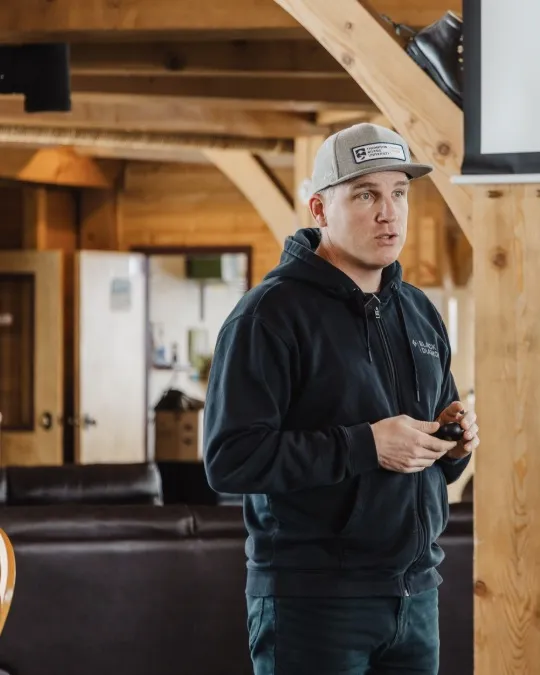
On today's episode of A Guide In Life I'm talking to guide and professor (that's not a combination you often hear) Jerry Isaak. Jerry is an ACMG/AMGA ski guide and has overseen more than 135 student-led expeditions across 26 countries. His passions include backcountry skiing, avalanche studies, expedition planning, and exploring how culture and decision-making intersect in extreme environments. We talk about Jerry's career, and get into why the "why" matters most!
Key Takeaways & Insights
Jerry wanted to be an NBA strength coach; 6 weeks in Austria changed that.
In the Austrian Alps, during a gap year, Jerry first worked with mountain guides. He later lived for a year in Schladming, Austria, then took a 2-year adventure guide diploma at Thompson Rivers University. Wanting to work at universities, he did a Master's in Outdoor Education at the University of Edinburgh.
A French guide Jerry met outside Aviemore valued Scotland's bracing, authentic climbing.
They met in Coire an t-Sneachda, and the guide essentially said it was authentic, with no bolted belays. Jerry says the Cairngorms have really serious weather and a history of tragic accidents. His travel lesson is to celebrate places for what they are.
Great days in the mountains flip what Jerry calls the modern digital paradigm.
Wealthy societies, Jerry says, stress things such as constant entertainment, physical safety, control and worldwide connection; adventure reverses each. He teaches that facing the unknown is one of adventure's core elements, and that authentic adventure is a work of imagination before an act of exploration.
Technical skills are a minimum, Jerry says; decisions and caring for others come next.
Jerry's programme has about 40 new students a year. He thinks pushing for goals should be celebrated, but encourages reflection. Many who spend a career in the mountains, he says, lose close friends, and that often prompts a change of perspective.
Jerry asks students to try outings with online sharing, group-only photos and no photos.
Jerry calls them micro adventures and suggests listeners try them. In parts of Canada once thought remote, his job means carrying a satellite communication device. Part of him, he thinks, mourns what that connectivity takes from adventure; part wants every advantage to keep his group safe.
Combining academia and guiding meant fewer mountain days, but Jerry would do it again.
Jerry calls it a compromise, with fewer days than he might have chosen on another path. He says the mountains can be dangerous and he does not fully know how to square that with being present for his family. He still goes because, he thinks, it is how he knows to be most fully human.
Complete podcast transcript
Hello, and welcome back to the Outmap Podcast, A Guide in Life. I'm Charlie Boscoe, and this week I am talking to Jerry Isaak. Jerry is a ski guide, but he's also an associate professor at Thompson Rivers University, and throughout his career he's mixed a passion for skiing and climbing in the mountains in general, with academia and an enormous love for teaching and passing on knowledge.
0:35 It's been quite an unusual career for a ski guide. He definitely isn't just a guide. He's much more than that. He's an academic, he's a teacher, and as you'll hear in this episode, to some extent he's a philosopher and he's got some fascinating things to say about why we go into the mountains, how we go into the mountains, and what it might mean.
0:55 He's lived on different continents in different countries, experienced different types of life in different areas, in his career, and it's a fascinating chat. I think you will really enjoy it, and I wanna thank Jerry so much for his time, especially given that it was officially family time for him when we spoke just before Christmas.
1:15 Enjoy. Jerry, welcome along. Thank you for joining. I know you're down in Orange County with family commitments, so thanks for taking a bit of time out of the day.
Well, thank you, Charlie. It's good chat, good chatting with you.
And just before we started recording you said Orange County's about to experience its most rain at Christmas since when? 19...
1971. Yeah, that's what my wife said. So it looks like the atmospheric river that we've been experiencing in British Columbia has followed us down to California.
I don't mean to be mean, but it's actually really sunny in BC today.
Well, yes.
Should've
In Coloma where
Right where we were. Yeah.
I might have, yeah.
So this podcast obviously is about your career and your life in the mountains, and I think, you've had, seems to me a relatively unusual career, or not a traditional guiding career. Let's start at the beginning. How did you get into mountains? What was your childhood? Where did you grow up? Where did this all start?
Yeah. I grew up in the Fraser Valley outside Vancouver, British Columbia, and our family enjoyed hiking in the North Cascades. We were close to the American border, and I have to say I probably wasn't the most enthusiastic participant as a kid. And I wasn't really interested in mountain sports until after high school.
2:54 I had wanted to actually be a strength coach in the NBA. That was my goal coming out of high school. And I took a gap year before going to university to pursue that dream. And during that year I spent six weeks in the Austrian Alps, and that was the first time I worked with mountain guides, and we were hiking and climbing and doing via ferrata and that was the first time I think as an independent adult that the mountain world was open to me and I thought, "This is..." It was just incredible.
3:26 And that was, I think, the switch. And it took a few years before I started to pursue it professionally. But for me, that was the switch, the first time I worked with guides and spending people who spent their lives in the mountains.
Where did you go in Austria, just out of curiosity?
Yeah, we were in Schladming. It's a town, it's about an hour south of Salzburg in the Eastern Alps, and the mountains there are the Dachstein range.
Oh, that is an underrated part of the Alps. We don't wanna go down a rabbit hole. Anyone listening to this, the Dachstein is one of those places that not many people know about it, but people who know, yeah. You know.
It's great year-round. There's, there is wonderful, rock and alpine climbing and then excellent, excellent ski touring in the whole area.
And so really that you didn't just burn everything and decide you were gonna be a mountain guide. It sounds like it just lit something in the back of your mind.
Yeah, it did, and I think, part of that was then coming back to British Columbia and pursuing kinesiology and strength and conditioning training. And being in a classroom and getting trained and it was so much of my first year was about working with geriatrics and the type of clientele I just was not very interested in working with. And more my mind just kept drifting to the mountains.
4:47 And so that was, to compress the story really the start of that journey where I wanted to pursue, being in the mountains. So after a couple years of undergraduate school, I went, back and actually lived in Schladming for a year.
5:02 And my wife Katie and I lived there, and I met Katie, who is from California, which is why I'm down here now. I met her in Austria. And so I'm from Vancouver, she's from San Diego area, and we met in Europe.
What are the chances?
Yeah. Right, I know. Yeah.
Although I met a couple the other day, only people from BC will get this, but they're a German couple. And they both, two Germans independently moved to 100 Mile House, BC. And I was thinking how do you find another German person? So if they can do that, you can meet another North American in Schladming.
That's right.
So at this stage, so while you're studying for your degree and everything, were you into mountain sports? Did you have expertise and experience or were you just inspired to do it one day?
Yeah, no, I was just inspired. So I think probably for most people, I was late to the party really. I would say a low intermediate skier at the time. And then when we lived in Austria, one of our roles was to be ski instructors. And so the local Austrians, where we were volunteering and working, put us through a staff ski instructor training.
6:16 And then I spent that whole winter, 100 days of skiing and really teaching people who were just slightly below me at an intermediate level, and it was the best thing ever for my skiing. I did these drills so often and got to ski in some great places and that took my skiing to the next level.
6:36 And but no, I didn't have that not like my kids. Like my oldest son has been skiing since really close he could walk, and now he can do things on skis that I can't even describe. Freestyle in the park and all these things and but for me, I didn't really have that. But after our year in Austria, that was 2004 to 2005, I decided I wanted to pursue this as a career, and I enrolled at Thompson Rivers University in the Adventure Studies department, and I did a two-year adventure guide diploma.
7:09 And that was where I started working with Canadian Mountain Guides, and we pursued, guide training really in the first formal way.
I think one of the barriers that people often face getting into backcountry skiing, but particularly getting into guiding is how do you actually start gaining that experience? Because backcountry skiing is a tricky thing to learn from the couch. And equally when days off are precious for people, so they don't necessarily wanna take out someone new.
7:40 But if you've never been ski touring, it's pretty tricky to do a course. How did you start acquiring the skills to move through the backcountry before that? 'Cause presumably you can't go onto that course cold, having never put skins on.
Right. And so that year that I was in Austria, some of my closer friends were Austrian mountain guides and fellow ski instructors, so I started going ski touring that year. And my ski ability had started to climb but of course, especially in ski touring and your movement skills vastly outpace your mountain experience and knowledge, especially in the early stages. And so for me then I realized, okay, I need more experience to know even just basic things, track setting up and down, much less, thinking about snow and avalanches.
So what was that course and that journey like then once you enrolled on the course?
Yeah,
'Cause presumably you had to... Sorry.
Go ahead.
Presumably you have to pay. Presumably you're incurring debt to do this. It's quite a serious commitment.
Yeah. I was lucky not to have to incur any debt. I had some scholarships, and, relative to other undergraduate programs, in Canada anyways, it's not overly expensive. It's not cheap, but I was a domestic student in British Columbia to be able to take that course.
9:06 And then at the same time, we were married at the time, and my wife was working and supporting me through these amazing courses where I got to go climbing in the Rockies and ski touring in the interior of British Columbia.
And you had to pretend it was work.
Yeah, I still get to pretend it's work. Yeah. Yeah.
So at the conclusion of that, what was the trajectory of your career from there?
At the time, I wanted to become a full IFMGA mountain guide and wanted to pursue that. For many people, I think they can't quite understand the commitment that takes and the timeline. And so I started pursuing that. Like I said earlier, my wife is from California, so I started going through my courses and exams in America with the American Mountain Guide Association.
9:57 And so I think I started with the rock program and did the first level of the rock program, and then started with the ski program and progressing through my different levels of avalanche courses. And that was, that was the start for me.
10:12 But my career, like you alluded to, is different than probably many guiding careers in that I was always interested in a dual path. I work at Thompson Rivers University now in probably one of the best jobs in academia, where I'm a professor of ski touring and avalanche education.
10:29 And so I've always had that kind of dual interest of working in education, working with college-aged people, who are pursuing their own goals and particularly related to adventure tourism and mountain guiding.
So what happened to the American guiding thing?
Yeah. So I kept pursuing that and in both Canada and the US, the timeline is typically slower or can be more drawn out than in Europe, for the guiding. So I was taking courses throughout, and we were trying to do my immigration paperwork to come down to the US, where I would start working as a guide.
11:08 We got some bad advice on some immigration paperwork, and it was just taking longer. And in that time, I realized, well, I do know that I want to work at universities, so that meant I would need a master's degree. So I started looking for relevant master's degrees, and the one that really came to the fore was the Master's in Outdoor Education at the University of Edinburgh in Scotland.
11:33 And so I enrolled in that program. We went to Scotland and lived in Scotland for a year, and were able to explore the Highlands and do expeditions to places like Morocco and Svalbard and that was something that then, helped me to then get the subsequent jobs that I have had, both in Canadian and American universities.
What was that year in Edinburgh like?
Oh, it was wonderful and wild. And we had two little boys at the time, and
Oh, wow. This is... You've already got kids on the scene.
Yep. Our boys, our oldest was born in 2008, and then our next one was born in 2010 in June. And in August we moved to Scotland. And so I
That That's brutal. Anyone with a kid is wincing at the thought of moving across a continent with a two-month-old.
Yeah. My wife is incredible and she I don't know if she makes it look effortless, but she pulls it off. And we work together. And now we have a third boy and so they're all teenagers now. But at the time, yeah, it's really busy and yeah, they're active kids. So I think in many ways that was both, challenging but also really fun 'cause it was this family year that we were able to connect as our young family and we met people that we otherwise wouldn't have met, because of the boys and Katie with me there.
I've got to ask you, what did you make of Scottish mountaineering/ski mountaineering?
I would preface that by saying a lesson that I've learned in traveling so many different places around the world is to celebrate the places for what they are and not continually wish they're things that they were not. So I will say it was very hard to leave my skis at home in Canada and know that I wasn't gonna be skiing that winter.
13:25 But then it was also wonderful to explore the Scottish mountains and know the history of climbing in that place and all the challenging routes that have been developed there and the Scottish and British climbers that have gone on to so many amazing adventures around the world. And so it was really cool for me to just glimpse at a portion of that.
13:44 Yeah, it was wonderful. I was able to do a winter term with Perth College, which is part of University of Highlands and Islands, and they had a program where, they were teaching young people some basic outdoor skills. So that got me out into mostly there into the Cairngorms, and we did a little bit of skiing, a little bit of ice climbing, and it was a great taster.
That is a brutal place, the Cairngorms, isn't it?
Yeah.
If it's easy to look at it and the highest mountain in the Cairngorms is Ben Macdui is what? 1,200 meters or... And take it for granted. But that plateau, the Cairngorm plateau in winter is no joke
No, it's no joke. They have really serious weather and there is a history of some really tragic accidents in that area. Ben Macdui, though, when we went up was a great day out and yeah, we had wind but yeah, classic Scottish conditions. A bit of everything really.
Yeah. I actually spent a winter working on Cairngorm Which is if where it sounds like, on the Cairngorms I think we had a sunny day per month Just to give some people an idea. It is so rare to get sun up there. April maybe, March, April, but early winter it's a brutal place to be.
Yeah. And I think the flip side to the really difficult conditions is the people that come out they love being in the mountains, right?
Yeah.
And they're able to tolerate, conditions that people that come from, maybe ranges that are blessed with more stable high-pressure systems don't get to experience. So yeah, there's a wonderful, amazing culture of enjoying being in the hills and mountains in the UK.
Yeah. I think there's something, in the brutality of those conditions and those places. If you look at the mountains in Britain and then you look at what British mountaineers down the years have achieved, it makes sense once you go to somewhere like the Cairngorms, doesn't it?
Yeah. And one of the, my experiences that has stood out to me from that time, we were up in there's a corrie, Coire an t-Sneachda is this famous corrie.
Yeah. One of the Climbing corries
Yeah, outside Aviemore and we were going up for just a, a scramble route to go up. And we were coming down and, or coming down towards us was a French mountain guide with two clients. And we started chatting a little bit and I was surprised that a mountain guide from the Alps would be there. And I asked him about that, and he essentially said it was authentic and real.
16:17 He liked the bracing nature of it. There wasn't, there weren't bolted belays. You had to find your own protection. You had to, you had to scrap up the route and accept what the mountain was able to give you that day. And I think for him there was a tremendous appeal in that.
Yeah. And it's remarkable when you go to Ben Nevis, which is the highest mountain in the UK for people listening, and also, probably the best winter climbing in Scotland is on Ben Nevis's north face. It's remarkable how many of the routes were put up by Chamonix mountain guides.
16:49 They used to take a vacation from Chamonix to go to Ben Nevis, to go ice climbing. Also, for people listening to this, maybe we're geeking out a little bit too But the massive temperature fluctuations mean you get incredibly sticky ice at times. You can get horrific slush and terrifying conditions, but when it's good you get... It's almost like climbing a, a vertical sponge.
17:12 Your axes just sink in and it's something really unique. But like you say, there's something very genuine about the Scottish experience. If you're scrapping up a route, there's no sign anyone's been there before. There's something special about that.
Absolutely. I think that's a reason that probably most people who love mountains keep going back to the mountains. We, in one of the classes I teach, at TRU it's on the culture of adventure, and we look at what is a authentic adventure, what does it have to say in the modern world, and especially how do we consider adventure in light of what I call the digital paradigm of the modern world where if we think of this modern world where wealthy societies today stress constant entertainment Physical safety, control, continual and worldwide connection with others, unlimited information, an emphasis on another world rather than our local and physical world, and then mental stimulation, above physical activity.
18:24 All of those elements are flipped on their head by great adventures and by great days in the mountains, where we might get bored, it might take a long time. We're not constantly entertained. Physical safety is. Not that we are pursuing danger or risk, but there is a component of risk in all great adventures.
18:48 We lack control. Like you're in Scotland and you give up that, and I think that's part of it is where there are fewer, regulations or limits. And whether that's in Scotland or in the Alps or in Canada, the lack of control is something that I think connects us to a deeper human past.
19:08 And then continual and worldwide connection with others. With our smartphones, we are connected all the time with everything, and in the mountains or on other great adventures, our world shrinks to the people that we're with. It's like you and your partner, your climbing partner, or just a few people that you're skiing with.
19:27 And that, I think, again, is this ancient human experience of traveling through landscapes with a small group of people and encountering what happens. And that, I think, is one of the reasons why we find it so compelling, 'cause it connects us to a more ancient past, a different way of being human.
I love that. I just love that. And I actually, while you were talking, I was having flashbacks to being, I don't know, a meter or two above some pretty shonky piece of gear on the Scottish winter climbing route. And yeah, you can go on Outmap and zoom in and see every detail of the thing you're climbing or the mountain, maybe navigating off is much easier than it was when we were using paper maps on the Cairngorm Plateau. But if you're a meter or two above a pretty shonky piece of gear on a Scottish winter climbing route, clearing out a crack and trying to make you are having an adventure.
20:19 For sure, you're having an adventure. And to me, the meaning of adventure is the outcome's As you said. And I think, it's a free world, everyone can do what they want. But that's why to me, something like climbing Everest in the way it's currently climbed is not super appealing, because you pull on a rope and eventually pull on to the end of the rope, and you're standing on the top or you bail. But really, with modern forecasting and a fixed rope and oxygen and Sherpa support, there's not a huge amount of unknown. You either get to the top or you don't. But the experience is not going to be, a big adventure. It's just gonna be a binary yes or no.
21:01 And I think I loved what you said about, that unknown element of adventure.
Yeah. I think, in my class, we talk about facing the unknown as one of the core elements, for adventure, because I think often, adventure is this metaphor or this reflection on life, where in our lives we face the unknown, and part of adventure is choosing to face our mortality and our humanness.
21:32 And when we remove that portion of it, you take out this key element that is so critical to that experience. Yeah. There's a wonderful line in. That was written by Robert Macfarlane, and I think it's in the film, "Mountain," which includes texts of his from the book "Mountains of the Mind." And he says, "Because the mountains we climb are not made only of rock and ice, but also of dreams and desire." and I love that line because in, again, in that class, we talk about the idea that authentic adventure has always been a work of imagination before becoming an act of exploration.
22:15 And if we're talking about Outmap or planning trips, that's also one of the wonderful things. We plan adventures, and they live in our minds before they become an act of exploration. And I think that's why even these podcasts or conversations are, appealing, because I like to hear about your adventures, and you perhaps find something engaging about, listening to different places I've gone or things that I'm planning as well.
Yeah. I think, oh, that's so true. I don't know about your journey, but I certainly found when I got into all this stuff, it's very much about ticking it off. I heard about this legendary route, I've heard about this legendary ski tour, and you're very focused on ticking things off. And actually, as you get a bit older, which sadly is happening to all of us, you start to appreciate sitting at home and planning it, and you start to appreciate when you go for a walk a few days later and you're decompressing and processing it in your mind.
23:17 That actually becomes a huge part of the overall experience. Okay. I hate coming back to a timeline, but
No, go ahead.
This podcast is about how you turn all that passion and all that meaning into a way to pay the bills. 'Cause, it's super easy to be, psyched and to philosophize on the mountains and stuff, but the problem we all face is you actually have to eat and have a roof over your head. When you came back from Scotland, what happened then?
Yeah. So I was fortunate to get a job at Eastern Oregon University in a small town of La Grande in northeast Oregon.
Which was where, Steve House came from, right?
That's exactly right, yeah.
There we go. That legendary American alpinist. He's actually from La Grande, right?
Yeah, yeah. He grew up there. We didn't overlap and I've not met him, and I'm definitely not in his class of adventure. But yeah, that's where he's from, and some wonderful, wonderful local mountains. The Wallowa Mountains and the Eagle Cap Wilderness, is a beautiful and underrated, part of the American mountain geography.
I think Oregon's one of the most underrated states in general.
Yeah. It's a beautiful place. And we loved our time living there. So after coming back from Scotland, I had a job there working, as an adjunct, faculty member and outdoor program coordinator. So I took people, climbing and skiing and taught some avalanche, courses.
24:57 And we were there for three years. And that job, then led to a job that I took in Upstate New York in just north of the Adirondack Mountains, quite close to the Canadian border. And I worked at the State University of New York, in their Adventure Sports and Expeditionary Studies program.
25:17 And yeah, I did that job for eight years before coming back home to British Columbia, where I've been the last several years at Thompson Rivers University.
It's quite an unusual career choice, though, to turn guiding into a... I mean, I know you're out in the field. But you don't meet many mountain guides who end up being professors at universities. But it sounds like you had that in mind all along.
Yeah. For me, although my career path has been winding, that has been a constant. I have always been interested in teaching and education and being out in the field. So as much as I can, I try and split time so that much of my time is in the mountains, and of course, that's often like these are the best classrooms.
26:01 I think I love the part of being in the mountains that is both intellectual and physical. It's this whole body experience, and if you only have one, well, then you're sitting on the couch thinking about the mountains. And if you only have the other and it's physical, well, you probably won't last very long in the mountains.
26:23 And so for me, being able to share that world with people who are really excited about it, that's been, I think the best part of my career. And I think that would be the element that would be common to guides around the world. Guides that really enjoy their job, and don't just do it to pay for something else, which is fine, people may do that. But for those that really, really love guiding, we love sharing these places that other people may not be able to go by themselves, or we help them learn this process.
26:55 And so in that way, as I teach my students, it's not about me ticking something off. It's not about, the day that I have. It's about how can I create this wonderful experience for the people that I'm with.
27:11 And for me, it's been teaching and working with college students in the outdoors.
Yeah. I think you're really onto something there, that there's not a lot of meaning in mindless physicality. It's the journey through your mind that's interesting. And what are the students like when they come to you? Because if I think about myself at that age, I was definitely not worried about the mental side of it. I was just head down, backside up, let's go as hard as we can.
27:43 Is that what you're seeing? Or do people have a more nuanced and developed understanding of the sports they're doing?
Well, in our program, we have about 40 students, new every first year, and so we have a wide range of perspectives. Definitely, we have some folks that are exactly like you described yourself, and they're keen, and they wanna just get after it and check off all the boxes on their way to full certification as a mountain guide or a ski guide.
28:10 And then we have others that are just exploring the mountains or maybe they end up working in another part of adventure tourism, sea kayaking or white water kayak, whatever they might be. So we do get a wide range, and I think, for me, my goal is to perhaps help both of those extreme ends of the spectrum. Help the people that are really getting after it to reflect more on their experiences, and hopefully have a really long and healthy life in the mountains or in the outdoors. And then for those folks that are often, more intimidated or scared, to really help them see what they can do and what their body is capable of.
28:52 Both elements are really rewarding when people come towards, I think, maybe a more nuanced perspective on being in the mountains. Hopefully a more joyful and a fulfilling way of moving in those places.
Yeah. It sounds like that's quite a big focus for what you do. You're not just saying, "Hey, here's how you analyze a snow pit. Here's how you build an equalized belay." Sounds like you're actually trying to develop them as mountain people.
I think that's exactly it. And I think I would say that would be one of the differences of, like, if I was making a pitch for people to come study and take two years out of their lives with us, it wouldn't be because we're the only place that can teach you how to build a belay or to set a track up a mountain. You can learn technical skills in many different places.
29:43 But the opportunity to spend time with mountain professionals, both our full-time faculty, but also many, many other wonderful sessional instructors that we have that are typically full-time working guides. We work hard to select the best people for those roles, and our students are incredibly lucky to spend days and days in these wonderful places, with learning from those people. Early on, they focus so hard on the technical skills, and the technical skills are a minimum requirement. You have to be able to move, you have to be able to swing an ice tool, you have to make a turn if you're skiing.
30:22 But very quickly beyond that, it's about how do we make decisions in these places? How do we care for the people that we're with? And that's the switch, I think, from being someone who loves being in the mountains as a recreationalist and then someone who's made a life and a profession of taking care of others in these places.
Yeah, for sure. And actually, for context, I spoke to some of your students last week, for people listening to this. And I was aware while I was chewing their ears off that it's quite hard at... God, I sound like such an old guy now.
30:56 But as you get a bit older, you appreciate that. For younger people, it's quite hard to view your life in its entirety. When you're 21, it's really hard to imagine being And how you might feel and life might be different. And it's very hard to picture that actually what you're doing now, which is just going hard every day, might not be feasible longer term. And I really liked when you and I were chatting before this and in the lead-up to me talking to your students about the fact that you wanna highlight to them that, hey, maybe just head down, ass up isn't how it's going to be forever.
31:38 I think I really liked that element of it. And do you find that people are quite receptive to that? And do you think that's probably the biggest thing they take away from the course?
Yeah, I do think people are receptive to that generally. Like you said, it's so hard for us when we're younger. I couldn't have thought when I was 21 what my career would be like or where I would be at 45, or even the things that have become important to me.
32:09 What is a good day out in the mountains when I was 21 is similar but not the same as it is now when I'm 44. And so I think people are receptive, but it's more time about building relationships with people and if we're lucky, we get to share those days with them, and then hopefully encourage them to reflect on what were the elements of it that made it meaningful for us as a group and for them as an individual.
32:35 And yeah, when I'm lucky enough to have those days with students, I can't believe I'm getting paid to do that work. It's incredible. Yeah.
That's actually one of the trickiest things, I suppose, for a career in the mountains, whether it's a paid career or whether we're talking about just a career of... in the mountains, is actually figuring out what it means to you. And I spent the formative years of my climbing career in Chamonix, and you have a pretty diverse range of what it means to you.
33:08 And you definitely get some tickers, they wanna climb this route and ski this. And then, you get a very diverse range of people. What advice would you have for people who are trying to figure out what meaning looks like to them?
33:27 Appreciate that's a bit of a question just to throw out there. But you deal with a lot of people who are probably wrestling with, what do I enjoy?
Yeah
Not comparing themselves to others.
I think it's a great question because as we go through life, we change and the things that bring us joy and provide meaning to us frequently change. And I am not the person to say, "Don't pursue the goals or the tick," or like, to really push and see where your body can go.
34:04 I think that's something that should be celebrated. What I would encourage those people to do is make sure that they're being reflective in that journey and that process. For many of us, if you spend a career in the mountains, like you said, whether you're getting paid or if it's just traveling through these places, you will experience loss, and you'll experience a loss of close friends or climbing partners, skiing partners, and that is frequently a catalyst for changing our perspective.
34:38 And not always. Sometimes then we continue to pursue it. But I think when you asked about, how do we help people to find meaning in the mountains is I would encourage them to be reflective on their process, wherever they're at on that spectrum. And I certainly wouldn't wanna put the brakes on someone who is finding that joy in moving quickly through the mountains and really pushing their body. That's an amazing thing to see and to help facilitate for people.
35:08 But at the same time, I think there can be other ways that we can be in the mountains where we can take incredible experiences and find, great joy and meaning, and we're not necessarily living right on that knife edge. But do we only come to that when we're 30 or 40 or first maybe later? I don't know 'cause I don't know if I would have fully understood that when I was in my early 20s.
Yeah, I get that. I think there's nothing wrong with going hard. I can only speak from my own personal experience, but what you get out of it evolves over time. And it used to be a sense of achievement and ticking this off and ticking that off, and actually now increasingly I'm thinking about who was I with, what was the view like, where did we sit and eat lunch. All this stuff that didn't matter a long time ago suddenly matters more.
36:07 And much of it, as you mentioned, was prompted by friends getting killed and you think, "Do I wanna die for this?" Maybe not.
Yeah. I think, one of the other themes that we come to in my class, which this class is on campus, is that the meaning of adventure is created and contested in community. So we have this history that we carry with us to these places. We have the history that we might carry with us to the Highlands and the stories that we've read there, or the Alps or the Canadian Rockies of the things that have been done there. And we also at the same time then shape and create meaning through the people that we're with and the stories that we hear. And so the people that we're with are often a catalyst for those experiences and how we create meaning.
36:57 And then the other element that I think is really significant today is that for many, many people, the first experiences of these wild places or of mountain places, is often through digital means and through some type of screen device that's mediated the experience for us. And that is profoundly shaping our experience of the mountains. And I think even for people that spend many, many days in the mountains, they also consume, again through digital means, so much of these places through a screen.
37:35 And that's different for the people who are alive today, very different than, even as early as, not as nearby as the '90s. And so that's something that I think our community should, I think, be reflecting on and wrestling with, contesting with. How do we wanna experience places? And again, how does that shape our imagination and therefore then that active exploration or climbing or skiing?
What is your observation on how that has changed the experience as someone who lived through both, like me? God, this whole podcast seems to be about how old we are. But no, we grew up in a pre-social media era.
Yeah. I think, in some ways maybe we're the lucky generation because we did have that experience where, now when I go into the field with my students, I have satellite communication device, I can use my phone, and this is not in the heart of the European Alps, this is in Canada, in places that previously were thought of as really wild and remote.
38:40 And now as part of my job, I have to have that connectivity. And I think a part of me mourns the loss of that part of adventure, and part of me, of course, wants to take every advantage I can to know what's coming next, making sure the people I'm with are safe. And so I think yeah, we bridge those worlds. One of the exercises I do with my students is I encourage them to think about how do we experience being in the outdoors? And so I ask them to do these little experiments on their own, these micro adventures.
39:21 Say, go on a climb or a ski tour, and I want you to go and do your normal how you might share. So take photos or share on social media, whatever platforms you're on, and I want you to reflect on that process. So a brief journal entry.
39:38 Then I want you to go on that experience, your normal climb or ski experience, and I want you to take photos and video, but don't share it with anyone other than the group that you're with. And then again, reflect on that experience. And then the third one I want them to do is go up and take no photo, no videos, only experience what they have that day.
40:03 And that would be something I would encourage listeners to try. We live in a world that is so digitally saturated that it's strange for us to disconnect in that way. And I think it's not that I would say that people are gonna all of a sudden stop taking their phones into the mountains or stop taking pictures, but I would think that for most people, they would be more conscious of how does this change my experience, and the people that I'm with how do they experience it? And so hopefully we just become a bit more discerning with allowing that presence, the digital presence into our offline adventures.
I think that's a perfect summary, yeah. 'Cause, much as I might claim to yearn for a more, pure experience when I didn't have this phone, if I'm lost, I'm pretty psyched on pulling that phone out and figuring out where I am, I'm by no means advocating for a technology-free future. But I love your approach of just figuring out where that technology and that little thing in your pocket that constantly distracts you, where that should come into the mountain experience.
Yeah. And these are choices, right, that were made. Some places we allow bolts as a climbing community, and other places we say we don't want them. And we don't want them for a reason, because maybe there's other options for protection or maybe we just want this place to be still, an experience like that French mountain guide I saw in the Highlands, that this was an authentic experience.
41:42 And that's why people enjoy those places.
Yeah. It's why we enjoy them. It sounds like it's why you've enjoyed them for a long time. Final thing, 'cause I'm conscious this is precious family time.
Mm.
Final question, for someone who, I suspect this might apply to some of your students, someone who wants that career in the outdoors, but also wants the academic and stimulation of what you've done in teaching and potentially working in a university and not just guiding day after day, what would you say to them? What would your advice be?
Well, for me, it's been a wonderful, career path. I have been able to pursue two things that I've really loved. There are actually two pinch me moments in my working life when I can't believe I'm getting paid to do it, and the first, of course, is when I'm skiing powder.
42:39 And I am like, "I cannot believe I'm getting paid well to ski powder." And of course, there's all the other things that come with planning that day and the rest of that day. But of course, that morning I'm like, "This is unbelievable." And then the other moment is a pinch me moment when I'm reading.
42:54 And I can't believe as a kid growing up, I loved reading. I was just curious about the world, and that's part of adventure. It's the imaginative part of adventure, and it's the pinch me moment. I can't believe I get to read and research and do scholarship on these activities that I really find engaging.
43:12 So for me, it's been a wonderful path. However, it has meant, compromise in certain areas. For many people, in order to really excel in mountain sports, you need to be obsessive about these activities. There's no substitute for days out and for good training and getting your time in these mountains.
43:34 And so for me, there has been some compromise where I've been able to get up to a level high enough where I've been able to pass exams and go through certification. But it also means that I've had fewer days out in the mountains than maybe I would've chosen in another path.
43:51 So I think that's the realistic part. It's not all perfect that, okay, I can have a solid salary, I can work at a university and full-time be in the mountains. It's a compromise. I don't do some things on campus that maybe I would choose to pursue had I only had a career there. And then there are many days that I would rather be in the mountains than I'm in town.
44:13 However, I would say I would do the path again, pursuing that double role. And for me, it's been really a part of the fact that the mountains for me are not as important as being present for my family. And so, that's something we haven't really spoken about, but that's a big part of why I chose the career that I have.
44:35 And the challenging element that I don't fully know how to square is that the mountains can be dangerous, and that doing these activities includes risk. And that doesn't necessarily mean that then, that presence for the family, for some people it... I mean, you could experience, disaster in the mountains, and so then you're not there for your family.
45:01 So then the question is, why do I still go to these places? And we probably often ask those questions of ourselves. And I think the answer for me has ultimately come down, it's the way that I know how to be most fully human, most fully me.
45:17 And the demands of both the mental and physical that the mountains place on us, and then that connection we have with others and with the landscape, I don't know of a better way to be human. And for me, that means being the best part of me for my family as well, and making sure I have those days, in the mountains. And I suspect that will resonate with people that are listening.
Yeah, I think so. And I think as well, you realize that you can't have it all. You wanna be out guiding every day, flying around in helis, going on expeditions, that's fine, but it's gonna be very hard to have a meaningful relationship with a family. Not impossible, but very challenging, and you're gonna have to make compromises in your personal life.
For sure.
I think that's absolutely true. I think that's a really nice, sentiment. And if I was to offer my thoughts, I would say two things. I think you're a better parent and a better husband if you're And you don't feel like you just gave up your life. And also I think if you set an example for your kids that you did what you wanted to do, I think, it's a maybe a romanticized view because if something happens to you that is pretty disastrous. But you'd like to think that your kids would at least think, "Well, he did what he liked doing, and I admire that. He didn't just have us kids and then go and get a job he hated." I'd like to think that could, that would be a positive role model you'd be providing for them. But it's a tricky balance for sure.
46:55 All right. Speaking of the tricky balance, there's gotta be a balance between podcasting and enjoying the last few minutes of Orange County sun before it starts raining.
Well, it's still clear skies now, so yeah, we'll see what the next couple days hold.
All right. Well, go get some vitamin D. I really appreciate you coming on though, Jerry. I love philosophizing and hearing your take. It was super interesting. You've got some lucky students.
Well, thanks, Charlie. It was great speaking with you the other day.