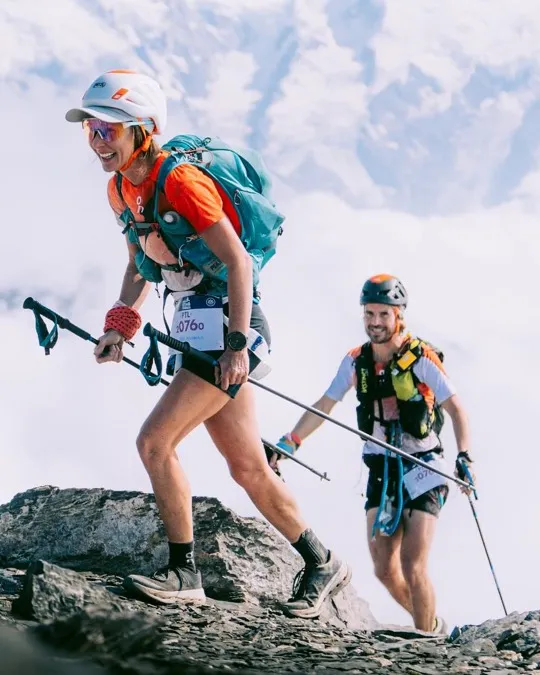
Kirra Balmanno is one of those people who seems happiest when she's moving through the mountains. An accomplished ultrarunner and endurance adventurer, she's raced everywhere from the Alps to the Himalayas, but she's also passionate about sharing those experiences with others through her company, Run High, where she leads trail running adventures in some of the world's most spectacular places. In this conversation we explore why running is such a powerful way to experience wild places, what draws her back to high-altitude adventures time and time again, and why the mountains have a remarkable ability to simplify life.
Key Takeaways & Insights
Kirra switched from road running to trails after winning a 50K.
Kirra trained with Ironman and marathon runners in Brisbane, mostly on roads, but on her path to a marathon she went for a trail race and found it more fun. She never did a road marathon again, and thinks trails spared her the injuries from road running's repetitive motion.
Kirra says the first 5 hours of a race are the hardest.
Then Kirra finds her pace, and that is when it becomes fun. In her view the athletes who do well in a long race adapt to everything that goes wrong and keep going with self-belief, because in a long race things can turn around.
Kirra was due to race the Tor des Géants in September 2026.
It was to start on the second weekend, and Kirra expected it to take about 4 or 5 days. It covers pretty much every nook and cranny of the Aosta Valley in Italy, with mountain huts serving Italian food and coffee. She expected some sleep, maybe about the 6 hours she thinks she got in an earlier race.
Kirra finds the Alps technical but close to civilisation, unlike the Himalayas.
The mountains are not so high but quite technical, with so much to explore, and a runner can drop to a valley village. Kirra's first years there taught her about the weather, glaciers, rock fall, scrambling and exposure, things you don't know growing up in Australia.
Running Nepal's Annapurna Circuit opened up Kirra's idea of what she could do.
That was on Kirra's first trip, about 10 years before the episode, when she entered a race and spent 6 weeks training there. She had gone back every year since. She finds Nepal quiet, remote and hard enough to get time by herself, and always feels she has grown when she comes back.
Run High began when people asked to run in the Himalayas with Kirra.
Kirra trained as a vet in Australia, then worked as a locum in the UK to control her schedule, with semi-professional running and writing for magazines. A permanent vet job in Hong Kong was not for her, and running her own veterinary telemedicine startup stopped being very balanced. Then came Run High, alongside some vet work.
Complete podcast transcript
Hi, and welcome back to the Outmap Podcast. Charlie Boscoe here, and today I've got a pretty inspiring guest. Kirra Balmanno is one of those people who seems happiest when she's moving through the mountains. She's an incredibly accomplished, ultra runner and endurance athlete. She's raced everywhere from the Alps to the Himalayas, but she's also passionate about sharing those experiences with others, through her company Run High. And she leads trail running adventures in some of the world's most spectacular places.
0:44 Alongside that, she somehow balances life as a freelance veterinarian with a calendar full of ambitious mountain projects. And in this conversation, we explore why running is such a powerful way to experience wild places, what draws her back to high altitude adventures time and time again, and what it is about the mountains that took her from Brisbane on the Sunshine Coast of Australia to the high mountains of the Alps and the Himalayas.
1:22 Kirra, welcome along. It's great. You and I have, corresponded quite a lot with Outmap and with previous companies, and it's great to finally connect, albeit online and much as I'd like to come and visit Chamonix.
Yeah, definitely. Thanks, Charlie. Yeah, it's nice to put a face to the name I've seen in so many different places, around the world. Yeah, it's nice to be here.
Oh, you flatter me. Yeah, and you're in Chamonix, place close to my heart. Where, just so I can reminisce, whereabouts are you in Chamonix?
Yeah, I'm, lucky to have a place in the center of town, so from my balcony I can see the VK, that kind of calls me every day. And yeah,
That's the, for non-Chamoniards, the vertical kilometer.
Exactly. Yeah, the Brévent VK. It's quite famous here. I'm sure you've done it a lot of times.
I've done it probably a few, a little slower than you, but yeah, I mean, I have. I've got myself up there. Where are you? In the, I mean, in the middle middle?
Yeah, pretty much in the center of town near the main station, so in the hub, but up high enough, on the top floor so I don't get all the noise, and it's not too busy here. It's a quiet street, so that's good.
Oh, nice. Nice. Yeah, I mean, Chamonix train station's gotta be one of the most iconic locations in the world really for mountain folk. I mean, it's appeared on so many ski movies and anyone who loves mountains probably has a vague
That's it
Of what Chamonix train station looks like, and you live right there, so that's pretty cool.
Exactly. We've all got a story of the first time we've got to the station in Chamonix, I think. Mine was to pick up
Yeah, I know I do
Yeah, mine was to pick up a Nepali friend who was coming to race the Ultra-Trail Monte Rosa, and he had flown in from Zurich and come to this train station, and we'd given him a lift, and he had this duct tape around his shoes to hold them together. And we were like, "Oh my gosh." and then he went and won the race, so that's my memory.
It's
Picked him up from there.
Pretty humbling for all the people in $400 shoes. It just goes to show it's the person firing the arrow, not the arrow.
Yeah, 100%.
Yeah, it's a long way from where you grew up, Chamonix, isn't it? I've suspect people with an ear for accents will figure out that you're not French. Where did you grow up in Australia?
Yeah, I grew up in Brisbane. Oh, yeah, running around Mount Coot-tha, which is like the highest mountain in the area, like 600 meters, so a little bit different to where I live today.
Yeah, I was going to say, it's Brisbane, there are some Aussie cities where I think, "Oh, I could see how you get into mountain running." Brisbane isn't one of those.
No.
Did you start out as a flat runner?
I started out cross country at school, and then I got taken under the wing of some Ironman and marathon runners in Brisbane, mostly road. But then on my path to my first and last marathon, I went for a trail race, and I just realized that was way more fun, so I stuck to those and never did a marathon on the road ever again.
Why did you like it so much? I mean, what was the big thing you noticed? What was the contrast?
I think I was just naturally very good at it. I did my race, and I won the race, and I had so much fun out there. I think, from some injuries from road running and the repetitive motion, I didn't get the same issues on the trail.
6:10 It's much more varied, so I think that suited me more. And it was just fun to be out in nature. You feel kind of free.
And did you... How long was the race? Was it long enough that kind of logistics come into it?
It was 50K. So yeah, I
I guess
My dad dropped me off in the morning, and I just met him at the finish line. Didn't have a crew or anything. Yeah.
I always relish talking to ultra runners 'cause the way you talk about 50K is the way I talk 5K. You know? Oh, yeah. It's, it's 50K, so you know.
Yeah. I forget that. And when you live in Chamonix, I think it becomes more normal to have these huge distances, normalized. And then you talk to normal human beings, where it's a bit wild to consider those distances. So, yeah, good to put me in perspective again.
I know it's only 8K. Oh, I mean, it's so ridiculous. 8K more than the marathon, You weren't intimidated by the distances of ultra running? 'Cause I think there's a big mental block for people. I know it's hard to picture running those distances. You,
Mm
Were okay with that?
Yeah. I don't know. I remember from a really young age, just when I was running at school, like increasing distance and just feeling really good. So I was never, like, the fastest runner. I'm not very tall. I don't have very long legs, and I don't think I'd ever be as successful as a marathon runner on the road.
8:12 But the trails, I feel like I can keep a solid pace, no matter what the distance is. And for some reason, the first five hours of a race are the hardest, and then I find myself and my pace and that's when it becomes fun. So for me, the distances are kind of... Yeah.
8:38 Yeah, the longer distances are where the fun and magic is.
Yeah, there's something in that.
To an extent.
There's something in that 'cause you do get to access a different mental state when you are that far into an event, and you can't just go and get it any time you want. 'Cause another thing, my thing was alpine climbing and ski mountaineering,
Ah, yeah
It's kind of similar. If you want that awesome feeling of battling for 10 hours, you've got to do the nine hours before it.
Exactly. And it's maybe just that one hour and a flip, a switch flips, and you're in this kind of different state of awareness or something and that's really cool.
It's hard won, though, It's really hard won. Just something you mentioned about there, actually. You said about, the size of ultra runners. Now I think about it, most of the ultra runners I've met are relatively small. Well, the
Mm
Ones are relatively small. What's the physiology behind that? Are marathon runners traditionally tall? My understanding is that sprinters are kind of six foot-ish. Apart from Usain Bolt, but generally sprinters are medium height. And ultra trail runners seem to be relatively small. Is being tall an advantage in a marathon because it's kind of the mix?
I think it is a bit because just your stride length is longer. Yeah. I don't know. I'm not an expert, but I did read something once, I can't remember where, about how the longer you go, if you're small and lightweight, then you're just using less energy to propel yourself. So that can be good for these endurance runs.
Okay. Yeah, I'm just fascinated by the physiology of it 'cause we
Mm
Another runner who's, who's doing the... Are you doing the ultra trail this year?
I'm doing the Tor des Géants this year. So do you know what that is?
And we had an ultra runner on who's... Yeah, no, the, I know the run. It's longer than
Mm
UTMB, isn't it? What is it, 320-ish?
Yeah. Yeah, 330 with a fair bit
330
Of vertical.
Honestly, who's counting once you get to 300, you know? I mean, you could shove Another 20 on there, no one's gonna notice.
For sure, yeah.
We did a podcast with another Outmap ambassador, Emilie Mann. She's coming to run the ultra trail in August. And she's also quite small and I was just... I'm always interested in the physiology of sports 'cause, I'm kind of medium build, medium height, so I can just use it as an excuse for everything. I'm too tall. Too heavy. I'm too light. You know.
Yeah, that's good.
Emilie just got back actually from the UTMB in Australia. She got third in her category,
Oh, my God. That's fantastic
Or maybe she won her category and was third woman. I don't remember. But,
Oh, that's amazing.
Oh, it's shame you're not in the same race. The Tor des Géants, what's, when's that?
It's September, second weekend of September it starts. And yeah, we'll go for about four or five days.
Wow. You're really butting up against the very beginnings of winter then, right? The weather's starting to turn by then.
Yeah. It can still be quite nice weather, but then I think some years, snow has already hit, so let's just see what happens.
Yeah, that's an adventurous race. What's Vague what's the course loosely?
Yeah. It covers pretty much every nook and cranny of the Aosta Valley in Italy, so the other side of Mont Blanc.
Wow. Okay. On a on the ultra trail I know people, obviously there's a time cut-off, so people might grab a nap but the winners certainly just don't sleep, don't really stop. On a race that long, what does your strategy look like?
Yeah. There'll definitely be some sleeping. I did the PTL last year, so that was 300, and I think I got about six hours, so yeah, I guess maybe the same. Yeah.
Are you snatching sleep or do you actually try and get three hours in a block or something?
For PTL I tried to get like a big two-hour block one night. And then there were a few like 10-minute naps on the trail, when you're so tired that you're about to fall over. And then, yeah, I think there was a couple of one-hour naps as well.
And how does it work, my understanding, again, from a very amateur, physiology student, is that fueling for races has really changed a lot, even in the last five years. What are the logistics like on a race that long, as well as sleeping? Do you have a support crew for that?
Yeah, I'll have a support crew for this one. And there's also a lot of mountain huts that the race passes through, so apparently it's a really nice vibe. It's a big thing in the Aosta Valley, this race, and yeah, we get lots of Italian food and coffee at the refugios, so I'm very looking forward to that.
15:01 Yeah.
It's one of the amazing things I find about, all, all mountain sports, ski mountaineering, alpine climbing, ultra running, is that actually so much of it just comes down to pure logistics. And just,
And just being able to get food in, digest food and keep fueling and drinking water. Yeah.
Yeah, and yeah, whichever one of the sports it is, so many of these things fail 'cause you didn't eat at the right Or you didn't choose the right moment to sleep, or you didn't wear the right socks, or you took slightly the wrong gear. There's so much overlap. Well, I mean, obviously you need the fitness, but it doesn't often seem to come down to, we just weren't fit enough or good enough. It's so much of
16:00 Is the organizational side of it. And it's quite an art, and I'm always fascinated by, by how it works in different sports.
Yeah. No, that's really true. I guess everyone that enters this race has a fitness level to get there, and great endurance and a strong mind. And yeah, I think the athletes that do well are the ones that can adapt to all the things that go wrong and keep this, self-belief, and keep going even when, yeah, things aren't working out. Because in such a long race, they can turn around.
Yeah. Where does your, clearly very strong self-belief come from? Is that just something you build up just by doing it enough times, once you've been really tired 500 times? The 501st time is easier?
Yeah. I don't know. I think it was something that I always had, and I guess I'm driven by this curiosity to explore where the limits are, and the comfort zone, and how far our mind can take us, how strong it is. So it's not like I'm pushing against myself when I'm in pain, or having a hard time, but it's more like, "Oh, this is interesting." How can we enjoy this place even when it's not very comfortable?
17:56 Yeah.
Yeah. No, that makes a lot of sense. Did Always have that? Or was
I think so
Something you discovered?
I think I always, always had it. I was very strong-willed as a kid, my mom would tell you. And yeah, so I think I'd always had it, and I guess I looked at people, Who had this kind of strong mindset trait, as inspiration as well as mentors.
You always identified that mental side as being what you aspired to?
Yeah. It's always something I felt I had. It's probably maybe not the most physically strong athlete out there or the fastest, but I guess I just made this story that my mind was strong, and then you tell yourself that enough and it becomes strong, doesn't it?
Well, it's manifesting for you. So where did you start building this up? So we got diverted, which I like. How did you go from 50Ks in Australia to the kind of adventures you're running now? When did you
Mm
"Oh, I'm really good at This could be my this could be a defining part of my life"?
Yeah. I guess, when I was growing up, I always thought professional athlete would be the best career. So I always took inspiration from pro athletes, pro cyclists and things like that. And then I trained for this marathon, but I found this passion for these trail runs and these long, long trail races.
20:09 And just winning helped at this. At the end of the first race, the first ultra I did was the president of the Australian team for trail running, and he said, "Oh, you should apply for the Australian team to go and race at the World Trail Champs." And this was my first introduction to these long races and I thought, "Wow, I didn't think that this was possible for me. This was just a dream that I had, but now it's actually happening." So I think that motivated me more because I was good at it and I found, progression.
20:54 And then I would do these races and I guess, 15 years ago, 20 years ago in Southeast Queensland, there wasn't as much competition, so I was just winning, everything I entered, and that gave me a lot of motivation to keep going. And then I moved to Melbourne where there was more competition, and I was still doing well.
21:21 Yeah. And then it just progressed, and I got injured a bit and had to stop for a while, and that's when I moved over to Europe. And I spent like a year just exploring in the Swiss Alps, and then I went to the Himalayas, and then after some time off I started racing again. And then in the Alps, as you know, the playground is so much bigger and there's so much to explore, so it was just exciting to go and test myself there as well.
22:01 And yeah, I guess things just progressed.
I mean, what was it like when you first got to the Alps? Try and explain what a life-changing experience it is to be in the Alps.
Yeah. I don't know. I went to Switzerland and I landed in Basel Airport, and went to Gimmelwald for a week, running there, and I just felt for the first time in my life, like, "Wow, this is home. This is where I'm meant to be. This is just my place." Just mind-blowing.
What is
How fun
What is the secret formula of the Alps? 'Cause I don't know about you, I just think it's a completely unique range. I've never been anywhere and thought, "Oh, this really reminds me of the Alps." I just feel like the Alps is so unique. What is
It is
What is that secret sauce?
I don't know. It's like a combination of these beautiful mountains, that are not so high, but quite technical. And there's so much of them to explore. But then you can run down to a valley and there's a really cute fairytale village or something down the bottom.
23:30 So for me, the Alps is like a really nice playground because as a runner, yeah, you can run so far and high, but then you can get back down to civilization. You're not too far from Civilization, I guess.
Yeah, you don't have
Unlike the Himalayas.
You don't have to go and live in the middle of nowhere.
Yeah, exactly. And,
You can just be a normal person.
Yeah, for sure, and still have friends and stuff, which is really nice.
Yeah. I agree. You can have a real life, but then also the best trails in the world, which A pretty nice combination. When you got to the Alps and were starting to explore, did your performance really just start to
I think it was about the same. I guess I was doing well in Australia, and then I came to Europe and was doing well here. I think I learnt a lot in these first few years about just how to be in the mountains. Things you don't know when you grow up in Australia about the weather, and the glaciers, and the rock fall, and scrambling, and exposure.
24:58 So that was all new to me, and I met some good people that showed me the ropes, so I felt safe and confident here. So that was like the biggest learning curve. But the racing was just the same, it's just more vertical.
Okay. And then you've done increasingly adventurous trips. Primarily, it seems primarily to the Himalayas. Tell me about those.
Yeah. It was like 10 years ago as well. It was becoming winter in the Alps, so I had this idea to go and explore the Himalayas. I'd spoken to a lot of people in Australia and overseas that their eyes light, light up when they talk about Nepal.
26:00 And I was like, "What is this place? I've got to go see it." Because when people go on a holiday, they eyes don't light up like this, but it was like a pattern I was seeing with people that had been to Nepal. So I went over there, and I entered a race and spent six weeks training there.
26:20 And I just, like, went and ran one of the trekking routes, the Annapurna Circuit, and it opened up, my mind and my kind of idea of what I could do, my self-confidence in the mountains. And yeah, I don't know, fell in love with that as well.
26:51 And yeah, since then I've been going back every year and exploring more. And yeah, I think the balance between the comfort and the cuteness and the beauty of the Alps is really nicely balanced with the remoteness and the discomfort of the Himalayas. But they're both such incredible places to be an athlete.
Yeah, for sure. Are you going there with goals in mind or is it just the pleasure of spending time there and exploring the mountains?
Yeah. It's mostly the pleasure and, I don't know, I find, I don't know, some magic there that helps me to, I don't know, get closer to myself, to open my mind in a different way than I do. I guess it's quiet and remote enough and hard enough that you get some time to really be by yourself and experience some challenges. So I always feel like I've grown
28:13 I come back from there. So I have tried some FKTs over there before, and I have raced, but my favorite part about going to Nepal is just going on this real adventure and you never know what's gonna happen.
Yeah. No, for I mean, do you generally go on your own?
Yeah, I was going on my own, for many years and then, people were asking me, like, "Oh, can I come with you running in the Himalayas?" So a few years ago I started, taking running tours over there and started a company called Run High. So now I've taken a few trips to go run there as well, which is a bit, bit less hardcore than when I run on my own, but really a special experience that is really nice to share.
Yeah, that's amazing. I'd like to talk about that 'cause this podcast is about people who've made interesting lives in the mountains. Obviously you've led a pretty adventurous life. That comes with a literally a financial cost. How have you made it stick work-wise? I know, I mean, that's just everyone I talk to, including me, has sort of done a bit of this and a bit of that and fudged it together, and then met this person and that led to that and
29:48 It's not like becoming a lawyer or whatever and you just climb the ladder. It's always fudging it together a little bit. What's been your story of fudging together a living in the mountains?
Sure. Yeah. It's definitely not this conventional career path. I guess I trained as a veterinarian in Australia. But after a couple of years I was just like, "There's gotta be more to life than just working and, I don't know, doing the same thing every day." so when I moved to the UK I was locuming as a vet, so that made me more happy because I was able to decide what I was doing with my time and I was more in control of my schedule.
30:46 So I was locuming as a vet, and then I was doing semi-professional running, and had some sponsorships and things like that, which helped. I was writing as well, for magazines and for my sponsors, like outdoor brands, which was good. And then, during COVID I moved to Hong Kong and became a vet again, and realized the permanent job out of the mountains, definitely wasn't for me.
31:27 And so I started a startup in a veterinary telemedicine company, and tried that for a few years, but also, it wasn't really very balanced anymore. So now I've started Run High, so I'm taking those trips and doing a bit of vet work on the side as well.
31:53 Yeah.
That is one of the more unusual answers. You don't call many mountain professionals and they go, "Well, I actually do online veterinary services as well." But that's great.
It's my side hustle
And kudos for yeah, kudos for kinda recognizing it wasn't for you. 'Cause obviously, I think a lot of people, especially when they've poured a lot of time and energy and money into getting a Probably feel a bit of pressure to put that qualification to use and have a career out of it. And I respect that you figured that wasn't for you.
Yeah. Yeah. It was a cool incredible skill to learn, and I'm thankful that I can still practice that sometimes, but also balance it with my love for the mountains and exploring. So now I've got the best of both worlds.
That's a pretty nice place to be. What do you think the future holds for you then? Just keep doing what you're doing, grow Run High, or do you like the variety of the veterinary work as well? What are you thinking for the next few years?
Good question. I'm always thinking about this question for myself as well. Yeah, I really would love to grow Run High. I have many places in the world that I have run and would love to share this, and the specific cultures and trails that go with them.
33:38 So that's definitely where I'm putting my energy at the moment. And then after having the startup, I think it's this love for just creation and exploring, and making something out of nothing, which is kind of what we're doing in the mountains as well.
34:08 But it's also similar to startups. So I think that will always be a part of my life and what I'll be interested in too. But I'm not sure where that path leads right now.
Yeah, but that's great. An uncertain life is actually quite an enjoyable one if you're okay with it.
Yeah. I think it's, yeah, working on the acceptance of uncertainty and kind of using it instead of having an aversion to it is what I'm trying to do at the moment anyway.
Yeah. Well, two, two of the fundamental human needs are certainty and uncertainty.
Yeah. Absolutely, Chad.
And everyone needs a little bit of both. And in varying quantities. But it's Chamonix for a while for you?
Yes. For now, Chamonix is the place that I call home. Yeah. Which is not so bad.
No, no. The one thing I would say, as someone who lived in Chamonix and then left. Just to warn you will never get to the stage where you feel you've done everything.
Yeah. There's so much.
You'll always leave thinking, "Oh, I never did that trail. I never went to that refuge. I never climbed that peak." I know people who've lived there 20 years who just, they, and they still have this massive bucket list in one valley, so.
Oh, my God. What's still on your bucket list?
Oh, it's so long. There's a few, the bigger Alpine routes I would really have liked to have done when I was, Fit and motivated enough. If I went back, I don't think I'd be super motivated by those goals, 'cause I know I'm not good enough to do 'em anymore. So I think I'd just enjoy the view and climb a few easy peaks next time I'm in Chamonix.
Yeah, no.
Yeah. It would've been nice when I was young and fit enough to do a few more. A couple of big routes got away from me. Whatever. I'm still here, which as you know, if you go Alpine climbing enough, that's not guaranteed, so. You gotta be careful what you wish for, right?
Yeah.
I got a lot of cool stuff done, so.
That's very good.
Yeah. Yeah, I don't think I'd go back super goal motivated. There are just so many ski tours, so many hikes, there are loads of refuges I've never been to in Chamonix. And let alone the surrounding area. And don't get me started on Innsbruck, where I know we've both lived as well.
Yes. Yeah. Innsbruck has so much to... And then in between, just on the way there, like Switzerland, I've run so much there, and I feel like I haven't scratched the surface yet, so.
Yeah. There's a, there's some stuff to do in Switzerland.
Just a bit. Yeah.
The problem is I can't afford to live there, so the only time I've ever done anything there is when someone else is picking up the tab. I think the only hotels I've ever stayed in Switzerland was on someone else's dime when I was working, so If Switzerland was a little less expensive, I'd be pretty open to it.
37:39 But it is the most unbelievable playground, so.
Yeah. Yeah, it's beautiful.
Yeah. And we haven't even talked about the Dolomites, which is probably, My favorite part of the Alps.
Well, this is, like, another reason to get fit for running 300-kilometer races, because you can see so much in one lifetime, right?
Yeah, that's true. That's true. Yeah, it's a really good point. You can just see more. Although luckily for people who are a little past their prime like me. You can just use chairlift and you can still do pretty well, which is great, so.
That's true.
Oh, I gotta get back to the Alps. I gotta get back. I'm so Talking to you.
Yeah. Let me When you're here. We'll go for coffee.
Yeah, I was gonna say, don't suggest we'll go for a run. I'll watch. But thanks so much for doing this, and thanks for the inspiration. And I just think everyone's got such a unique story, but ultra runner from Brisbane who's also a vet, I don't know. I think it's a really unique story, and I really enjoyed hearing it. And,
Yeah. It's
I'm sure you and I could geek out on who we know, and have you done this? Have you done that?
Exactly
We'll spare the listeners, a comparison of which trails we like best and which people we know and which bars are best, but you're in a very special place, and It's a pretty special story you got, so thanks for sharing it.
Oh, thank you very much. Yeah. Sometimes it's hard to cut down into something palatable when you're going for a run club or something. To explain how did I get from there to here. But no, it was super cool to chat, and thanks so much, Charlie.
All right. Thank you. Well, hopefully we'll speak soon. Well, maybe in person if I'm in Chamonix. That'd be great.
Yes. Sounds good.