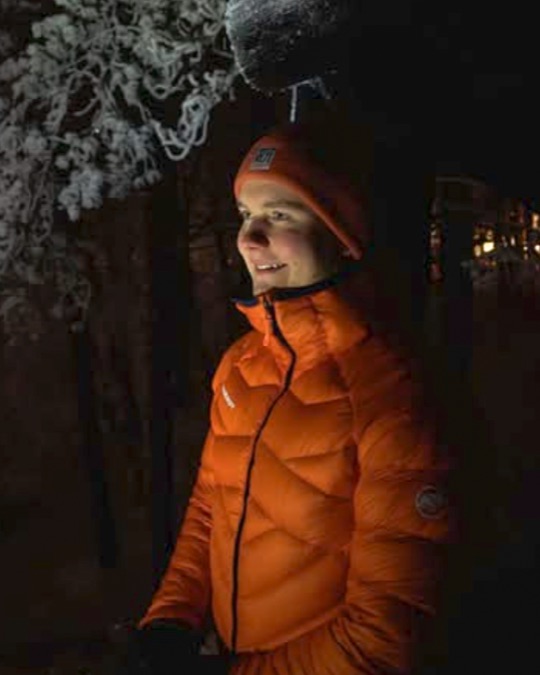
In this episode we dive into Project Sisu with Pyry Hyppölä — a backcountry skier and adventurer who’s got BIG plans in Norway this season. Pyry’s Project Sisu isn’t about chasing aesthetic lines or accumulating vertical meters (though there’s plenty of that in Lyngen) — it’s a mindset rooted in ethics, perseverance, resilience, and the kind of determination the Finns call sisu.
Key Takeaways & Insights
Pyry aimed to cross the whole Lyngen Peninsula, south to north, in one push.
That was Project Sisu's athletic aim, and one push meant no camping gear. Pyry thought the start would be at Nordkjosbotn. His rough estimate was close to 120 kilometres and close to 9,000 metres of elevation gain, and he was aiming for 25 to 35 hours in total, depending on conditions.
Halfway across Lyngen, Pyry planned to swim a fjord, towing skis on a raft.
Pyry would carry the inflatable raft to the northern end and drop nothing, because the aim was to be unsupported. How much to wear for the swim was still being planned, since anything worn would be wet and heavy afterwards. He calls the fjord crossing probably the single most dangerous part.
Pyry drew the route from an earlier traverse's description, and was scouting its cruxes.
Pyry found no GPS track of that single-push traverse, only its description, and drew a line on the map. The straightest reasonable line made the rough route quite obvious to Pyry. Pyry planned to have done every section beforehand. He likes Outmap's 3D view for seeing how steep parts are and picturing terrain traps.
Pyry was planning for mid-April 2026, needing at least 30 hours of good conditions.
In high alpine terrain, visibility is the key, and snow is as important. The highest peak is over 1,800 metres and temperatures differ a lot from sea level: snow too warm at sea level slows Pyry, but good snow there may leave the north faces too icy. He calls it a bit of a gamble.
In cold water, Pyry says, moving is much harder than staying still.
Staying still, Pyry can cover himself with his hands and warm a bubble of water. Swimming keeps letting in new water. He had trained for it for about 10 to 12 months. He found going in exhausted makes the cold hit like 5 times harder than going in fresh, so he worked on raising his easy touring pace.
Pyry turned a ski tour into a project while struggling to find work.
In his master's last year, Pyry sent application after application and felt he got no chance to show what he could do. He was managing it with a professional cameraman who is a producer, and wanted to show that people can take matters into their own hands. They were planning a documentary for film festivals, budget permitting.
Complete podcast transcript
Hello, and welcome back to the Outmap Podcast: A Guide In Life. My name is Charlie Boscoe and on today's episode, I am speaking to pretty extraordinary guy. Pyry Hyppölä is a Finnish ski mountaineer and he is going to attempt the first ever unsupported solo ski traverse of the Lyngen Alps in northern Norway. He's called it Project Sisu and Sisu is a Finnish concept. I'm quoting from Pyry's Instagram here as if my Finnish would stretch to this. Sisu is a Finnish concept referring to a combination of extraordinary determination, resilience, grit, and courage in the face of adversity and I can't put it any better myself.
0:54 Outmap are supporting Pyry as are Mammut and a couple of other brands. If you'd like to show your support for the project, go to Instagram and check out @pyry_hyppola. His name is in the title of the podcast if you are struggling with spelling. And speaking of the podcast, if you'd like to help us out, give us a like, share it, give us a review on whatever platform you use. Show us a bit of love and we can keep getting better and better guests.
1:21 I have to say though, they will struggle to be more impressive than Pyry. Pyry, welcome. Where do I find you today?
Thank you. I'm based in Lapland, Finland, in Rovaniemi.
Oh, Lapland is so cool. We all know Santa lives in Lapland, but what is it like for everyone else who isn't Santa? What is Lapland like for people who've never been? I've always wanted to go, never been.
Currently it's very cold. It was minus 30 degrees yesterday when I arrived here.
Oh, really?
And even more.
Is that normal for you?
I wouldn't say it's not normal, but it's like it can be that way. It's every winter, I guess.
Yeah. And do you get some daylight in the winter? You get a few hours or is it just total darkness?
Well, there is this polar night light, so it's not like sunlight, but it's still some, some hours of light.
Yeah, I bet. And you also, I guess you get heavy snow in Lapland?
Yeah, it depends on the area. This year has been a pretty good year, but for me, it's not enough for skiing, like ski touring, so that's why I find myself quite often from the north Norway, especially this winter.
Okay. Yeah, for sure. Well, we're not here to talk about Lapland, but it's just so famous, because of its most famous resident. I guess you're the second most famous resident of Lapland with the big new project. But Santa is still number one, but you have mountains in Lapland, right? Can you actually ski tour or can you just cross-country ski?
Well, we don't call those mountains. They are like more like hills, but you can do ski touring there.
This winter you are focused on Norway. Tell us about that. In fact, before we get into that, I'm kind of interested. You live in a place, where you get a lot of snow, but you just said the ski touring's not amazing.
3:36 How did you get into ski touring and ski mountaineering?
Well, that's quite a strange way how I got into 'cause I have a background as a cross-country skier when I was younger, and I actually did a sport called ski orienteering, which you might have not heard before.
No, I feel like I can figure it out. Is it like summer orienteering just on skis? Is that it?
Oh, yeah, basically.
Or is it
On small, tiny tracks and you have a map on a map holder and you are just skiing with tiny cross-country skis as fast as you can and collecting all the control points.
Okay. And what... How did that lead to ski touring?
Well, that was the ski touring was not really a thing where I grew up. So I grew up in Vuokatti, which is a very cross-country oriented place. So when I got older I found mountains, first in the summer form. So I started climbing and since I had the background in cross-country skiing and ski orienteering, and then I fell, fell in love with mountains, so it was quite a natural transition towards the skiing side of the mountaineering.
And how'd you actually, get into it? 'Cause presumably the nearest place for you is, I mean, really high quality ski touring is what? Northern Norway?
Yeah, I would say that's the closest place. So that was actually one of the first trips I went, for ski touring. I've done the resort skiing quite a lot when I was younger and we did plenty of trips, over the Europe in resort skiing. But for the ski touring, the main trip was to Lyngen exactly. So that's
5:28 That's the starting point of my ski touring career, I would say.
Yeah. Yeah, and Lyngen, for the people who haven't been to Lyngen, people refer to Lyngen as an area, but really it's one peninsula just to the east of Tromsø. And I have to say, it's maybe my favorite place I've ever been ski touring. There's something so special about Lyngen.
5:52 You have this, incredible blue light. The mountains are just, to me, just designed for ski touring. Everything is between about 25 and 40 degrees and there aren't many big cliff bands, you can almost anywhere on Lyngen. I just think it's, the terrain, the light, the people, the whole feeling of the place is so special.
6:16 Did you feel that as soon as you went?
Yeah. Yeah, I would say pretty much the same. And it's so cool that it's only ski touring there. It's no resort skiing, so it's pure nature and the mountains itself that is the whole surrounding that makes it beautiful.
Yeah. And everybody in Tromsø just seems to embrace ski touring as a way of life, in a way that in a Swiss Alpine village everybody embraces skiing on the groomers and everybody embraces skiing on the chairlifts. And in Tromsø it feels like everyone just embraces ski touring.
Well, yeah. Well, at least on the circles where I've been.
Yeah, for sure. And tell us about the project, because you're going to Lyngen, and when you and I first started talking a few months ago, I'd heard about the project, and then you told me about it, and it just blows my mind.
7:23 What is the project? Project Sisu. Is that... How's my pronunciation?
Yeah. That's pretty well.
Okay. What is Project Sisu?
Yeah. So the Project Sisu is it's a quite multidimensional project for me. It's a huge ski tour, which is the main objective is to cross the whole Lyngen Peninsula in a single push attempt from south to north. And that's basically the athletic aim of the project.
So you start where? Near the, at the Tamokdalen?
Yeah, pretty close to that place. A bit more to the west. Nordkjosbotn is the place, I think.
Okay. And so you're going south to north. What are the total statistics of distance and height? I know you're still working on the exact route. Do you have a total statistics of how much height gain it'll be, how far it'll be?
Yeah. I have the rough estimation, which is something close to 120 kilometers in length, and the total height, the elevation gain is gonna be somewhere close to 9,000 meters of elevation.
I'm sorry, I did one ski mountaineering day. We had overnight bags, so it made it harder, but we did two and a half thousand, and I was just broke. Two and a half thou with an overnight bag, that was the biggest day I've ever had on skis. And I thought you were gonna say, "Oh, it's 6,000," and I was gonna laugh.
9:11 9,000. But I guess it's not one it's one push, right? It's not gonna be 24 hours.
Well, it's one push, so that means it's no camping gear with me.
Yeah. But do you have a time limit in mind, or is it you just go until it's done?
Well, I have a sort of time estimation, but it's very condition dependent. But what I'm aiming for is somewhere between 25 and 35 hours in total.
Yeah. Again, I thought you were gonna say like 50 hours. So my brain is struggling to compute the idea of covering that distance in 25 hours. But you kinda get a free pass on the down, so the distance, I can imagine the distance in that time, but the height gain is tough.
10:05 How many climbs do you estimate you'll do? 'Cause there's not many really long ascents in Lyngen. Hey, like, 1,500 is about the longest ascent. So how many total climbs will you have?
Well, that's something I actually haven't, haven't counted yet. But there
Are you
Gonna be plenty of transitions.
Yeah, for sure. Tell me how this started. We'll go to the start. How did this start? Where did the idea come from? Yeah, tell me how you hit on this concept. Because to me, I would think, "Oh, wow, it would be fun to traverse the Lyngen Peninsula in 10 days." Where did the idea come from to do it in one go?
Well, that was actually my thoughts exactly. About three, four years ago when I visited Lyngen, and I found the beautiful continuous mountain, mountain peninsula, I thought it would be, very cool to do a long ski touring trip, which would include crossing the whole, whole peninsula.
11:10 But then, all the sudden the idea a bit evolved on the way, and I realized that I could maybe do it in one push. And when I started to search, search for the information about the possible route, I found one guy who had done it before.
So it has been done?
Well, it has been done as a single push attempt. So that's why I came up with something even a bit more crazier.
Oh, all right. We've gotta talk about it. People listening are probably thinking this trip sounds really hard, and I think what you're about to say is, for me, the hardest part of the trip. 'Cause you're adding in a, an extra element, right?
Oh, yeah. Yeah. So halfway up the traverse, there is a fjord that almost cuts through the whole peninsula, but not completely. But what I'm trying to do is the, is to cross the fjord by swimming.
But without a wetsuit. That's the part that kills me.
Well, yeah. It's under planning, how much of clothing I'm gonna need. Well, of course, I'm aiming, aiming for as less as I can 'cause the main deal is to be unsupported, which means that I'm gonna carry everything what I take with me.
12:35 For the cold training, what I've been finding very beneficial is the collaboration with Finnish ice swimmer Elina Mäkinen, who has been a big support in my project. And I had a pleasure to share a session with her on this fall and the tips for cold swimming and general how to cope with cold was very valuable lessons for me.
But how are you gonna transport the skis in the water? Are they gonna strap to an inflatable bag?
Oh, yeah. Almost. It's like I have a inflatable raft which I'm gonna tow behind me, and they're gonna be floating on top of the raft.
'Cause when we first talked about this, I assumed somebody would meet you at the fjord with a paddleboard or something, and you would swim pulling the paddleboard. But you're gonna carry the raft from the start.
Yeah, exactly. So for me, it's the most pure form of ski touring, that you are not taking any assistance and you are carrying everything. It's like leave no trace behind principle almost.
I love that. I've just, the idea of swimming in that I hate cold water immersion. The Mediterranean in August is kind of acceptable. Anything colder than that is completely unacceptable, so I just can't imagine swimming a fjord. But that is a really admirable, respectable, adherence to ethics. I love that.
14:16 So you'll then take the sled to the end of the traverse, or will you leave it on the far side of the fjord? What are your plans there?
So as I said, it's, unsupported, so it means that I'm not gonna drop anything behind. So basically, I'm carrying the raft all the way to the northern end of the Lyngen. And which is also even more than carrying the raft is the, if I wear anything on the swim, it's gonna be wet and very heavy after the swim. So that's also a consideration for maybe not using a wetsuit or something like that.
Yeah, that's a good point. Yeah. Wow. You and I had talked about this but I hadn't appreciated just how strict your ethics are. Which I like. I feel like you look at what happens on Everest and many mountains where the ethical standard is dropping and it's becoming less important how you do something, and style is becoming less important. Everything is just about achieving this, achieving, with inverted commas, this thing.
15:27 And I really love someone who is so strict ethically. I think that's great.
Thank you. Yeah. I've been seeing the same in the whole mountaineering. Even though I haven't done any mountain climbing, I've still, still got my share of watching how the whole terrain has changed more into the, that you can basically buy a ticket to go on a mountain, and that's why they are even restricting some mountains.
15:55 So that makes it a way different, different game in total, and that's also one thing what I love in Lyngen, that it's so pure.
Well, be the change you want to see in the world, and for me, I appreciate that it makes it so much harder for you. It would be so much easier if somebody met you with a paddleboard and you paddled, or you wore a wetsuit, or you got some fresh food, or you could leave your wetsuit. But the fact that you take everything from the start and carry it till the end, I think is amazing. So yeah, hats off, chapeau.
16:33 And then in terms of planning, how long is the planning process? Do you start with the route? Did you have a GPX from the person who attempted it before? Where did you start with the route?
Well, I started the search from the internet, and it was pretty hard to find. I didn't find the GPS track for the previous person who did it, but I found the route description, and based on that, I draw a line to the map and tried to estimate where he might, might have gone on his push.
17:12 And what actually surprised me was that actually how clear it is to see the way through the Lyngen. There are not too many options to cross the Lyngen fjord. You can definitely do multiple variations, but if you find the most straight and the most reasonable line to cross the whole peninsula, it suddenly became quite obvious for me, what should be the rough estimation of the route.
Is it quite direct, the route?
Well, that's what I'm aiming for, and it is quite straight.
Okay. And so did you start planning it on the map, or did you immediately go to Lyngen and start thinking whether it was truly possible?
Well, I had been in Lyngen bunch of times before, so for me, it was easy to see from the map and reflect the places I had been before to realize, is it possible? And it's fair to say it is possible because there has been a guy who did it.
Yeah. Yeah, for sure. And so what's the process of researching? 'Cause you go up to Lyngen quite often now, I guess. What's the research process like? How long has it been?
So I started the research already last spring when I did trips, and I knew that I have this ache on my head to do this kind of project. But back then I wasn't that serious with the planning. But coming into this year or now, now it's like one or two weeks in this year, but the previous year, this season I would say, I started to do the serious route planning. And now I've been visiting the place a couple times this winter already, and I'm scouting some of the cruxes of the route.
In terms of scouting the cruxes, are you actually visiting them, each one? What does the process look like to find those cruxes? Now we're talking in January, you've been going in December. December and January is gonna look very different in the spring, so what is your, what does your research consist of right now?
That's the tricky part 'cause it's like constantly changing environment there. So what I'm looking for at this point is sort of the... 'Cause there is not that much snow at this point. There is obviously enough snow to ski. But with this, at this point I can watch the natural formations on the cruxes. So basically I can see the stone ridges and without that much snow it's easier to get a full picture of the terrain.
19:57 And then when the snow builds up, what I'm doing on the second phase of the preparation is that I'm scouting for the snow conditions 'cause there is quite a bit of avy terrain in the route and very technical skiing. So it's like you need a very perfect conditions for this to be possible. There has to be enough snow to cover all the icy parts, but then the snow should be enough stable to not make any major avalanche problems.
20:28 So that's something I'm constantly trying to estimate, how it builds up, before the spring.
Yeah. Will you have done every part of the traverse by the time you start? During the research, will you have done the whole traverse in sections or will there still be some sections that you haven't seen before?
Well, there definitely won't be any sections I haven't done 'cause that's the preparation phase that I wanna visit all the possible aspects that I'm facing on the exact push. And that also makes it easier for the navigation, navigation of the route that I know what it should look like.
Yeah, for sure. And of course you also have Outmap. That just makes it easier, of course.
Yeah. That's been a handy tool 'cause with Outmap I've been able to scout the line with a 3D view, which I really like in that app 'cause, that gets me not only the... Like as I said, I have a orienteering background so I'm pretty, confident with map reading. But this 3D view will make it into a different dimension, so that helps me to get a view of how steep some parts are and basically how they interact with the other parts. Like if there is like some terrain traps, it's easier to get a picture with the 3D view.
Yeah, for sure. And you said, that there's some, some technical sections. And at the start I was saying one thing I felt about Lyngen was the skiing wasn't generally very technical. It's fun skiing, it's interesting skiing, but not a lot of it is technical.
22:14 But obviously you have to visit some areas that maybe a recreational ski tourer wouldn't go to. What are some of the technical cruxes you're facing?
Well, it's a lot of steep skiing, especially on the first half, and That's the first crux is I think I'm gonna be less than four hours in of the trip and there is some, some steeper formations that I'm gonna ski.
Okay. And then north, presumably north, I'm guessing north-facing 'cause you're going south to north. Are the technical ski sections are north-facing?
Yeah, most of them are north-facing, so that makes it, the conditions should be more stable on that aspect 'cause it's not that much taking the sun, since it's Or not late spring, but somewhere in the spring when the conditions align, I hope.
Yeah. 'Cause what time of year are you planning? You're thinking early May?
I think it's, it Is it's,
The fact that you have to check makes me feel better.
Oh, well, it's April, so mid-April that I'm planning. So there is mid-April is the sort of window what I'm looking for. 'Cause for this project I need this at least 30 hours of good window. So it's not Every, every day.
No, sadly not. But for people who haven't been to Lyngen, mid-April is still real winter. Conditions-wise you could easily ski to the sea in April, right? We were there the first time I went, we went the first 10 days of May, and we skied to the sea a few times. So I thought you may go a little bit later.
24:13 Are you going when there's still so much snow so you don't have to take skis off? Is that the goal?
Yeah. That's the main reason 'cause I'm also skiing on the lower parts of the Lyngen, and if that happens to be without snow, that makes it way slower to approach. So that's the reason.
Yeah. So you're not taking running shoes. You expect to be skiing the whole way?
Yeah, that's what I'm approaching. But yeah, I hope there is good enough winter in the spring. But I haven't made a plan for that.
What are the conditions you're looking for? You need stability, good snow cover, I guess low-ish temperatures, but not so cold that the north faces are icy, I'm guessing. What are you looking for? What is the weather window? What is the conditions window that you're looking for?
So there is plenty to look for. So it's like the
And you'll and the thing about... I've done long ski traverses, but not in one day, but it's never perfect, right?
Yeah.
If you want the north face to be skiable and not icy, then maybe the south face is slushy, and then you want low avalanche risk, but you need enough snow. You're always compromising, right?
Yeah. That's true. It's quite of a puzzle. But what I'm mostly looking is the bright day, 'cause, when I'm moving on the high alpine terrain, it's like the visibility is the key, and that's the one That can basically make a horrible day if that won't happen. Then the snow
Yeah, because
Well, yeah.
Go ahead.
Yeah, the snow conditions is the second, which is as important as the bright, bright day aspect. So for the snow conditions, what makes it tricky is that when I'm, skiing on the sea level and on the highest peak, which is over 1,800 meters, the weather is gonna be, the temp is gonna be way different on the sea level compared to the mountains.
26:19 So what I'm looking for is that the snow shouldn't be too warm on the sea level, 'cause that makes the skiing way slower than it should be. But then if the snow is good on the sea level, that might make the north faces to be too icy. So it's a bit of a gamble between those two factors.
Yeah, for sure. And also, if you get hot, your performance just disappears. Certainly for me. So I'd always rather be a little bit cold. So I guess for you, as an athlete, cold is better, right? You can always put a jacket on.
Oh, well, yeah. And That's why I take
If it's too hot, you
Take the dip halfway.
Sorry?
That's why I take the dip at the halfway.
Yeah, I would rather just be hot than take a dip, but it's true. I know it's not comfortable, but I have a little home gym and it's outside. And in winter, I have set workouts I try to do. I do, maybe 20, 30 different workouts, and each day I try and pick one.
27:30 And my times are so much better in the winter, and it must be because you perform better when you're not super hot. That's my theory anyway.
Well, yeah. I take that.
What clothing are you taking, by the way? How light can you go? I guess it's a question of risk tolerance as well, right?
Oh, well, that's true, 'cause, if I'm planning the optimal way how everything should go. And then, of course, to make it, the risk tolerable, I have to make also a plan for if it doesn't go perfectly, how bad it can go that I can still survive.
Yeah. Yeah. And that is so for every trip at every level, that's always a question you're asking. If you took everything you might need, you'd have a very heavy bag.
Yeah. That's very true.
What kind of emergency support will you have? I'm guessing, talking about your ethics, you won't ski with anyone. It's just you alone, or will you have people joining you at times?
Well, it's only, only the cameraman who will join. But no assistance.
Yeah. And what do you have for emergency? Do you have an inReach? What is your communication with the outside world? Is cell coverage good in Lyngen?
It's usually good when you're on the higher mountains, at the close to the top you get a good, cell reception. But on the lower, lower down the fjords, it's not very covering everything. But that's, still under consideration.
29:21 This inReach could be an option for the tracking in a emergency situation. But for me, it's like mostly planning the most risky places on the route, and those are the places that I'm gonna concentrate the most. And of course, the fjord crossing is probably the single most dangerous aspect of the whole, whole, traverse.
Yeah. You're probably right. Is there meaningful search and rescue in Lyngen? I actually don't know, if you press the, it's okay to have an inReach and you press the SOS button, but will anything happen?
Well, that's something I haven't tried personally, but I generally think the rescue in the whole, whole north Norway is pretty good, but that's not what I'm trying to test this winter.
No, no, it's just you have to think about, there are some places you could go where you can press your SOS button on the inReach and nothing happens 'cause there is no rescue. So I was just curious if in Lyngen, if something terrible does happen, there are, there is rescue, right? Heli rescue
30:30 Okay. Okay. 'Cause, yeah, you never wanna think about it, but no, it's just a friend of mine did a trip in a very wild part of Canada, and I said, "Are you taking inReach?" And he goes, "Well, there's no point." "'Cause if you push the button, nothing happens." "Nobody's coming." So yeah, okay. It is interesting.
30:52 What about it is the most, exciting element for you and what... We, I know we're talking a little bit about if things go wrong, but you have to think about it. What's the most exciting thing for you and what's the scariest thing?
Well, for me, the most exciting thing is it's hard to point 'cause, I find the whole, whole journey to be the most interesting part. There is no single thing that doesn't inspire me in this project.
What about the scariest? The swim?
Yeah, I would say the swim. Even though I love cold, when I started the planning, that was the thing that I was most uncertain that if I can do it, and that's what I've been training a lot over the last six months or even more, to be honest, like 10, 10, 12 months, but most intensively the last, last six months.
Yeah, I mean, what's that been like training for the swim? How do you start? Is it just time? You know, you do a minute, then you do two minutes, then you do three minutes. How does it work? How do you get better at cold swimming?
Well, that's the time is one thing, but then the other dimension is that you are not just staying in the cold water, but you have to move, and that's actually way harder than just staying still.
Why? Because you start to seize, like, your body gets stiff or psychologically it's hard. Why is it harder to move than to stay still?
Well, when you stay still, you can cover yourself by hands, and you can stay in the one position, and it actually warms the water around you. So basically, you're building yourself a small bubble of bit warmer water. If that makes sense.
I did not know that. Really?
Yeah, and when you start swimming, like a proper swimming, then you have the way, way worse heat loss in your body 'cause you are always opening up your limbs and basically you're letting in new water into your system all the time.
And I guess you don't wanna swim too hard, right? Hard enough that you start to get really hot because you'll be exhausted.
Well, that's the balance I'm, currently seeking, is that what is the optimal pace of the swim? 'Cause, If I'm swimming hard, I can build heat while swimming, which is the goal. But I shouldn't be too exhausted 'cause if I gas out during the swim, then it's gonna be game over, 'cause if I can't really build up the heat enough, then I'm gonna freeze.
Yeah, for sure. And the swim is, my geography of Lyngen is not perfect, it's, like, halfway? Almost
Yeah, it's quite exactly halfway
On the traverse. Okay. Yeah. So you're just trying to find the balance for the speed. And what about the training for the skiing? What's, what's that been like? Obviously, if you were into cross-country and ski orienteering, and you're already fit, but this is another level. What's your training program look like?
Well, I have this different cycles in my training. But most, most important thing is to push your comfort zone higher. So basically, what is the chill pace on my touring speed, that's what I'm trying to increase, over my training to keep the sort of like the exhaustion as low as possible for the first half. 'Cause that's what I've been seeing in the cold training, what I've been doing hybrid sessions including physical training and then cold swimming, and that's the most tricky part 'cause when you are already exhausted and you go to cold water, it hits like five times harder than you would expect going in as a fresh.
Yeah. For sure. So you're basically trying to make your, if we... I don't, I'm not an expert on training, but zone two. You're looking at operating at zone two, that kind of conversational pace. Or are you aiming to be going quicker than that on average?
Well, that's the simplest way to say it is that I'm trying to make my zone two speed to be on the zone one, if that makes sense.
Right. Okay. So your goal, I guess, is that you are always, keeping your heart rate below a certain level. You're never really exerting yourself. Is that accurate?
Not quite, 'cause there is technical parts which are basically, scrambling up a mountain ridge and with skis on my backpack, so it's not possible to keep my heart rate so low. But I'm trying to have the, the overall, stress of my body to be low enough before the swim.
36:04 That's the goal.
And how technical are you with this? Do you measure heart rate and measure training or is it a feeling?
I like to use some electronics on my training and of course, I'm clocking the swim sessions to see how I adapt to the cold water. I've always done ice hole swimming, since, since I was a kid, but I never pushed it into the extreme end. And now over this project, I've been pushing that limit, limit further, and that's the, monitoring my times on cold water and my heart rate, and especially the recovery pace is that what I'm interested 'cause, when you're training that much, you always have to consider the overtraining threat.
37:00 It's always, like, around the corner.
Yeah, for sure, and it's really easy for it to creep up on you, right? I trained for again... It was actually a 120-kilometer ski traverse. I trained for a 120-kilometer ski traverse. It took us nine days. So obviously the training is a bit different, but not overtraining was really hard, for sure, and also, figuring out what training you should do 'cause you only have so much time, you only have so much energy.
37:33 What is your training program? Is it weights, interval training, just hours and hours at zone two? What are you doing to train?
Well, it's quite diverse training. What I'm trying to do is do a specific training. That's why I've been doing a trips to Norway, already, plenty of on this winter. So the ski touring is the most important training part. But then when I'm in Finland, the ski touring is not that good, so I do a lot of Skimo training in the resort. So basically I can do laps for the endurance, but I also like to have those harder sessions, like doing some max, max power endurance sessions on the Skimo, Skimo gear.
They are psychologically hard, though. You're not find. When you're driving to the hill or the gym, you get nervous. I don't know about you. I do. If I know I'm gonna do a max effort session. Are you okay with that stuff?
Well, I love it. Like, it's
I'm not sure me and you would be good ski touring together. You like cold water and high intensity. Yeah, you enjoy those sessions, though.
Oh, yeah. Yeah, I wouldn't like to do just like the zone one and two training. It gets boring after a while. You can do it, but then it also doesn't benefit you. You have to push your extreme end to make the zone one and two better. So that's my philosophy of training, that you should always aim to push, your comfort zone by training harder.
Yeah, I totally agree with that. I think the other thing is, though, with doing a lot of slow zone one, zone two training, you do get more efficient. That's one thing I've noticed. I've been out ski touring with people who are super fit but quite new to ski touring, and they struggle. Physically, they find it hard. I think, one big gain from doing lots of long days is the efficiency of movement.
39:49 And the same with swimming, right? Really good swimmers can swim all day, and they don't get tired. So I think efficiency is an underestimated part of getting good at this stuff.
Yeah, I think that's the baseline. When you start to plan this kind of project, you have to be efficient already. That's something you just build up by, by doing enough. But I wouldn't plan this if I couldn't swim.
Yeah. No, I know, but when swimmers train, Olympic swimmers, they're training in the pool for multiple hours a day at a slow speed. And you're just gaining these thousandth of a percent of efficiency. I remember one time I was at a professional tennis tournament, and I couldn't couldn't believe how long Roger Federer just practiced at a slow speed, and it's just this micro gain in efficiency, if you do it enough, I think is really beneficial.
Yeah. That's very true, and especially in swimming, which is so technical sport in general, that if you have been a competitive swimmer, you can be so out of shape and still beat 99% of the amateur swimmers.
Oh, for sure. We have a friend here. We live by a big lake, and he's not in shape anymore, but he used to swim at university. He had a scholarship for swimming, and I'm not joking. It is like a fish.
41:22 I would say I need six or seven strokes for one of his. So yeah, I think the efficiency's big. The other thing I would you know a lot more about training than me. I thought weight training was really effective for me, but maybe I'm a bit older, so you don't naturally retain muscle and strength in the same way.
41:47 But do you do some weight training as well?
Well, what I've been currently doing is body weight training more. I don't hit big weights, but you can
Yeah, not big weight. I should say resistance training, not weight training.
Yeah. But it's definitely a big part of the training 'cause that helps. It's the same principle as with the zone training, that you have to have more energy than you're planning to use. So basically more power and using less power means that you can keep, keep going further.
42:20 So that's why I'm aiming to keep my, like, power levels also high enough for the project.
Yeah. I guess it's like a car engine. If the engine's bigger, going at 20Ks an hour is easier. It's simple, really. What weight training are you doing? Are you circuit training, CrossFit-type things? What is your resistance training?
Well, what I like to keep on side of the, of specific training is climbing. I try to climb at least once a week, which is very good full-body workout, especially for the upper body and movement. And for the legs, I like to do different types of leg training drills, which are very skiing-based training.
43:12 So single-leg squats and different type of types of variations of the squats and other sort of like resistance training.
So how are you fitting all this in? I mean, time must be one of the biggest problems.
Well, yeah. When you asked what is the most interesting part of this project is the how to manage this whole thing, and how it started is that I'm a student still. I'm a last-year student of my master's, in digital marketing and analytics in economics. So basically, when I started getting closer to my graduation, I realized that how hard the job market is and that gave me a hit that I have to do something. I just sent applications over application, and I got boring of the process of applying job 'cause I knew that I'm...
44:25 I should be good enough for some type of positions, but then I don't get a chance to show. So basically, I collected this energy into, into a project and I might be going back a bit, but when I first started planning this as a multi-day trip, like three years ago, it was nothing to do with the media production.
44:51 But then when I started to have this unemployed situation and getting close to graduation and feeling worthless in a job market, I started to think that could I do this as a project, not just a single ski tour? Make it more meaningful.
Yeah. And how have you gone a... How have you made it more meaningful? What have you done for that?
Well, that's sort of like building, building a company. It's a project, but it's sort of like I'm managing the whole, whole, project. Of course, not by myself only. I have a professional cameraman who is a producer, but that's like I'm, basically managing the project, and that's sort of like gives a meaning for me in this. And I, with my example, I wanna show that it matters, that you can take, take matters in your own hand and create something new if it feels like you can't get further. You just have to reorganize and push harder.
Oh, for I agree 100%, and it's crazy when you do one thing that it leads to the next thing. I don't even like to use the word career. I don't feel like I've had a career. I've just had work. But you do one thing with no expectation. You don't know where it will lead. You're just doing this cool thing, and then you meet someone and they say, "Hey, I liked that project you did. Let's do another project." And then you meet another person, and you meet another person. You have a new idea, and it's crazy how, one thing leads to another even if you don't have a plan.
46:36 So I really love that you're just trying to make a cool life. It doesn't sound like you have this really clear plan for the next 10 years. You're just trying to make a cool life. I think that's amazing.
Yeah, that's what I found very inspiring in you. When we first talked, you said that you are still figuring out what you wanna do when you grow older or something like that.
Yeah, I still don't know what to do when I grow up. Yeah. No, it's true. I always say that. It's totally true. But I think it's amazing, and you are making a film of this project, right?
Yeah. That's what we are aiming to do, with my producer. Depending on the budget, we are trying to make a documentary film about the whole project, not only the ski tour, but the side aspects and the whole, whole story.
And where... And then the goal is that goes to film festivals?
Yeah. That's the plan for the distribution. If everything goes well, we're aiming for the film festivals.
Okay. Well, I love your bravery to do it. I know it's really hard when there's a huge project. It's really hard to start, and that's why most people don't start, because it's just too much to think about. The...
48:00 They say if you need to eat an elephant, just start with one bite. And it's true, you know? If you just start, it's amazing what happens. So I really have a lot of admiration that you've got this far and now are hopefully close to ready. I know you have three more busy months, but hopefully you're getting pretty close now. And man, I would love to come and support.
48:26 'Cause it's an amazing part of the world, and I think it's an amazing project, so hats off. Yeah, really a lot of respect for what you're doing, and I really wish you so much luck. And I'm glad Outmap can be, a little bit of help along the way.
48:40 But you got a lot to do yourself. We can't do it for You gotta put a... You've got a lot of effort to come, but yeah, full respect for doing it. I love it, and I can't wait for the film.
Yeah. Thank you for your support.