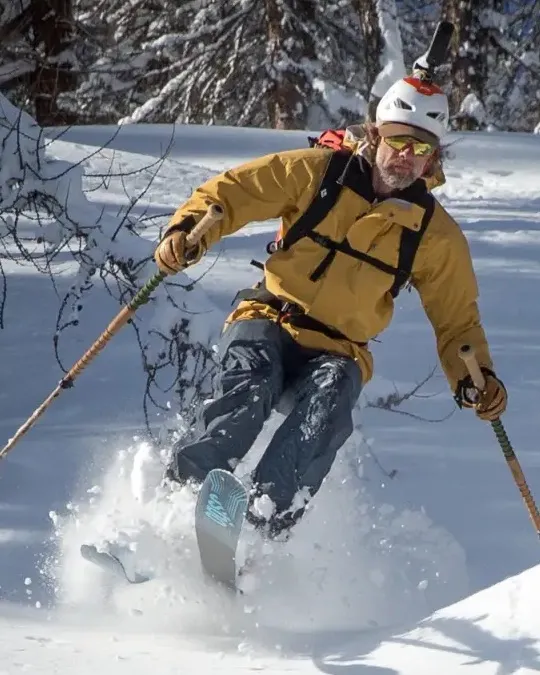
On today's episode we're talking to Rob Benton (https://www.ecrinscollective.com/ ), a passionate climber, skier, kayaker and guide. Rob had a great career in the UK but was hungry to spend more time in the mountains, so he took a chance and moved out to the southern French Alps. The plan was to give it a couple of years and see how it went, and 20 years later he's still there, still excited and still passionate. We got into his story, and what it is that keeps him going back to the mountains day after day.
Key Takeaways & Insights
Rob says Briançon's 300 sunny days are the tourist office's figure.
Rob believes it counts 4 hours of sunshine as a sunny day. The weather is more settled than in most mountain regions, normally drawn up from the south, so the climate is Mediterranean. For a school group that had been coming in June for 15 years, his team went from worrying about heatstroke to needing wet weather provisions.
Rob first came to the Briançon area for disability skiing with a local college.
People told Rob to come back for the climbing, then for the kayaking. The move meant selling their house in the UK and buying one in France, with going back to find jobs as the worst case.
The hardest part of Rob's move to France was transferring his UK qualifications.
Rob found it a bureaucratic nightmare. He says France believes in protectionism and wants you to do the French system, whose courses have a long waiting list. Anyone already living there before Brexit was automatically given a carte de séjour, a resident permit that lasts 10 years.
Rob says the Briançon area has grown into probably a top summer climbing destination.
It was known far more for white water kayaking when Rob arrived. His school work tended to be in spring, and his biggest group was about 200 children for a week. He did not teach skiing: in winter he was writing a ski touring and ski mountaineering guidebook, and worked with local mountain guides.
Rob's double breath technique for refocusing: breathe out twice, then take a full breath.
Not breathing in between pushes all the air out of your lungs. It is for when people get anxious and start to breathe quickly and shallowly. Rob says doing it a few times relaxes the brain, so you can make decisions more easily, and that the trick works across all sports.
Climbing since 1995 or 1996, Rob says he is still driven to get better.
Rob likes to keep learning. Nearly 50 when they spoke, he had just built a ramp to practise jump turns for really steep skiing, 50 degrees plus. He tells clients a climbing grade is only a guide to the experience, so he hopes to keep the experiences he wants as his grade comes down.
Complete podcast transcript
Hello, and welcome back to A Guide In Life, the Outmap podcast. My name is Charlie Boscoe, and on this episode I'm speaking to Rob Benton, a fanatical climber, skier and kayaker who lived in the UK but moved out to the southern French Alps in 2007. I've collaborated with Rob quite a bit down the years on various projects, but I've never really sat down with him and really talked through how he got into these sports, what drives him, what he's all about. And it was a treat for me to get to know him better personally, and there's some brilliant stuff in here.
0:45 Rob talks about his passion for his sport. He talks about how he made the decision to move from Britain to France, what that was like, some of the challenges, some of the successes. And there's also some wonderful stuff about the philosophy of the sports we love. Why we do them, what motivates us, what keeps us going.
1:03 I found this a really, really enjoyable conversation. You can find out more about Rob at his website, ecrinscollective.com. Ecrins is spelt E-C-R-I-N-S. Ecrinscollective.com, and you can even hire his services if you're lucky enough to find yourself in the Briançon region. But enough from me, let's go on to Rob.
1:37 Rob, welcome along. Thanks for joining me. Where are you joining me from?
Hiya. Yeah, so I'm joining you from, just near Briançon in the Ecrins, so the southern French Alps.
Ah, such an underrated part of the world. I think so many people... I'm probably as guilty as anyone 'cause I lived there for a long time, but people focus on Chamonix so much and the skiers focus, I guess, on the Three Valleys and the better known places, but that's a really special part of the world where you are.
Yeah, it's just amazing. For activities you've got every activity, all different levels. Great weather. But yeah, as you say, most people head slightly to the northern Alps, so it gives us, a little bit more peace and quiet.
So the rumor I heard was that Briançon gets 300 days of sunshine a year, and I used to work on the climbing World Cups, and it rained every time we went to Briançon. We'd somehow hit one of the rainy days every single year. But you do get an exceptional climate down there, much better than most of the Alps, right?
Yeah. It's a lot more settled. The 300 days is the tourist office, and I believe it counts four hours of sunshine a day as a sunny day. But compare that to most mountainous regions, yes, it is more settled and you get more stints of very settled good weather.
Yeah. And why is that? 'Cause I guess it's Chamonix gets most of the bad weather, right? 'Cause it kinda gets the weather from every direction. It's on the curve of the Alps, but Briançon's right down at the southern end of the big Alps. So do
Yeah, it is. I
Do we understand meteorology?
Yeah. I'll give it a go. It's basically that the weather normally gets dragged up from the south, so it comes up from Marseille, and it gets pushed up. And really, when you hit Briançon, that's the peak of it coming up. So that weather pattern's all drawn up from the south, so it's a Mediterranean climate.
3:37 If
Mediterranean climate in the mountains, I mean, That's winning at life.
It's very nice. You can climb here year-round. You know, as long as it's a sunny day you can get out and climb. But at the same time we still have lots of great skiing, so it's kind of the Of both worlds. It is changing. Climate change is... We've been here since 2007, and we've noticed a difference how the seasons have changed and things have moved a bit.
What has been your primary observation? It's just warmer and less snow, or is there more to it than that?
The seasons seem to have moved. So originally when we first came out here, spring was lovely, autumn was lovely. Always kind of dry, great for doing stuff. And we've seen more and more wet weather come. It's still not bad, but we've definitely noticed a change.
4:33 We work with a big school group in June, and they've been coming out for 15 years, and when they first came our biggest concern was heatstroke. And now we have to have wet weather provisions in case the activities, in case it rains, which, it's a definite change 'cause it's the same week every year.
4:50 You know, you see it.
Okay. Okay, interesting. My observation from my, I lived in the Alps nearly 15 years, was that you actually got the same amount of precipitation throughout the year. By the way, this is with no scientific measurement. This is me sucking my finger and sticking it out the window and seeing what the weather's doing. But it felt to me like you got the same amount of precipitation, but it came in massive waves.
5:15 So you'd get these record-breaking snowfalls, and then three days later it's 12 degrees. It seemed to me, was that it was more extreme. And so instead of just January, February's cold, warms up in spring, cools down in November, you could get anything any time of year.
Yeah. You do notice that. We've had a, this season for example, has been a very strange season. But I've said that for the last three years, that every season seems a bit strange. But we've had this position where, we've had a bit of snow come in, like, November, December, then huge chunks of dry spells.
5:53 Everything was down for the season. Snow levels were down for the season. And then the last couple of weeks we've had lots and lots of snow, and we're now in excess for the time of the season. And it feels like it just comes. Originally when we first moved out here, you'd be used to seeing the seasons start sort of November and build up.
6:14 And now you can be like spring skiing in January and then skiing powder in April. It's just very, very strange.
Yeah, it's more erratic. Yeah, people listening to this are probably thinking, "Rob doesn't sound that French." you moved out from the UK, so you've been there nearly 20 years. What, well, what were you doing in the UK before you came out?
Oh, so in the UK before I left to come out here, I was teaching. So I teach climbing, walking, kayaking, things like that, and I worked in a college running an instructor training course teaching other people how to teach and instruct and coach others in the outdoors.
6:55 And that was 10 years in the UK. Really enjoyed it, great life, and then we decided through a series of life changes that we wanted to do something different, so we decided to up sticks and move to the Alps.
It sounds like you're summarizing quite a lot there. Why, why the Alps? Why Briançon?
I came out here originally on a ski trip. It was a ski trip. We were working with a local college, and it was disability skiing. And I thought the place was amazing, and everyone I spoke to said, "Oh, you're a climber. You need to come back for the climbing." So I started to come back for the climbing, and then people said, "Oh, you're a kayaker. You need to come back for the kayaking." And one of those classic stories of you end up spending every holiday you have at the same destination loving it, hating it when it comes to packing up and going home.
7:52 So the decision was eventually made that we would stay. We would find a way to make our lives here.
I love that approach. It's amazing to me that people would let circumstance decide where they live. I love the approach that you decide where you wanna live, and then you make it happen.
Yeah, definitely. You've got to kind a we hear of a lot of people who say, "Oh, I wish I could live in the Alps, or I wish I could be there." And yeah, everyone's circumstances are different, but sometimes I think you just have to go for it and see what happens.
8:27 We made the deal that we had a little bit of savings. We sold our house in the UK, bought our house here and said, "Well, we'll give it two, three years. Worst case scenario, we'll go back and find jobs. And we'll see whether it works out." And so far, touch wood, it has.
Touch wood, yeah. 20 years later, it seems to be going all right. So far so good, I mean. What was the toughest part about moving? 'Cause again, I think a lot of people listening to this, would like to do something like that, and I appreciate everyone's circumstance is different. My circumstances are such now that I can't move.
9:11 But I could back in the day, so I do appreciate not everyone can go and do it. Or what was the scariest element, I guess, of doing it?
I think it was a mix of things. So I've always been quite gung-ho. My wife, girlfriend at the time, but now wife, was a little bit more sensible. I think she maybe had a few more worries than I did. The hardest things I found was I had to get my UK qualifications transferred to France for rock climbing, kayaking, and walking, and that was a bureaucratic nightmare.
9:50 Trying to understand different systems and get involved and get permission to do things was really, really tricky. I think it's the not knowing the different systems. You're used to whatever you've grown up with and the system you're in, and then you get dumped in another system, and France is not that much different.
10:10 But there are enough to knock you off balance and make you work out whether you're doing the right thing and how you get through things. And often when you speak to people, because they've grown up in the system in France, they just take it for granted and maybe don't have the answers or understand why you don't understand what they need.
Yeah. I think it's changed now, but anyone listening to the old British climbing system, SPA, MIA, MIC, they would be thinking, "What on earth? I'm losing my mind here." So being dropped into a new system is probably tricky, but dare I say it as well, France is known for having a little bit of bureaucracy here and there.
10:51 Not always the easiest place to navigate.
No, they believe in protectionism, and I think they'd admit that quite honestly. Seek to have your qualifications transferred, it's not an easy ride. They don't wanna make it easy. They're not interested in making it easy for you. They want you to basically do the French system.
Yeah, and France isn't exactly short of competent climbers who'd like to make it their living.
No, and the courses here are very challenging, and there's a long waiting list to get on them, and the level is high, and there is a lot of people that want to do them, and the places are limited.
Yeah. What has integration into French culture and society been like?
We've been really lucky. Our neighbors are lovely. We came out, the first time we were in the house was Christmas Eve. It was a Christmas holiday, Christmas Eve, and our neighbors, we'd never met them, came and knocked on the door and were singing a carol, and there was like four generations of them.
12:00 And they said, "Well, where's your family?" And it was just me and my wife, and they we said, "Well, it's just us." And they said, "Great." Our house now, and that was it. We went to their house for Christmas dinner, and it's been like that with all the people locally that we know.
12:14 It's been really welcoming, really nice. It's been great.
Okay, great. I mean, what was your French like when you've went out?
Bad. I'm not gonna say it's improved massively. I struggle a lot with my French. Partly the issue is I work with English-speaking clients, and therefore a big chunk of my time is still spent speaking English. And most of the people I climb and ski with, it's people from Holland, French people, expats, and the common language is always English, so that's spoken when we're out as well doing activities.
12:53 So to my shame, it has improved, but it wasn't great when I got here, and it's probably not fantastic now.
I suspect you're not the only expat in France who, gives that answer. It's tricky, isn't it, when essentially there's not that huge motivation to learn if you can get away with it, which was my experience of living in the Alps.
Yeah. It's a hard thing because, in all honesty, I moved to France because of the mountains and wanting to do activities. My neighbor finds it very funny that I don't particularly like wine or and can't understand why I've moved to France until he sees that I go out every day climbing or skiing and then he gets it. But the first kind of call was, "Well, you don't like wine and you don't like cheese? Why have you come?" And it's that different things, isn't it? You come for the mountains.
13:46 And I do love living in France and the way of life here, but my priority was always being in the mountains, and everything else is tagged on to that.
Yeah. If you ever wanted to start a nuclear war, you could say, "Well, the cheese and the wine isn't even that good in France."
I'm not that brave.
Maybe we're getting slightly off topic, but it's interesting as someone who also spent a lot of time in France, what are your observations of French culture? If someone was thinking about moving to France, I don't like to generalize, but let's, let's do it anyway. How have you found the French to be?
Locally, the people you speak to face-to-face are lovely, easygoing. When you have to do things in an official capacity, that's when it becomes a bit of a nightmare because there is so much bureaucracy. A friend of mine that we knew when we moved out here said, "Living here is amazing. Everything is so laid back until you need something to happen, and then everyone
14:50 Will still be laid back, and it's just whether you get stressed with that or not." and that's pretty much been the case. When we speak to people, when I work with local guides, local companies, people we know in the valley, it's all brilliant.
15:05 But then the minute you need something to happen, especially quickly within the bureaucracy, it just takes forever.
We probably shouldn't express political opinions, but I'm going to here. You moved out in the happy pre-Brexit days. Have you done citizenship and things? What's your... Or did you just get grandfathered? 'Cause as I understood it, everyone that lived in the EU got the right to stay post-Brexit. Have you had any issues on that front?
No, not really. Anyone that was here before Brexit got automatically given a carte de séjour, which is a resident permit to stay. It lasts 10 years, and then in theory you just renew it, and there shouldn't be an issue renewing it. My wife, she's gone through citizenship, and she now has dual citizenship.
15:57 I'm not at the process yet.
Okay. Oh, interesting 'cause, yeah, it's hard to remember now, but pre-Brexit we could just go and live in And just go to the mairie and say, "Hey, I live here now," and then you become a resident. Which, it was 10 years ago, but that seems crazy now given that. Well, you know what? I don't wanna dwell on Brexit. Spent a pretty good chunk of the last 10 years dwelling on Brexit, sadly. What did you do for work when you first got out there?
So I basically the same thing. So I had my qualifications transferred. It took a big chunk of time. When I first moved out here, I was still going back to the UK for work every now and then, so that was good for the first few years.
16:52 But then once I got my qualifications transferred, I basically set up shop in France, so now I work doing the same sort of stuff, teaching climbing, taking groups out walking and trekking, kayaking. Yeah, those kind of things still.
You must be out more than almost anyone. You're working outside, you're playing outside. Have you built up your own business? Are you freelancing? How have you, how are you getting enough work through the door?
So I've got my own business, and basically within that I still team up and work with other organizations. So I work with a few other organizations, and we have some school groups come. Our biggest school group come down for a week, and they bring about 200 kids.
17:42 So it's,
Wow.
Yeah. Pretty full on.
200 from the UK?
No, that's an international school. We have some schools from the UK. Because we offer everything from teaching kids how to actually climb. We've had schools that come out and we teach them to climb multi-pitch, to lead. We also have them come out for ski touring and things like that, and they tend to be smaller groups that are focused on the kids who want to actually learn a skill.
18:12 And then we'll have bigger groups where they come for a week and they'll try everything. So they'll try rock climbing, they'll try via ferrata, they'll try white water rafting, and they'll just get an experience of each of the kind of sports we do.
Okay. And what is that experience like? It must be pretty eye-opening for a lot of the kids to suddenly be operating in the kind of terrain that surrounds you.
Yeah. It's amazing fun for us, and the kids get so much out of it because it is so new to them. For example, one of the year groups, we will walk them up to the refuge and take them onto the glacier, and they'll spend time on top of the glacier, walking around, seeing crevasses, getting lowered in and then ice climbing out. And yeah, it's a whole new world to them when they've come from a big city and they've not seen anything like that, and it's a real experience for them.
And how many of those people then transfer into becoming adult clients of yours? 'cause you work with adults as well, right?
Yeah. So, the school stuff tends to be in spring, so the end of the school term. And then once the summer holidays get here, I tend to work more on my own, and I'm doing adult groups, mainly climbing. It used to be a lot of white water kayaking when I first moved out here, just because this area is known, especially then, far more for its white water kayaking.
19:35 It's now grown and probably one of the top summer climbing destinations. So yeah, climbing has taken over completely for me now. And in the summer it is a mix, mainly adults.
Okay. What type of climbing? Are you taking them multi-pitching? Are you just. Are you cragging? What are you up to?
Sports cragging. Generally coaching. So generally helping. Occasionally, learning to lead, so you're getting people who've never climbed before or maybe done a bit of top roping or indoor and they wanna make the next step to outside. And then quite a lot of coaching where people come and they wanna improve their climbing.
Oh, so movement coaching?
Movement coaching. Yeah, breaking down head game, helping people with overcoming anxiety on the wall, things like that.
Oh, interesting. Okay. So with those clients, you're getting in the summer, how have you created so much, I guess expertise? It seems like you can take people cragging, white water kayaking, on the glaciers skiing. What would your advice be to someone who wants to start a career in the outdoors and would like to cover as many bases as you clearly have?
Well, I think, first of all, I have to say I... When we do skiing, that's with a local guide. So France being
Oh, for legal reasons, yeah.
Yeah. France being France, you've gotta be very clear on that. So I don't teach skiing. In the wintertime, I write a guidebook for ski mountaineering and ski touring, and through that I get a lot of people approach me, then I work with local mountain guides who take them out onto the hill.
21:17 Sorry, you have to say that in France or you'll get lynched, if
No, of course. I'm assuming the same, in fact, I know the same for the glacier as well. You need a qualified mountain guide. But, whether it's you or you hiring someone, you have expertise in multiple areas. What would you advise someone? It seems to me that you've got a varied career because you've got varied expertise.
Yeah. It's kind of two things. You have to be hugely passionate about the sports you want to do, you know, and driven to go out and do them. And you'll find that you will just pick up so much experience being out and actually doing them, as much as you can, going to different places, having different experiences and climbing with different people.
22:08 And I think it's hugely important. And I also think, you know, a lot of outdoor sports, part of it is the head game. It's understanding like a lot of the skills are not super technical, but it's applying them in maybe a riskier scenario. And that's the bit that's hard.
22:29 And if you can start to get your head around that game, then it's easy to apply them to different sports. For example, skiing turns aren't necessarily that technical, but applying them and going into the fall line and being committed to it's more the head and the commitment maybe than it is in the basic ski technique.
22:49 And I think if people are inclined to push that, then it's very easy to move that over multiple disciplines.
True. Yeah, true. Although I also think that expertise makes you more comfortable. So if I have to do a steep icy turn above a consequential drop, I know I can do it, but I can't white water kayak to save myself. So there's a limit to what my head will do because I don't know what it's gonna feel like when I hit that rapid, and I won't react the right way because I don't have that instinct.
No, but I think if you can control your head in an icy turn, then I'm not suggesting we chuck you on some class five rapid to start with and be "It's all right. You can ski. Kayaks technically have edges the same as skis. You'll be all right." I was thinking more the fact that as you build up from beginner to expert, your head would allow you to develop those skills probably a little bit quicker, if that makes sense.
23:50 Because you're okay at processing and doing what needs to be done in maybe an environment. Now, that might come over time, but I do think if you have a head game for that, you have a way of developing it, you still start kayaking as a beginner and build up, but I think you'd, you'd be quite good at building up in it.
Yeah, I totally agree with that. Well, two things. We've both skied, I'm sure, I know I have, with people whose head is either well above their physical ability Or well below their physical ability. I've skied with people, I'm thinking you're one of the best skiers I know. Why can't, why you just turn? I mean, come on. So that mental aspect is huge. But also I think as you do more sports, you do develop the ability to pick up other sports really fast. I remember I did my skydiving licenses, and you instantly...
24:45 If you've done loads of sports, you just think, "Yeah, well, obviously if I move my arm," it's not conscious, "If I move my arm like this, my body's gonna react in this way." and once you get used to the different medium, which is air coming past you, it's actually not...
24:58 If you have that awareness of your body, it's like gymnasts.
Yeah. Yeah, yeah, yeah, yeah.
You just know if my leg moves this way, it'll have this effect on my core.
Yeah. Coordination, all those things come into it.
this is mainly for me, do you have any, any hacks for the head game? You know, what's your kind of go-to advice for people?
One of the tricks I use a lot is what I call the double breath technique. So a lot of it is about being able to refocus on what you're doing and evaluate what you're doing. And the double breath thing is that most people, when they get anxious or they get worried, they start to breathe quicker and they start to shallow breathe.
25:42 And you can try this at home. If you sit at the sofa and just shallow breathe, you will start to feel a little bit more anxious because it's your body getting ready for fight or flight. So what I often teach people, and you can build it up, is the idea that if you breathe out once but don't breathe in, and then breathe out a second time, that basically pushes all the air out your lungs, and then when you do breathe in, you take a full depth breath.
26:10 If you do that a few times, it will essentially relax your brain and allow you to process and allow you to make decisions a lot easier with a lot more informed. Because when you shallow breathe and breathe fast, it can affect everything from your perception to your vision, and it gets you into panic mode.
26:33 And just being able to relax and breathe is a starting point for bringing that back to a neutral position. I'll give you an example, a climber's example. There'll be lots of times when maybe you've climbed up, you're hanging on with one hand on a small hold, and you're going to clip a bolt or put a piece of gear in.
26:54 And you're aware you're at your highest point from the last piece of gear. You may be a bit nervous about falling. You're a bit worried your hand is too tired to hold that really, really small hold. So you pull the clip, you clip the rope. It's really nervous.
27:10 But the minute you clip the rope, you tend to go and breathe. And then all of a sudden, that hold you were hanging onto that you were worried is massive. All of a sudden it's like, "Oh, I can hang on this. I can rest. I can shake out." And that's because you've started to breathe and you've allowed your brain to relax.
27:28 So that's a trick that works across all sports. You can do it in kayaking above the rapid, or you can do it climbing, and it's just a basic reset for getting the brain back, being able to focus on what it needs to do.
That's great. I really like that. Perhaps we're straying too far into science here, but is that just literally because you get greater oxygen saturation in your brain?
Yeah. I was told it by a doctor, and I'm not gonna pretend to have all the proper words and the science behind it, but essentially the shallow breathing is putting you into fight or flight. It's part of your panic mode. And the breathing and taking full breath, it's where yoga comes from.
28:10 If you're into yoga and you're doing all the breathing with it's essentially the same as that. It's just putting you in a position where you can relax, and then when you do relax, your brain can function because it's not panicking about all these other stuff.
28:25 It actually just allows you to refocus on the situation and process the information.
Now I'm fascinated. I'm gonna be on Wikipedia and YouTube trying to research the effects of different types of breathing. Breathing exercises and yoga all come under the same umbrella in a way, so it makes perfect sense. Actually it reminds me, I actually interviewed someone once who talked about, what's it called when you're really in the moment? How can
Flow state.
Flow state. Thank you. Wow, that was a bad start to the story. But she was telling me about flow state she said, "When I'm..." She was a professional freerider. She won the Freeride World Tour, so she was good. And she said, "When I'm in flow state, I can't remember the last turn and I can't picture the next one." And I just thought, "Oh, I love that.
29:24 I love that." But she said the tricky thing is you can't always access it.
No, there's no magic button, unfortunately. Yeah, that state, if I'm honest, I think that's why I got into outdoor pursuits. That ability when you're climbing, skiing or kayaking, where everything boils down to the next move and you feel so focused that you are in that flow state, I think that's a big draw for me.
29:52 And yeah, you Just turn it on, which is a shame 'cause that'd be very nice.
It would be great, wouldn't it? Seeing as you touched on it, I wanted to ask you anyway, where did your interest in all this stuff come from? Where did the, where was the passion born?
It was a little bit of a strange start. So I grew up in Mansfield, in the UK, which is not known for outdoor pursuits. It
Hold on. Mansfield is... Where is Mansfield?
North of Nottingham. South of Sheffield, north of Nottingham. Midlands.
So pretty much the middle of England?
Pretty much the middle. The only thing that was good, it was about an hour from the Peak District, so gritstone climbing and things like that. But I was always into being sporty. So at school I played basketball, rugby, football, anything that was going, more than academic. Always been a sporty person.
30:52 And when I left school, I went on a college course. My intro to outdoor pursuits are a little bit strange, I think, compared to by a lot of people. So I went on a college course that was a sports course, and the guy who ran it was into climbing and outdoor pursuits, so we got to try some outdoor pursuits.
31:12 And I'll always remember, so climbing's my main love, and we went out with him climbing to the Peak District, and he went to the top to set up some top ropes and I thought this looked amazing, so I climbed a route to meet him at the top. So I soloed up.
31:28 Needless to say, he properly shouted at me when I got to the top, which was fair and well deserved. And he made me stand with him all day. I couldn't leave his side, so I had to behave. And I watched what he did. I watched how he put gear, I didn't know what it was called at the time, in the rock and I thought, "I reckon this is for me." So my way of getting into climbing then was I went out and bought a rack, and I went to a cliff that he'd pointed out near where we'd been, and I basically started to climb routes without the gear.
32:02 And then when I was confident I could climb the route solo, I got my friend to come back with me and belay me. 'Cause my biggest fear wasn't the climbing, it was what happens if I do something wrong with the gear? What happens if I get tired to put the gear in?
32:14 And soloed stuff first, and then went back with a friend and got belayed and led it. Which at the made perfect logic to me, but in hindsight was not the brightest idea.
That is the first time I've ever heard that answer to how did you get into climbing.
I've got a similar answer.
You started free soloing.
Yeah. I've got a similar answer for ice climbing, high altitude kayaking. Yeah, it was a common theme. My first ice climb, I'd never held ice axes before, double ones, and I was leading the second pitch and I had to go back and ask my friend, "These ice screws, you do just screw them in, don't you?" To which his answer "Yeah, pretty much." So I'm like, "Great, that's not a problem." and off I went.
33:00 So yeah, it's been a common theme. So I've always been like, "I wanna do that, so I'll go and find a way to do it."
I love that. And when did you think this could be a career?
I think I'd been climbing two years. And the good thing was, I think the way my brain processes it, I have to go and experience it and then when I've experienced it, I throw myself into getting the knowledge and getting better.
33:30 So it's probably about two years after I first started climbing, I was talking to people and they were saying, "Oh, you can do this. You can teach. You can take groups out." And then I started to look into that and jumped on a course.
And what has, sustained the passion? 'Cause, it's probably a couple of years ago now, but here you are still doing it. What's what still feeds the rat for you?
I don't know. I'm still driven to get better. Yeah, you're right. I started climbing 1995, '96. I'm nearly 50, but my skiing is getting better and better. I've literally just built a ramp so I can practice jump turns to get better for really steep skiing, 50 degrees plus.
34:27 In terms of what drives me, I just enjoy it. I enjoy that focus. I enjoy being out. It's where I find peace and quiet. And I struggle if I can't get out. You can definitely tell if I've not been out in a while. You might tell in my voice I've just got over a cold, which was about two weeks long, and two weeks of not being able to go and do stuff is pretty crazy.
34:55 But yeah, the joy is still pushing and learning. It doesn't necessarily have to be hard, but I like to be learning and trying different things.
Interesting, 'cause I think for a lot of people, myself included, the motivation and the reason that you do it completely changes. But it sounds like for you it's been pretty consistent throughout.
Yeah, I'd say so. I think a lot of people change when people have families and things like that. I don't have kids, and I tend to work with other people's kids. It's better 'cause you can give them back at the end of the day.
35:30 But for me, so yeah, the passion's just always been there to keep pushing. I had some injuries and when things like climbing, I couldn't climb as hard as I want to, that's when I've almost gravitated to other sports more. So the first big injury I have, I struggled to get back and climb at the level I wanted to and that's when I started kayaking, 'cause it was new and everything was great and I could see myself developing very quickly and thought, "Yeah, this is amazing. I love this. It's the next best thing." and then I slowly started to recover on the climbing side, and then climbing's probably always been my main thing and I think I'll always gravitate back to.
36:12 But I like that doing something new and getting to push and challenge myself on it.
Are you still improving at climbing?
Probably not. I always think I will. I think that's part of my DNA is, I don't see why I won't get better. But in the reality, probably age is gonna be... You know, I've got probably a few more years where I can still make gains.
36:40 It's changed. When I first moved out here, I didn't really like sports climbing. I wanted to climb in the mountains. And then I went through a big chunk of time enjoying sports climbing, enjoying it for what it was, pushing myself physically to, you know, to climb higher grades.
37:00 And now I'm back to climbing in the mountains a lot more, for my own personal time. So I'm challenging, but yeah, maybe top end grade, I'm maybe not gonna improve unless I do in the next couple of years, I think.
'Cause I was gonna say, with this, by the sound of it, your motivation, that improvement, that learning, are you concerned that there is a point at which you're not gonna get any better. We just have to accept that, and it's probably not a million miles off for both of us age-wise.
37:33 Do you think you might struggle basically getting worse? With the best will in the world and the best
No, no,
You're not gonna hold onto it forever. Does it bother you?
Yeah, it's a very valid question. I've got friends who are a bit older than me. I'm thinking of two of them. One of them just walked away from climbing pretty much, got into
'cause he Getting worse.
And just got into road biking because he wanted a different challenge. And then I've got another friend who's totally chilled and mellow with it and happy now just to go out and just climb whatever grade. Just wants to go out and be social.
38:14 I'm a big believer in we go into the mountains for experiences. So we go out, and they could be everything from time with friends, going to beautiful places, being chilled, or pushing it really hard. And all grades do essentially is give you a guide of what experience you're gonna get. That's all they're there for, and it's different
38:36 Different people. If someone wants to go out and get scared, grade's irrelevant 'cause it's gonna be personal to them. Or somebody wants to go out and push it or have a chilled day. And as long as you're getting the experience you want, that's okay. So I'm hoping as my grade comes down, I'll still have the same experience as I want.
38:55 I just have to accept that the number's gonna be different. I'm very good at telling my clients, and I totally believe this, it's about experience. The grade only tells you what experience you think you're gonna have. There could be some exceptions, but it's basically the benchmark of what experience you want and what you're gonna get.
39:16 So I'm hoping as I get older and the grade comes down, I'm still getting the experiences I want even if the number changes.
Yeah, I totally agree with that. That sounds like a really healthy place to be 'cause ironically, that philosophy in reverse killed my desire to train super hard for climbing 'cause I thought being scared and feeling like I'm gonna fall off feels the same whatever grade. I go and train really hard in the winter, go climbing again in the summer.
39:48 Like you change the number on the guidebook on the grade, but basically I'm still scared and I feel like I'm gonna fall off. I thought, same thing. I'm having the same experience, so why bother training?
Yeah. That's it. As long as you're getting the experience you want, if you're happy with your experience, then you're in a great place irrelevant Grade. Grade is only the indicator of what you want. If you're not happy then, it needs to be changed or mixed up a bit, or you need to look at what you're doing. But by and
40:22 If you're getting the experience you want, then you're in a very happy place. And I'd like to be very zen and say that's how it's gonna be. I'm sure there'll be a little bit of give and take as I get into it and maybe a few little stroppy days, but I'm hoping I'm gonna be very zen.
Yeah. And the other thing I realized a long time ago is there's always someone better. I know people who've trained super hard to climb 8a. It was this big thing that I wanna climb 8a. They do an 8a, what do you know? There are thousands of people literally who can on-sight 8a, these days. So in a way, as long as the grade is for you personally, then grades are fine. But as soon as you start using it to compare yourself to others, you're soon gonna be humbled.
Yeah. You can't compete with other people. We, strangely enough, when I work with the kids groups, we talk about PB, personal And about how that's the thing that's celebrated rather than... 'Cause, even 100-meter sprinters do not line up on the start line. They're not racing each other. There's no point. You can't control how well somebody's trained or if somebody's injured. All you can do is try and get a PB.
41:33 And if you win, amazing. But whatever, if you give it your all and you get what you want out of it, that's gotta be the way. And especially living here, where I live at the moment, everybody climbs hard and everybody skis hard. So if you go out with an ego or you think you know, you've arrived or you're at a certain level, somebody will go past you in a set of crops.
41:56 It's just the way it is. So, which is lovely. I quite like that.
I like it too. 'Cause you don't develop much of an ego. But one of the people who is most insightful about this is a fantastic name drop, but spent a reasonable amount of time with Adam Ondra, and who's for the non-climbers out there, Adam is the greatest all-round rock climber in the history of the sport.
42:24 Redefined how good you can be. And I remember talking to him about his ambitions and his, his future hopes and dreams. He said, "Well, I'll always sport climb." I said, "Well, you got a kid now." Or when you have kids. I don't remember if he'd had his kid already, but, "You'll have kids one day and you won't be as good as you are." And he went, "Yeah, but it's just, it's so beautiful figuring out the moves-" finding a sequence, and unlocking a sequence. He goes, "I don't, I don't care about the grade.
42:55 It's just the experience is too wonderful. I'll never stop sport climbing." And I thought, "That is fantastic."
That's the way to be. I'm sure he'll have some ups and downs getting there, but yeah, I think that's a fantastic way to look at it. I
Yeah, but he is fantastically motivated. That should never be mistaken for him being zen about getting worse. He will fight getting worse with all he's got, but ultimately he loves the experience just a smidgen more than he loves being amazingly good.
Yeah. It's that balance between being driven enough to get the goals and the experience you want versus at the same time not putting your whole ego and, you know, how you feel and your self-worth on a number which is arbitrary at best.
43:51 You know? It just, you know, you can, you've gotta have the fu... I think that, if you think about it from a sports coaching, they used to talk about with athletes, you train as though it's the most important thing in the world, but on race day you don't care. Otherwise, it becomes such a big thing that it'll mess you up.
44:10 Gotta be the same in climbing and whatever else. You don't leave anything behind. You put everything in you can, but at the end of the day, we're climbing up a piece of rock or falling down a mountain with a set of skis on.
44:21 You can't let it become the be all and end all. It can be a huge part of your life that you enjoy, but it is only climbing up a piece of rock and sliding down a hill on a set of skis.
Yeah. You're so right. And I've been in communities, I'm sure you have, where essentially their whole wellbeing and their demeanor is dependent on how they're doing right now at their sport. How they're getting on with their project, what they've skied recently, whether they went and succeeded on their latest expedition. And that is not, a route to fulfillment and happiness to have your wellbeing essentially dependent on how you've performed recently in your chosen sport.
Oh, because as you say, at some point we're all gonna get a little bit worse. It's better than the alternative. You know? Being, getting slowly worse and a bit weak and everything else is better than giving up and stopping. So yeah, I do think it's gotta be tempered with, you know, an enjoyment of actually being outside and having...
45:26 Part of the reason I like working with kids as well, or working with people who are getting into it, is seeing their experiences. I did a recently about ski mountaineering, and at the end, one of the guys I was chatting to said, "Well, how come, in your own time you're out jumping off really steep faces and skiing hard lines? Do you not find it boring working with kids and beginners?" And I was like, "No, the exact opposite." It's seeing them get those experiences is a whole other enjoyment and something else that you can get out of it.
46:01 So I think, you
Yeah, absolutely. And I think that's when you're in the thick of your own personal climbing, skiing, whatever sport, it can be really hard to lose sight of that, the wonder of someone starting out. I remember when I was guiding, we'd get to Everest Base Camp. I was trekking guiding. I wasn't going to the summit.
46:23 Not that I particularly wanted to be honest. But we'd trek up to Everest Base Camp, and it's a beautiful place and I used to love the experience of going, but I've never really considered it a life achievement. It's just, you hike up there and you get a headache from the altitude. But it wasn't a huge deal as an achievement. But then I'd have clients burst into tears at having finally got to Everest Base Camp, the place they've dreamed of for so long, and suddenly it would make me emotional. It would mean a lot to me.
46:53 So seeing it through someone else's eyes is huge and can provide an awful lot of meaning.
100%. I had a client end of last year who I did a day with a pair, and it was very good. It went very well. And then she wrote a blog post, and in the blog post she put basically me, Rob, doesn't know how much he's helped me with my climbing. And she wrote a blog post about it.
47:19 That's gotta be worth far more to me than whether I get a, you know, a grade in climbing. The fact that somebody After a day's coaching has literally gone, "You don't know how much you've helped me. I'm now achieving my goals. I'm now getting the experiences I wanna get," that's far more fulfilling than whether I get a, you know, a 7b or a 7c or whatever. It's one of the best feelings in the world.
Yeah. Oh, that's brilliant. I love that. It's something you don't always appreciate when you first start out and you're just so entirely focused. I was actually having this conversation last night over a glass of wine with a friend of mine, and we were saying, "God, do you remember when you started out?
48:06 You didn't wanna hear about helping anyone out. I was just head down, backside up, let's go." And now, yeah, I do search and rescue here and take kids out skiing and climbing, and the reward I get from knowing that you made a difference to someone else is actually huge and in some ways a bit deeper than your own personal fulfillment.
Yeah. Yeah, yeah, yeah. And I think that's when you look at instructors and guides, they need to have both. They need to have a wealth of experience personally, 'cause they need something to draw on, but they also need to get something out of working with others. There needs to be that people side and that helping people side. And if you can get the two together, then you're probably in a good place.
Yeah. And I'm sure you've seen it as well. I've seen people get into guiding because they like climbing and skiing, and they didn't want a real job.
And they don't like people.
And actually, that's not really enough. Yeah.
Like, I really like climbing
If you're not getting anything out of your client's, if you're not getting anything out of your client's happiness, it's gonna be a long, not very enjoyable career.
No, it's gonna suck. If you get something out of clients having their experiences, their goals, their dreams, then A, you're pretty dead inside, but also, yeah, it's gonna a long, old life.
Well, I love it. I love that you've kinda... It sounds like you've found your place looking forward. It sounds like you're not going anywhere.
No, no. There's No plans to go anywhere different.
Keep doing what you're doing. Keep trucking. Don't beat yourself up too much if you drop a letter grade in the climbing.
I'll try not to.
But thanks so much for your time. You and I have collaborated a few times down the years in bits and pieces, but I really enjoyed actually talking through what life's all about and how you got where you are. I love it when someone just says, "My life's great, but it could be even better, and I'm gonna go and make it happen." So chapeau, hats off. I really respect what you've done.
Cool. Well, thanks for having me. It's been great to have a chat, and always good to stay in touch.
Thanks, man.