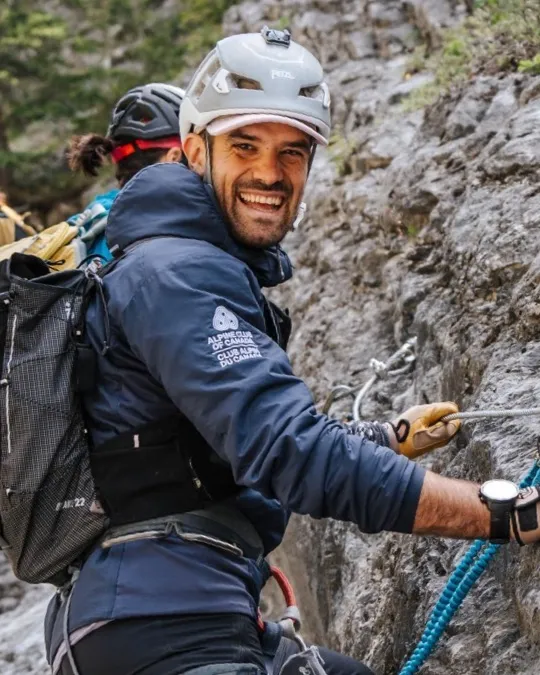
On today's episode I'm speaking to Rob Mazenc - the Alpine Club of Canada's Services Director, and a man who has taken a long and winding road to reach a destination that he describes as "a dream come true". Born in France, he now lives in Canmore, in the heart of the Canadian Rockies, and does a job which makes a real difference to the mountain community around him. If you want an uplifting, positive and inspiring assessment of why we love mountains so much, this is the episode for you.
Key Takeaways & Insights
Awe, learning and friends keep Rob hooked, whether the day is hard or easy.
Rob finds the feeling of being in the mountains hard to put into words. Around it sit learning, sharing with friends and partners, and an escape from screens. He has been 14 hours in and bonking, and has also skied puddle laps in the trees with chocolate or tea. He values both.
A story of ski tourers sailing from Bella Coola inspired Rob's move to Canada.
At about 20 Rob moved to Cork, where he lived with 16 roommates: his first step out of his comfort zone. He read the story in New Zealand, in a small magazine called Say Yes to Adventure. He settled in Canmore because staying in Banff long-term is hard without seasonal work.
Rob warns that mountain towns can bring housing strain, isolation and seasonal turnover.
Especially since COVID, housing and stable employment have been a bit hard to find. Rob says mental health is a known issue, as the towns can be isolating for some and risky activities can bring trauma. Seasonal workers may stay only 6 months or a year, so finding people who stay long-term can be the challenge.
The Alpine Club of Canada manages North America's largest hut network, Rob says.
Its Canmore staff manage the huts, camps held every summer for over 100 years, and courses such as avalanche safety training. Its 26 sections across the country are volunteer-led and often run heavily subsidised or free programmes.
Rob has seen interest in mountain sports rise sharply since the pandemic.
Guides and volunteers are finite, so Rob sees the question as how to break barriers and democratise access to learning to get out safely, with more courses, resources and mentorship. On the 93 North, where some areas he skied were quiet on Saturday mornings 8 years before the episode, he sees a lot more people, and welcomes it.
Rob sees space for everyone and suggests pushing one valley beyond the usual spot.
That is Rob's answer to those who say there are too many people now. An eternal optimist, he also wants these places kept safe and not competitive: on the Vallee Blanche, in the Chamonix area, he saw people racing each other with no regard for safety, and does not want that model.
Complete podcast transcript
Hello, and welcome back to the Outmap Podcast, A Guide in Life. My name's Charlie Boscoe and this week I'm speaking to Rob Mazenc, the services director at the Alpine Club of Canada. Like many of us in the outdoors, and I suspect like many people listening to this podcast, Rob has led a life that was never defined by a central plan or a central goal. He's just followed his interest and his passion where it took him. And it's taken him from his home country in France to Ireland, New Zealand, and now Canada.
0:44 And he's carved out a career doing something he's passionate about. But more than his work, I wanted to talk to Rob about the why. Why he does the things he does, why he loves them. And I thought he had a great take on what we all get out of these sports and why we love them so much.
1:01 This was a really heartwarming, positive chat. I really enjoyed it, and I know you will too. Rob, welcome along. Thank you for joining. You said just before we started recording this is your first ever podcast.
Correct. Yeah, first ever. I've done a few radio, reporting. There's a CBC, I think it's called the CBC Ski Report that they do in the winter that I've contributed to a little bit. But I've never been on a podcast before. Yeah.
Okay. I'll try and go easy on you.
Thanks.
It basically just feels like going chatting in a pub and then someone records it.
Yeah. I like that
Hopefully that's how it feels.
It's a bit too early to have a beer. I just got coffee now. But,
Well, I don't know It's 5:00 somewhere.
Maybe that's the trick. Yeah, true.
Whereabouts am I talking to you from? Where are you?
So I'm in Canmore, Alberta in the Canadian Rockies.
Okay. And you've had a really... This series is all about people who've created interesting lives in the mountains. And I can say this because I've had the same. I went on your LinkedIn and it's a varied, it's a really varied career you've had. And apparently the term is a portfolio career. Which basically means you've never really focused on anything. You've just done interesting things, which I think is great.
2:39 Where did you grow up? Where did this all start for you?
Mm-hmm. Yeah. I grew up in France, not too far from the French Alps. So about an hour west of Annecy or Chambery, if you can place that. And growing up, I played in the mountains a little bit with my parents, but this was very much a, on a weekend or vacation, school holidays, we'd go ski resorts.
3:06 And I was actually doing a lot of team sports at the time. So growing up wasn't really, exposed, to the alpine and mountainous environments. But anytime we'd go resort skiing, we'd always go in Combloux near Sallanches and not far from the Chamonix Valley. And you'd see Mont Blanc and I'd always remember being like so just attracted to that. Like those really high peaks and high summits. And growing up going through my teenage years, I really kind of stopped skiing for quite a while.
3:41 Skiing was really the link there and I stopped skiing for quite a while. I was really focused on team sports. I was playing basketball. I was a point guard, playing
Oh, really?
Semi-national level. Very, very, very, different life it feels like. It was, yeah, years ago now. And,
You're sitting down. Are you 6'9"?
No, no. I'm actually just 6'1". I was the smallest guy in the team. But yeah. I fell off with that and then as soon as I hit university, I started, connecting more again with folks that were involved in some sort of outdoors pursuit. There were skiers, backcountry skiers, climbers.
4:18 And that connected me back to it. I studied abroad, a little bit. I went and lived in southern Ireland in Cork City. And then there were involved to exposed to a lot more climbing. And then I spent, six and a half month in New Zealand and bike touring came along and a little bit of winter mountaineering and that sort of thing, and it really connected me back to that. And that's when I decided that this was the life I wanted to build. I just didn't wanna be in the city. I wanted to find a small mountain town somewhere where I could, start building those skills, whether it was towards ski touring, ultra distance running, climbing, et cetera.
5:00 Yeah.
Yeah. What was it about the sports that captured you? 'Cause I feel sometimes we're all into these But it's not really obvious why we're into them. And sometimes especially I'm sure you're the same, like you've got cold hands and you're transitioning on some col. You're just thinking, "Why am I into why is this fun for me?" What was it that captured you about the sports?
It's a feeling that I find always hard to transcribe in words and I feel like people that do spend time in the mountains understand it. But there's this sense of awe, you're up there, whether you're climbing, running, ski touring and it's just a deep sense of joy. It's pure joy. It's the most amazing feeling I've ever experienced in my life.
5:59 And as soon as you experience it, I think you're hooked and you just can't go back, right?
Yeah.
And so that's really on the kind of feeling deep feels level. And then there's everything else attached to it, all those layers. The learning, the sharing it with your friends and partners. And it's just in a world where we seem to be so often connected to devices and screens and just spending a lot of time online, it's a place where you can just escape and just be really present in the moment.
6:35 And all of these layers together, I think is what really kinda attracted me. You know, I was exposed to it. When you start something, you go out with people. Sometimes you go out solo, you know, and you figure out your gear, you figure out what you need to learn, and then you go with other folks that are either your peers or your mentors, and you just get exposed to all of those layers, all of these layers. And then, and that's what gets you hooked and then keeps you coming back.
You know what? That's actually one of the best summaries I've heard of it for a long time, actually. I like that. And what was the initial motivation for you? Were you driven by getting better? Was it pushing the limits, speed? 'Cause it feels like everyone's got their own
7:20 Especially somewhere like the Chamonix Valley. Everyone's got their own reason and their Thing they're chasing. What was it that got you most?
It's interesting. I think when I reflect back on that, I think there's always a certain level of performance that's attached to those pursuits. And they're not necessarily performance in terms of comparing yourself to others. They might just be how hard can I push myself? What is hard for me? What does that mean? And is it just in terms of the elevation that you can do in a day, when you're ski touring? And is it more than you could do last year? And what is the limit?
7:58 So I think there's always a little bit of that. But in my own case, I think it fluctuates a lot. There's moments where you're interested in saying, "Hey, I'm feeling really healthy, this month or this winter. What can I go do with that level of fitness?" But there's also sometimes where you might actually feel quite healthy and quite ready to go push limits and do something that you've never done before.
8:25 But at the same time, you've got your friends that are like, "Hey, do you wanna go ski puddle laps in the trees? And it's just gonna be giggles, and we're not gonna have a worry in the world in terms of how many laps we're doing. We're just gonna stop and have a bit of chocolate or tea between everything." and it's just a, just a really fun day out.
8:43 And I think both are just absolutely incredible, and I've experienced both. I've experienced days when I've pushed myself and you're really tired and you're bonking and you're like 14 hours in and then you're like, "Why am I doing this?" And at the same time, there's a sense of like, "This is amazing. Please sign me back up." And then there's days that are just really simple, and you're just moving in on the landscape and sharing with your friends and just enjoying the nature. And it's just got value to it, right? And I think, I see my friends and some of my friends are, they are athletes or they've trained for the Olympics or they're just really high performers in their sports and in their discipline.
9:24 And they're in that phase where at the moment it's all about training and a certain objective and a certain goal, and that's completely fine. But I think there's also all my other friends that are just purely just happy to be out there, and it's all that matters.
9:39 And yes, if you can implement a little more, objective-based sort of thing. Let's say you wanna go do a Wapta in, or Bow-Yoho Traverse, if we're taking examples for the Rockies, and you're new to skiing. You've been doing it for two or three years. You've never been on a glacier before.
9:59 In a sense, you're pushing your own limits when you do that, right? It depends. It meets you at where you are in that moment. Sorry, it's a very long, strenuous
No, I,
Response. But that's where my brain goes when I think about that, right?
I think that's a really good answer. I think it's a healthy answer. 'cause I sounds like similar to you. I know people who've, won the Olympics. I used to live in Chamonix for a long time, and a lot of people there are very driven on every day is gonna be the biggest, baddest thing it could be. There isn't a lot of, "Hey, let's just go cruise some powder laps."
10:40 And my observation of incredibly driven people is that it does not create a lot of happiness, would be My overall observation. With some exceptions. You can create short-term happiness, and maybe in a way it's the only way you can achieve something amazing. Maybe people like you and me are never gonna win the Olympics or pioneer some massive new ski descent 'cause we just don't have that drive to always be getting better. But I
11:06 You probably end up happier in the long run.
As soon as I clip in on my touring gear, I think I just got an instant smile, you know?
Yeah, exactly.
It's just, you're like, "Cool. We're gonna have a great day." There's no bad days on skis, right?
Yeah.
And I just feel that way in every other pursuit, right? I like to say that I'm very mediocre at everything I do, but I like to do it all.
Yeah. But that's great. It keeps your motivation moving.
Yep. Yeah. 100%.
Yeah. No, I think that's a really healthy approach to doing it. So how did you start to turn this passion into a career?
Yeah. I'm gonna try
'Cause as I say, I was
Trim this through the sensor, but
I was reading LinkedIn. I was thinking, okay, so Lyon Cork. Okay. I was like, okay. New place, new job, so yeah.
Yeah. Yeah. Fair.
I doubt there was ever a master plan. You might tell me otherwise.
No. No, never. I felt like I just met the right folks at the right time. And it was always about people, and I think I've got a fairly outgoing personality. I just really like hearing other stories and when I moved to Cork, I lived in a place I had 16 roommates. We're in this massive house and everyone
16?
Different backgrounds and everyone was students, right? They were all there to do internships or work placement or going to university. And folks from all over Europe and I think we had roommates that were from South Korea as well, and Japan and you just talk to them and you learn their stories, and you learn their dreams and their inspirations. And some of them you really connect with, right? And then they just expose you to their world, and then if it ticks, then you're like, "Cool, I wanna see where that goes, and I'm really curious about this aspect of your life or this sports that you're doing." And yeah, "Show me." "What does that look like?" And so I think Cork was that initiator for me.
13:02 It was the first time I was stepping out of my comfort zone of like going going abroad and, you know, I was 20 years old, I think, when I first moved there. I think it really shapes you, right? An experience like that. And then you just wanna keep pursuing that.
13:17 Same thing happened with New Zealand and then with Canada. And in New Zealand, I actually read a small publication, a small independent publication called Say Yes to Adventure. It was By an I can't exactly remember the name. I'm pretty sure she was based in Christchurch. The tagline was, "Ordinary people doing extraordinary things." And I really, really enjoyed that, and I was just became addicted to it. I found it in a small bookstore in Nelson, on the northern tip of the South Island.
13:48 And there was a story in there about a bunch of ski tourers that got on a sailboat in Bella Coola, and then just had an epic adventure, on the western, coast of Canada in the Coast Mountains, and just bumping from sound or fjord to fjords, and then bushwhacking through hell, rainforest, from the water up into the alpine and just trying to go find some lines to ski.
14:14 And I found that so inspiring and I was like, "I wanna go try that out." so then I got my visa for Canada, moved to Canada. Had literally no, idea of what I was gonna do. And I knew about two places. I knew about Banff, and I knew about Prince Rupert.
They're quite different places.
Very different places. And Banff, because of the film festival that You know, every year, and they stopped in Lyon. Also, as a student, I would go watch the films. And then Prince Rupert because of the Shames Mountains. And I had a, I had an old poster of Richard Permin, which you might know, like a French free, free rider. And skiing like spines in the Shames.
14:58 And so that's all I knew about the place. Ended up moving to Banff, landed at Canmore, and then just again, met the right folks at the right time. People that were connected somewhat to the outdoor space and had work opportunities, and I just took them up on it and then just went from there.
Yeah. Why, why Canmore? What ended up getting you there?
Yeah. So it's pretty, pretty hard to like stay long-term in Banff if you're not seasonal. So I ended up coming to Canmore, and I didn't know much about it. I had one connection, fairly far connection that was living there. And I just found a place that was very-- it felt like a very, tight-knit, diverse community in Canmore.
15:50 And everything I'd sort of envisioned in terms of the type of mountain town I wanna be established myself in and try to build a career and get access to the sports that I've been wanting to try and develop my skills in Canmore, Canmore's the perfect fit.
16:05 And again, I met people, that just became friends right off the start and are still friends to this day, you know, eight and a half years later. And mentors that took me out to the mountains and showed me the ropes. And the way I like to say it is I feel like I had a dream or a vision of what I wanted life to look like in terms of personal life, but also career and the work I would do and the impact on the community, and I feel like I've been living that dream for the past eight, eight years.
16:35 So that's pretty special. I feel very lucky. But credit to the people that enabled that really.
That's pretty powerful, though, Not many people say that. And I think as well, you touched on it talking about Banff, it's hard to be there if you're not seasonal. The reality of living in a mountain town is not always as fun as the idea of living in a mountain town.
16:58 Just quickly elaborate. I don't know Banff or Canmore well at all. Why was it tricky living. I'm just thinking about people thinking about living in mountain towns and creating a life in the mountains. What are some of the challenges you faced in Banff? Why is it tricky to live in that kind of place?
Well, I think initially when you show up and you know no one else, if you've got no other connections, it first takes that first step, right? On trying to put yourself out there and trying to meet the right folks and folks that you are on the same, you vibing with, right? Same, same connection and then same length waves. Wavelength, sorry. And there's obviously, you know, these towns, especially since COVID, there's been a bit of a difficulties around housing and finding stable employment and these sort of things.
17:50 So I think that's a reality that folks should be aware of. On the, on a personal side of things, I think what sometimes makes it difficult as well is there's a known effect in mountain towns. I don't know if effect is the right term, but about mental health and the impact of these towns and sometime how they can be somewhat isolating for some folks. And there's also aspects of trauma that can be lived through the activities that we do in a mountain, which are inherently risky.
18:24 And so those are things that I've heard a lot about and those are conversations that I wasn't aware of before I moved to a mountain town. And then I found out about that, when I established myself in Canmore.
18:38 So I think those are some of the aspects. Obviously the sort of turnover that you get when folks work seasonal jobs as well, right? You might find people that you're connecting with and that you wanna go do activities with, but they're only here for six months or a year.
18:57 And so being able to establish that really foundation, in your community and finding folks that are staying long-term, that somewhat sometime can be the challenge. I feel lucky that I haven't felt really exposed to that. The friends I've made eight years ago are still around.
19:13 So been very lucky in that sense, but I've definitely heard stories that it can be difficult.
Yeah, for sure. And I think people have to be selective about which mountain town they live in. It sounds like you have been. Yeah. So you get to Canmore, how do you go about-- 'Cause I mean, we should tee up what is your title is services manager at the ACC, right?
Yeah. Services director at the ACC. Yeah. Mm-hmm.
Services, sorry, director.
No worries.
Golly. Okay. But yeah, services director. But how did your career evolve to that? How did you get started? 'Cause people probably think, "Wow, live in Canmore, work for the ACC." Yeah. You said you're living the dream. I think a lot of people listening to this would agree. How do you
20:07 Started towards that?
Yeah. Again, I think it was just lots of luck, meeting the right folks at the right time. I started working for Alberta Parks when I first arrived in Canmore, and we have a provincial park here called the Canmore Nordic Center, which is a Nordic center. It's in the name, but it's also-- it's more than that. It's a facility. It's a year-round facility that has mountain biking trails, lots of events.
20:34 It's the National Training Center for the cross-country skiing and biathlon teams. And I just started working, at the front desk there, and then just giving people tips on the trails and maps and what visits in the region. It's also a visitor information center for Banff National Park and for Kananaskis Country.
20:53 So you've got folks coming in from all backgrounds. Your international visitation, like folks coming from Calgary for the weekend or just Canada-wide, national visitation as well. And then, you've also got the athletes coming to train or folks participating in mountain bike races or running races, et cetera.
21:12 It kinda set the tone for what came next, in Canada. It was really at the intersection of community and sort of outdoor knowledge sharing in a sense. So a lot of it initially was just sharing information about wildlife conflicts and what to do if you run into a bear when you're mountain biking, and how, how to react and how to use your bear spray.
21:39 Hot tip, you don't it's not sunscreen, right? You don't put bear spray on your skin. I've seen that happen.
Ooh
It was interesting. There's a lot of fun stories from that time with Parks. But that really exposed me to this kind of world of being able to share your knowledge, of the outdoors as you're building it yourself, right? And you start really small. You start with some very basic information, how do you navigate, how do you use a compass, and you read a map. You know, here is the trailhead for that peak.
22:07 And then as your own personal pursuits evolve and grow, you're able to then share that with the public and share that with the folks that you're working with. And so this was really the foundation for me working with Parks. I was also exposed to visitor safety and first response work.
22:25 We're super lucky to have a program where we could work in collaboration with Kananaskis Mountain Rescue Team and respond to any incidents on site up at the Nordic Center there. So think a bit of the ski patrol for sites that are year-round activities. Yeah. And so all of that helped develop my knowledge and it helped me in my personal, endeavors, but also in, you know, creating that feedback loop of you learn on one side and then you're able to share back with others.
22:53 And this is a model that is very much at the heart of what the Alpine Club of Canada does, right? It's volunteer-led, outings and knowledge sharing and peer-to-peer mentorship. So I was exposed to all of that up at the Nordic Center through Alberta Parks, before coming to the ACC.
23:15 And in between that, I also had a small experience with a mapping company actually, parallel to what Outmap is doing. A bit of a different ecosystem, but I helped, grow a small startup based in Nelson, British Columbia. It was launched by Julien Locke, and it's called Nordic Pulse, and it was a live grooming system for Nordic ski areas with live grooming information.
23:41 And so I did a bit of mapping using GIS and this sort of thing. And yeah, helped develop the product, which is available across Canada and Europe now. And again, this was a lot of work with nonprofits, volunteers, communities, small community organizations.
24:00 So very much connected to that. And I think this is what then led me to the ACC, right? Like the intersections of all these different layers.
Yeah. And I mean, two things that always come up that I always say whenever people ask me about this stuff is who you know matters more than what you know. So I don't know about you start working for Parks, suddenly you meet this person, and this person comes in the office and you get chatting to them and that's huge. But then also just doing stuff, like you said, showing people where the trailhead is seems, seems relatively simple, but you learn how to talk to people, you learn how to judge your audience. You're just subtly learning, so much, and
24:41 I guess if someone wanted to do something similar to you, just getting in at what is a relatively low-level job and just getting going is the thing to do.
Absolutely. And just being curious about it, right?
Yeah.
I love learning. That is just a primary driver for me. And you just open up opportunities, right? By doing that and taking that approach. And whether it's learning about people, whether it's learning about certain skills, whether it's learning about, you know, certain type of education or things that you wanna improve on.
25:16 Learning about yourself too and where you wanna be headed. And I think, it connects with that outgoing personality that I had and just being interested in others' stories and then it just opens your world, right? 'Cause you're seeing all these different perspectives and all these different things that people do, and you just pull inspiration from it and be like, "You know what? This is something I could try. This is something I could be really interested in." And then you somehow piece it together,
25:44 Piece by piece, and then that gives you sort of that roadmap of where you wanna be headed and what you wanna do with your time.
Yeah. And now, now you're doing the Services Director job. What does your work with ACC actually involve?
Mm-hmm. Yeah. So a lot of it is support for the sections across the country. So the ACC has an office in Canmore where we've got paid staff, and the staff here manages, a wide array of programs. So there is the sort of hospitality and hut infrastructure domain, so we manage the largest, hut network in North America.
26:25 And then we've got, programming that we do, whether that's general mountaineering camps that happens every year. It's been happening for over 100 years, every summer. And then, skill courses. So you'll have avalanche safety training, introduction to sport climbing, trad climbing, et cetera.
26:44 And then you've got everything else that happens across the country that's fully volunteer-led and managed by 26 sections. So we've got sections from Newfoundland to Montreal, the Yukon, Whitehorse, Vancouver Island, Squamish, Whistler, et cetera. They vary in size, but they're all volunteer-led. And these folks deploy programming locally that's often heavily subsidized or completely free. And the goal is just to get like-minded people out in the mountains safely and teach them skills, so then they can go and on their own or go with their friends or go with a group of folks that belong to the sections.
27:26 And so my role is really to support that work, whether that's on kind of the less fun side of things with insurance and legal, aspects, or on the more fun side of things in terms of developing programs and curriculums and that sort of... And just that culture of safetying and going out together, in the mountains and sharing, sharing knowledge.
27:48 Yeah, that's the foundation of the role.
Yeah. I live here in the Okanagan. We have the Okanagan section. It's so impressive what sections can put on. It's an amazing organization you're part of.
Yeah. Yeah. It's truly incredible. It's a very old organization and it's an organization that's changed a lot in the last few years. And it's really interesting. A lot of the role and a lot of the job that we do here is also thinking about how do you bridge this sort of legacy of what the ACC, is and the historical context with what a modern mountaineering club looks like.
28:32 And what are the needs of people that wanna go to recreate in the mountains? What are the needs of volunteers? One of my absolute dream would be that when folks think about someone new shows up, like me when I showed up in a mountain town, all these years ago, and you don't really know where to start. And unless you meet the right folks, which I was very lucky to meet, if you don't, what is the organization that you could go to get you started? Whether you wanna pursue simply hiking and winter hiking, you wanna go snowshoeing in the backcountry, to high alpine alpinism.
29:06 And I really hope that the ACC can be that place, and I think the ACC is that place in a lot of situations. But my role is to make sure that we're the first organization that comes to mind for these individuals that really wanna start and get out there.
29:22 Yeah, it's a fascinating role. And we get to work with the guiding community very closely, obviously, 'cause all the programs are facilitated through ACMG Mountain Guides. We get to work with organizations such as Avalanche Canada, the CAA, in terms of the programming. And so this is ecosystem of conversations and discussions about things that I connect personally with, on a personal level. I'm really, really interested. So I feel like I'm just working in this environment that I'm passionate about.
29:54 So it's, yeah, it's quite exceptional.
What are some of those changes? I was interested how you said, not how are the organizations changing, but how are the needs and the deliveries changing? Because to me, as we touched on earlier, one of the wonderful things about mountain sports is they don't change that much. Social media comes and goes, but actually the experience of going ski touring hasn't apart from the improvement in mapping and safety and communications, but the experience hasn't really changed. You've still gotta get yourself up that hill and down the other side.
30:29 How are-- how is the environment around the organization changing?
Yeah. My own perspective, I don't know if it's true for everyone, but from what I've seen, and we've seen an sharp increase in interest, right, in mountain sports. Especially since the pandemic. There's just been this really, increase in terms of who wants to get out there and try outdoor sports, right? And then you've got folks coming from the city a lot more and folks moving to the mountains, you know, wanting to get away from the city life and access that environment.
31:12 So I think the change has been in terms of how many more folks are now wanting to be out and learning those skills. And obviously you've got a finite amount of mountain guides that are available, a finite amount of volunteers that can take people out and get you started. And so I think the change is really in terms of how can you break barriers and really democratize the access to resources to learning how to get out there safely.
31:40 I think that's the main change that I've seen. Yeah. Even compared to eight years ago, I used to go to ski on the 93 North and you go on a Saturday morning and some areas were super quiet and now you get to see a lot more folks and a lot more people are out, which is absolutely amazing for the growth of the sport.
32:00 And so with that comes a need for more courses, more, more resources, whether they're online or elsewhere, more mentorship. And I think that's what we're here to provide.
Do you have any insight into why these sports have exploded in the way they have? If I was playing amateur psychologist, I would say it's because people want something that's a bit more real.
Yeah. Yeah. I'd say so. I think, again, I'm basing this purely on my own personal experience, but I think once you experience it once, you can't really go back on that, right? And I think it connects back to who we are as humans, right? As a species. Just we're made to be on the landscape and moving on the landscape.
32:55 And I think very much aligned with your, description here of feeling more real. I think that's very much, it's right on point. It's just you're just connected to the land, you're connected to fresh air, to you know, sharing with people that you care about.
33:14 And I think it's pretty simple really. I don't think there's anything to overcomplicate. It's just getting out there with the people you like and learning and growing.
And do you think that there is that space for it to grow? 'Cause I know, and by the way, I'm as probably as guilty as almost-- Well, not guilty, but I would say without wishing to blow my own trumpet, I would say I've been responsible for a lot of people getting into the outdoors, specifically into climbing.
33:44 And I think that's great, but there are people who don't like that these sports aren't small anymore. Especially a British mentality, British trad climbers. It used to be this real kind of weird niche activity that nobody did, and suddenly you're queuing for famous routes in Britain now.
34:03 And some people don't like that. I personally think it's a good thing, but some people don't like it. What do you think, or how will these sports evolve to accommodate more participants, and greater volume? Are you optimistic about the future and how it can all work?
100%. I'm an eternal optimist, so I, yeah.
Me too.
There's nothing that bring me more joy than seeing people enjoying the outdoors. I think that it's-- we're just better off as a society if people are exposed to these places. Because-- in terms of, is there enough space? Of course. If you look at Western Canada, there's lights on every spot.
We're not gonna run out of wilderness.
We're not gonna run out of-- No, absolutely not. The landscapes are so wide and, you know, there's so many places and, you know, for the folks that tend to be a little gatekeepy around like, "Oh, there's too many people now." I was like, "I bet you that these folks probably have quite a lot of experience in the mountains."
35:08 What prevents them from just pushing one valley further, or the next valley further? And they can go maybe get out of the comfort zone of going to the same spot every time and then actually go check out and explore. And I think that's that kind of exploratory, trait that tends to drive a lot of folks, in these environments is something that you've gotta rely on, right? There's a lot of space, there's space for everyone.
35:37 But with that comes the responsibility and the shared responsibility of understanding our impact, you know, where we recreate. And so ensuring that we're, respecting others and respecting other parties when you're out recreating, especially if there's a safety component to it, and just communicating with each other and making sure that these spaces don't become sort of a place for competition. I know it's something that sometimes is talked about a lot, especially in the Chamonix area.
36:04 I went back a couple of years ago to visit my cousin, and we went and skied, a few lines down, down the Vallee Blanche. I just couldn't believe what I was seeing. Just people racing and just racing each other and just no regards for safety and it felt very judgemental and cliquey, but also a lot of competition and performance associated to it. And I think it's not a model you wanna strive towards, right? You just really wanna find that right balance between, getting people out there, as many people as possible, because it is an incredible experience, and if it makes you a better human, it'll make, make them better humans as well, and we all benefits from that.
36:45 But also making it in a way that it's sustainable, and it's safe for everyone. It may be a bit of a utopic vision, but again, eternal optimist here, so this is what I wanna strive for towards. And I think it's a shared vision with a lot of folks that volunteer their time to take people out and to expose folks to these environments.
Yeah. Oh, for sure. And it's funny you mentioned Chamonix 'cause, me and you have been trying to line up for a little while. You were on the Wapta Traverse, and then I was on the Spearhead, and I didn't get back to you. And we were doing the Spearhead, and before we went, a friend of mine was saying, "Oh, I saw a picture of the Spearhead Traverse. There were, like, 30 people skinning up the first col." I was thinking, you have never skied the Vallee Blanche.
37:29 30. That's like 30 is one cable car. Half of, no, it's not even half of one cable car. I was thinking, but to a Canadian, he was just thinking, he was thinking, "I can't go with this 30 people. This is insane," you know. We've got some way to go, I think, in Canada before we're Chamonix.
37:48 And I always say to people as well, everything was wilderness once. Anyone that's complaining about the Coquihalla being too busy or Kananaskis doing too busy, think, well, no one was skiing there 100 years ago, and you came along. Yeah, like you say, people will find somewhere else and already having done things like the Spearhead and the Wapta myself, they were super fun to do, but I'm already thinking about, what's this range I've never heard of? I'm looking through the "Coast Mountains" guidebook, and you're looking for more remote locations
38:25 There are plenty of places in Canada you can go, and I would bet my mortgage you won't see anyone.
You know, the ACC has grants, that they offer, every year to certain projects. And there's one grant that I'm particularly fond of. It's called the Jen Higgins Fund. And Jen Higgins was someone who, you know, was a mountaineer, was a mountain person. And she passed away very unfortunately, on a, on I think her way to a trip, to one of the ACC huts. And her family set up that fund, so that they could empower, women to go on expeditions out in the mountains.
39:08 So this year was my first time. I've been reading the reports for a couple of years now, but this year was my first time actually kinda coordinating with the committee and through my work here at the ACC, and getting applicants and reading the project descriptions, and reading what people wanted to go do.
39:25 And this group of women that went to northern BC into the Stikine Traverse area and just incredible projects in really remote places all over Canada and the world. And just seeing, I'm always curious how did you hear about it?
Yeah.
And what makes you wanna go out there? The why it makes you want to go out there, I think I've got a bit of an idea. In terms of, how did you read about it and were you just browsing on Google Earth or Maps or found an old guidebook?
39:57 And it looks me back to this experience that I had personally when I found this "Say Yes to Adventure" magazine back in New Zealand that just really launched me into this trajectory, right? And yeah. So these are the sort of things that I just really, really appreciate. Feel just really grateful to be exposed to that through, through, through work.
Yeah. And yeah, I gotta say, there are some women, it seems in Canada, doing some pretty extraordinary things. We drove over to do the Spearhead whenever it was, two weeks, a week ago, two weeks ago, and we were talking about the mother and daughter whose, names I
40:32 I've actually forgotten, who did the whole Coast Range. And we had a five-hour car journey, so we had so we were saying, "Well, you gotta start in December." And we're thinking, well, so you're basically doing the first half in the dark, you know, 'cause it's light 9:00 till 3:00, and then it's probably raining, and
40:52 Yeah. We would sort of putting together the logistics of how it might work, and it was just completely overwhelming, as well as the idea of just how hard you would have to To do that. Like river crossings, Weeks of bad weather at a time. I'm just in awe that two humans could do that, so.
They've got an incredible story. I don't know if you've seen the movie, but there's a movie about that traverse and,
I saw the movie, and now I feel 'cause I forgot their names.
Yeah, me too. I can't quite place it. But yeah, they came and did a presentation in Canmore actually, a few years ago. Yeah, it was incredible. There was a movie showing and then, and the mother was here and did a chat about her background and her past and her arriving to Canada and doing that with her daughter.
41:39 Just incredible stories really. Yeah.
Yeah. I'm just, I'm in awe that you can possibly be that hard. That's gotta be the toughest ski trip in the Western Hemisphere.
I, probably, honestly, just in terms of the scale of the terrain that you're traversing and just the potential for weather up there. You're just sitting right below the Alaskan Panhandle just getting battered by low-pressure systems after low-pressure systems. I just don't know how you do that in a way that logistically is not a complete nightmare.
42:19 And Not entirely terrifying. But in a weird way, I don't know about you, but in a weird way, I look at that and I'm like, "That could be cool one day."
I know. Martina. Martina and Tania.
Yeah. Thank you.
Thank you. Yeah. I knew it was gonna come to me. I don't know. I actually looked at it and I just thought, "I just don't wanna do that." Some adventures, you look at and you just think, "That's too rich for me." I can, yeah, a week. Yeah, I can do a week. I'll probably be complaining by the end. I'll be ready for a shower. I'll be ready for my own bed. I'll do a week. Six months, no.
42:55 I don't have the toughness for that
At the same time, you don't really know until you go, right?
No, for sure
It's just I don't know if it's completely delusional, but part of me sometimes is like, "How cool would that be?" And, And I think it's... And it's the drive, right? Earlier in the chat, in our chat we were talking about, are you motivated by just pursuit of pushing yourself. And I think that this part of that is a common link, is that you grow your skills and maintain your fitness and your ability to get out to these environments so that you can maybe say yes to an opportunity like that one day if it comes around. And it might never comes around.
43:38 It might be a totally different project, totally different opportunity that comes your way. But you've got the foundation to maybe work towards it or be able to say yes to it. And I think that's a personal driver for me, but I'm sure I share that with quite a lot of folks.
Yeah. And the highest pleasures only come at the end of the hardest days. That's the rough thing. If I think about the hardest things I've done, I can almost feel the glow of satisfaction. And you don't get that just from going for a day tour on the,
44:12 Malakwa Gorge. You need to go hard to get that. Oh, maybe you're right, man. No, I just know I'm not tough enough. But I really admire that you like, I admire you because you think you could do it. I already know that you're, you
And you
Ready
At the end of the I don't really know if I could do it, right?
Ready to tough it.
Like, I,
But I bet they didn't know.
Yeah. Fair. Yeah, yeah. And you just don't know, right? But there's that unknown that's also interesting and it comes with a balance between the risk that you're undertaking and where your skills are at. But at the same time, you also gotta live this sort of experience to also further your skills, right?
Yeah
It's a matter of what's the minimum foundation that you need to even be able to think about a trip like that, and then how do you get there, and if you wanna get there, right? And that's really much how I approach it personally, is,
Yeah. No, I would say as well I back in Chamonix did alpine climb with a guy who was nominated for the Piolet d'Or, so he's a elite, elite alpinist. And I realized that the difference between me and people like him or people that manage to traverse the entire Coast Ranges, they actually just wanna be there.
45:24 That's the difference. And because ultimately you could train and be the, literally the fittest human being on Earth, but at some stage your brain is gonna be what gets you through, and you actually have to want to be there. And that was super interesting to me 'cause I was looking at him thinking, what's different about this guy?"
45:43 And just realized, oh, he actually wants to do it. The reason I'm not gonna go a new route in the Himalayas is 'cause I don't want to shiver on hanging off two ice three nights running. I just don't wanna do it like this. Just I would do the first night and just say, "Right. That's it. I'm going." But they wanna do it. So if your what I'm saying is if your mind wants to do it, your body will do it.
Yeah. Well, and again,
Like I
What do you connect with, right? What drives you?
Yeah. Yeah, yeah.
It's what is your drive and how do you find that out? And you find that out by going out there and trying things. And once you've found it, you know, you just give it all.
I love that. And that's a nice place to leave it, but I will also, I will keep an eye out in the next few years. As I think you'd be the third person to attempt the Coast Range Traverse, so I'll just keep an eye on the ACC newsletter and if you take a six-month leave of absence, I'll be like, "Wow, that he went for it. Rob went for it."
Yeah. One, one can dream, right?
Hey, thanks so much for joining though. I really appreciate it. I know it's been tricky to line it up. We got there in the end and I Enjoyed, riffing on all things mountainous. And keep up the good work with the ACC. It's important work that you do. I see it a little bit here and I know the community appreciates,
47:06 Keep, keep it up. Yeah.
Thanks, Charlie. Yeah, that was great. Thanks again for the chat.