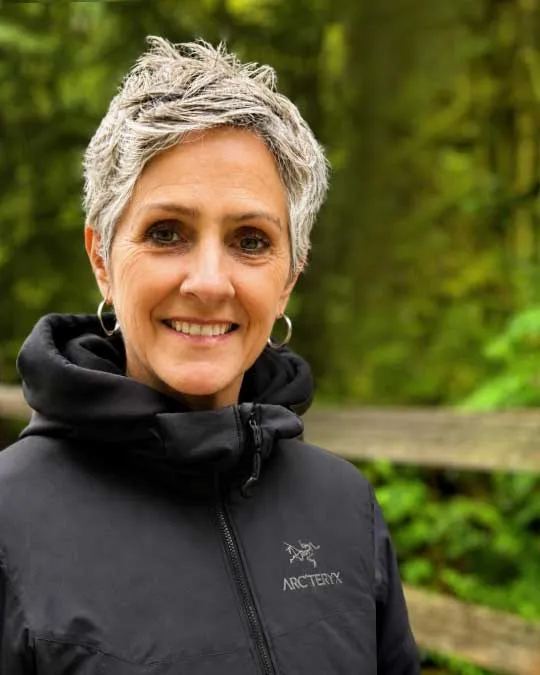
Sandra Riches has spent years helping keep people safe in the mountains, but her own story starts a long way from British Columbia. After growing up in Ontario, she made the move west and has often said that the moment she arrived in BC, she felt like she'd come home—even though she'd never been there before. That connection to the mountains and the outdoors has shaped everything since. In this episode we talk about how search and rescue really works, why prevention is just as important as rescue itself, and what every one of us can do to reduce the chances of ever needing that call for help.
Key Takeaways & Insights
Sandra began at BC Parks cleaning pit toilets and rose to senior park ranger.
Senior ranger for about 12 years, Sandra feels field experience helped her gain credibility, even more so as the only woman in a very male-dominated workplace. After a few years at home with her children, she joined BC AdventureSmart as an outdoor educator, and through it trains BC Parks outreach staff and rangers in safety messaging.
Sandra calls a number of BC's 1,940 search and rescue tasks in 2025 preventable.
Sandra sees a false sense of security among enthusiasts that she would dare to say was not there as much two decades ago. Many used to join groups or hiking clubs and be mentored. Now everyone scrolls their phone, sees beautiful peaks and wants to go there, and many do not succeed.
Sandra bases prevention on BC's search and rescue data, down to individual trails.
Sandra's 3 pillars are using the data, partnering with industry, and creating content and outdoor education. Partners include Avalanche Canada. She asks which user groups and regions come up most, and the top 3 reasons, then makes education for them, such as safety videos filmed on trails with some of the highest call volumes in the country.
Getting lost or disoriented is BC's second most common reason for search and rescue.
Sandra says avoiding it might mean taking a navigation course. The third most common is exceeding abilities, a chance to talk about the goals of the adventure and everyone's skills. One webinar in her expert series covered map and compass basics, such as contour lines and terrain features.
Trip planning should cover the 'what if', such as a broken leg, Sandra says.
Sandra's three Ts are trip planning, training and taking the essentials. She wants friends planning a trip together to work out who gives first aid, who handles communication, how to signal to aircraft, and how to manage shelter, food and morale if they have to spend the night.
Sandra sees BC search and rescue groups increasingly backing prevention, unlike 20 years ago.
BC has over 550 AdventureSmart volunteer educators, about 60% of them search and rescue members. Almost every one of the 78 groups has trained educators. Sandra changed AdventureSmart's aim in BC to reducing the impacts on search and rescue, so a task of 2 hours rather than 8 still counts as success.
Complete podcast transcript
Hello, and welcome back to the Outmap Podcast, A Guide In Life. I'm Charlie Boscoe, and I know we haven't had any podcasts for a little while, but I have recorded three in recent days, so we're gonna go from a slight, famine of podcasts to a feast. And we'll try and keep the cadence a little bit more, consistent in the future. But when the weather's this nice, people like to be outside rather than recording podcasts. But I did manage to speak today to Sandra Riches.
0:40 She's had a really interesting journey. She spent years helping keep people safe in the mountains, but her own story starts a long way from British Columbia, where she now lives. After growing up in Ontario, she made the move west and said that the moment she arrived in BC she felt like she'd come home even though she'd never been there before.
1:00 And that connection to the mountains, particularly the BC mountains, and the outdoors has shaped everything since. Today she's executive director of AdventureSmart, part of the BC Search and Rescue Association, and she leads education programs that help people make better decisions before they head into the backcountry. In this episode we'll talk about search and rescue, why prevention is just as important as the rescue herself, and what every one of us can do to reduce the chances of ever needing that call for help.
1:34 And we also dive into Sandra's story, which is a super interesting one and quite an unusual one. She started out at the bottom of the ladder cleaning out pit toilets, for BC Parks, and has worked her way up now, and it's been a pretty interesting journey to where she's found herself.
1:52 So over to Sandra, and enjoy. I was really interested to talk to you for several reasons. Firstly, the podcast that we run is about people who've led interesting lives in the outdoors. Maybe not as a job, maybe as a volunteer, maybe as both I think in your case. And just really try and get some insights into how people create an interesting life, and end up doing something they're passionate about. So that's why I wanted to speak to you was reason one. And reason two is you're a longterm SAR volunteer, search and rescue, and I'm also a SAR volunteer in BC.
2:39 So interested to pick your brains a little bit about that as well. But if we start with your personal journey into the outdoors, what lit the fire?
So I'm originally from Ontario, and often people have stories of going camping with their families or hiking with their friends and family when they were little, and learning how to fish and boat. And that wasn't the case. I moved out to British Columbia in my early 20s and felt like a door had opened to a world I had never known existed.
Yeah. That's, it's I have a similar journey. Didn't do it as a kid. And then you go, "Oh, you can do this? This is unbelievable. Why have I not been doing this my whole 20 years on this planet?"
Exactly. And I didn't know a lot of what we do out here existed. Of course you did, but not really 'cause it wasn't really a part of my life growing up. So I moved here early 20s and just felt like a piece of a puzzle that I didn't know was missing was added to my puzzle. It just all came together for me. It just really felt like I had come home, and I had never been here before, and so it felt right for me. It felt right for me. So I was jumped right into all the outdoor rec stuff, camping and hiking and biking and all fun things as I learned more.
3:59 And then I saw the outdoor recreation management program at Capilano College when it was a college back then, and was really intrigued to think, "You can do work in this industry and just love all these things and still work somehow." so I did. I took that program, had a wonderful two years.
4:17 And in the middle of that program, I actually started a job with BC Parks, and I was a senior park ranger for about 12 years actually at the beginning of my career. So that springboarded very nicely for me. Mind you, my first jobs were cleaning pit toilets, stuffing brochure boxes, cutting the grass.
4:35 But nonetheless, I grew up on a farm back in Ontario, so I was comfortable doing manual and learned a lot along the way. And a lot of the things I did learn were about public safety, park visitation, how do we make that work for those that come to play and be in the park safely.
4:53 And then was introduced to search and rescue, as we would support through resource support to search and rescue tasks that happened in the parks that I was working in. That was my introduction really to search and rescue. I had no idea what this world existed of, what it entailed, what it offered opportunity in.
5:12 And that was the beginning of what has turned into a colorful career for me.
Yeah. What was it, if you can... 'Cause I think a lot of people listening to this probably have that experience where they go, I can't believe this exists. This is what I wanna do." I actually think in some ways you retain the wonder for it a bit more because you're still, part of me still can't believe you can go ski touring. It just seems unbelievable growing up in the north of England that you can do a multi-day ski tour. It still blows my mind.
5:46 What was it about the outdoor sports? Was it the challenge? Was it just the environment? I think we all have a different why, but what was the thing that gripped you about doing it?
It sparked something in me that I didn't know was missing, and it just felt like a piece of a puzzle that I didn't know needed to be filled really. Through my school at Capilano College, we'd go on out trips, and I just kept being fueled by our outings. If it was to the West Coast to go whale watching or if it was to go backpacking in the interior up towards Cathedral Park, and all these adventures we did just kept fueling me more and more.
6:31 And I knew I was where I needed to be is what it felt like. It just It grounded me. And I like a physical challenge, so that was okay. To play outside is a good one for me. And connecting with other like-minded people was a biggie.
6:47 That was one that really solidified everything for me. Should I stay and move 3,000 miles away from my family, who've never left their street just about, and be the only one in the family to leave? So there were some struggles with all of that. My mom and dad, I think for about 15 years said, "When are you moving home?" "When are you moving home?" I'm like, "Well, I am home." so, 35-plus years later, I'm still in British Columbia, so it is my home.
7:13 And I've been able to make a career in it here with BC AdventureSmart, with the BC Search and Rescue Association, and still be heavily involved in outdoor recreation personally. And that connection to the industry through my work just continues to fuel me. It really is where I thrive.
It sounds like you're not super motivated by, goals and ticking. Or are you? Is there a
Oh, I am
Guidebook ticker?
Well, Not so much. Nothing. I'm not a cert chaser, if you will. I'm not after certifications, even though I've got a few, and this and that. But I do feel the need to get outside on a regular basis, i.e. Daily, to do something. Whatever that is, big or small, with friends, on my own, locally, where I live, where I travel, I try to do something. And it just, it sets me up for success if I go early in the day, and it wraps up the day if I go later.
8:10 And it's just a part of a lifestyle really, which is a big part I feel that a lot of us embrace on the West Coast is that lifestyle piece and what we like to do on a daily basis.
I agree. Yeah. I think it's a much healthier, reason than chasing a goal. People who chase goals either burn out or are never happy 'cause when obviously we all know once you do one thing, you immediately move on. So you get about two, two hours of satisfaction, you move on to the next thing. So that's a really, healthy way to be in my humble opinion. But I'm interested, how you moved through the ranks at BC Parks. So obviously nothing against people that empty pit toilets, but it's near the bottom of the rung.
Literally
Yeah, exactly. I'm trying to be polite here, but it's kind of the lowest level of the jobs in there. Did you have in mind that you wanted to climb the ladder, or was it just a I'm gonna just do what I love and see where it takes me?
Probably the latter part of that. I got into that job, like I said, I grew up on a farm back in Ontario, so I was used to physical labor. That wasn't a problem for me. I was inclined. I was capable. I asked questions, and I learned along the way.
9:32 I was also the only female in a very male-dominated workplace. And that was something that I didn't really think about though at the time. I just thought, "I can do this. I've been trained, or I will be trained, and I'll ask to be trained." I also brought skills to the table, or I wouldn't have been hired. So I was able to meet the needs. And over time, there were opportunity to take a next step up the ladder, if you will, and be a full-time ranger and then a senior ranger leading the crew in that region and helping with the parks system in that part of the province.
10:09 So I was very proud of that. Still am. I still look back to that as a huge, part of my career and a great start to my career, and I feel it's come full circle 'cause the work I do now with BC AdventureSmart goes back to BC Parks. We have a lovely partnership with them, and I train their outreach staff and their rangers in safety messaging and how to keep the park visitors safe with our curriculum. And so it's come full circle for me. And at the beginning of the career for me, it was cutting the grass and stuffing the brochure boxes and cleaning the pit toilets, but then I just kept trying to move along and see what else I could do to further my career.
What were some of the learnings from that early phase? If someone's listening to this thinking, "Well, I want to do that," what are the some of the things, your takeaways from that period?
Ooh, some of the takeaways from that period of my career. I was a hard worker. I am a hard worker. And so I think if you're willing to get out there, it's not for everyone. You know, if you're digging holes in the ground at 3,000 feet above elevation and you're having to eat bugs for lunch as they fly around your it might not be for you. But that's not every day. You could be out for a mountain bike patrol. You might be on the boat doing a marine patrol. You might be talking to the public and sharing information about trail safety.
11:39 So it was so varied, and I think all of that fueled me 'cause every day was different. We had our regular maintenance to do. We had our regular shifts to cover. But it also every day brought something new, and it allowed me to learn along the way really. You know, if it was more hands-on skills or facility maintenance or management skills and volunteer support, I don't think I realized what I was gaining at the time that would help me later in my career, i.e. Working BC Parks, industry sectors, search and rescue, having management opportunities. It really, looking back now, was a great start to my career.
Yeah. And I think for people starting out, I actually coincidentally got an email from someone today who's 17. He said, I'd love to get involved. Do you have any openings?" And the hard truth is, I suppose, it just takes a long time To figure out how to deal with people, how to deal with different stakeholders, challenges, successes. It sadly for this guy who's 17, and I sent him a very encouraging email and told him to keep in touch, but in the nicest possible way, it just takes a little while to build a skill set.
It does. I fully agree with you, and patience is key, and I think it's completely different now than it was 30 years ago for me, whatever the math is. There's a few more credentials that are probably needed. Maybe it's only seasonal work, different funding.
13:16 It's a different equation now for maybe that age range getting into these sectors, so it could take time. You're right. And having that short-term goal. Short-term could be three to five years. Right. And that long-term could be five to 10, and the looking forward, 10 onwards. However you wanna divide that up is a really way to look at it. Short-term is definitely not a
No
Gig anywhere. Short-term, I like to say that too. I have quite a few students that come my way too asking certain questions, and I say try to think in that three to five for that first section of where you wanna go.
Yeah. In my opinion, thinking past five is tricky to say the least. Very, very speculative. I think if I look back at five-year segments in my life, I definitely didn't expect each five years to be what it was.
No. No. No.
Someone said to me, I remember early on, "Don't worry about what's gonna happen more than five years from now. Only make five-year plans 'cause you it's, how could you possibly know?" So I think that's pretty good.
And so much changes. Look at technology nowadays and where are we gonna be five years from now? We think we're at it now. You know, we thought that five years ago, so who knows what can change in the next five.
Well, we didn't really have AI on a meaningful level five years ago. A month before COVID, no one knew we were about to have a global pandemic. I mean, it's, you just
No. But
You can't stress about it too much, so.
No.
So as you climb the ranks at BC Parks, what is the progression? And as you move through the ranks from ranger to senior ranger, do you start to get chained to a desk, or can you retain that connection with why you liked it in the first place?
Yeah. It was a combination. As I took on that senior role, there was a combination of administration, if you will, or desk, and contract management, all those fun things, project management, and field work still. We still had to inspect or go out and lead a crew, a construction crew, a trail crew, and work with park permittees. So it was a combination, which was really nice. I do like both of that. I really enjoyed that. So it wasn't all just field till the end, which is nice as well, right?
15:42 On those ugly days, you can do your which boded well. So, to me, it was a happy medium, and it really, really complemented each other, which I enjoyed. And so it allowed me to see both sides, right? 'Cause there's a lot of planning, there's a lot of strategy behind what happens and that happens at a desk usually.
16:02 But to have that field experience, I always felt that boded me at that time as a female even more so. I had the field experience. I operated the tools and the gear and everything and kept up with the Joneses, if you will, and that helped me gain credibility and accountability as I continued on in my career 'cause I'd been
16:26 Literally in the trenches, in the mud. And there's something to be said for that, and I've always been grateful for that opportunity to have had that field time. Even now, if I jump this forward into my career now, I can reflect on that and share that and empathize with anyone else who's out there. If it's a volunteer or anyone in the sectors, industry affiliates that are out there, I get it.
Yeah. Yeah. And everyone respects hustle. I notice that. Everyone loves a boss who will get their hands dirty or has got their hands dirty in the past, so I think it's a very, very valuable thing, and you also understand what hard work is.
You got it. There's a big respect there on both sides. On both sides.
A friend of mine, I remember when I lived in France, came back and I said, "How was your day?" He goes, "Oh, it was brutal." He said, "I was heli-skiing and I had this client and she couldn't keep up, and I was kept having to pick her up." And a friend of mine, we're in the pub, goes, "You know what hard work is?
17:32 Digging holes is hard work. Heli-skiing with a client who's not that fast. So just try and have a little bit of perspective here." I think it's true. It does give you a good, a bit of good perspective.
It does.
So how did you move on from BC Parks? You were there 12 years. That's quite a long career. Sorry, just one thing slightly randomly to pick up on. You said there weren't many women in BC Parks. You all know the statistics. I have my own libs of, lived observation. It feels like that demographic has changed a lot these days.
It has. It's definitely shifted. You jump all the way here to 2026, there's no question it's definitely a more atmosphere and environment, but when I was there, literally there was no one for me to look up to, be mentored by, work with that was female. And again, I didn't really think about it, to be honest. I just jumped in and did it. And I fit in, and I worked hard, and I did my thing. I was respected by our, my crew and the others.
18:28 And then as I became their supervisor, or others that came on and I led them, they respected me wholeheartedly. So I'd earned my stripes, I guess. And that was something. But looking back, I realized it was at a time that wasn't common to have many female in those male-dominated fields, and that can also speak to some search and rescue work. I just did a podcast recently and invited a search and rescue volunteer with Whistler Search and Rescue to describe her experiences with being a female in still a male-dominated field.
19:06 Is it better than it was 20 years ago, 30 years ago? Absolutely. Is it 50/50? No. So that balance still needs some work, still needs some TLC, that starts at the ground level with search and rescue, with SAR groups, and that comes all the way up to the board. It comes all the way up to advisory committees. It comes to working groups. The balance is key. It's key. Even on our BC Search and Rescue Association team, I'm grateful there's three women, and there's only five of us in total. So, we're fortunate, and our CC, our CO, CEO is a woman.
That's great.
And so it's great to see. And I can say from experience, going back to 1992 to now, I'm grateful for that balance within my workspace, and it's a strong space to be.
Again, you probably have statistics about this, but it would be my observation, that female participation in the sports has increased as well. Shout out to climbing here, which has a 50/50 split of participants, male and female. But it seems to me that, I know even when I started in these sports in the early 2000s, didn't feel like there were that many women doing them, and it does feel like it's shifted a lot.
It has shifted a lot, too. I agree. I'm out there skiing, mountain biking, hiking. Those are my tops. Mountain biking's my fave. And that, just speaking about that sport, has evolved a lot. I see balance in that sport. I do. I see that in group rides. I see it in friendship rides. I see it in the field when I'm out for a solo ride, and I look around. It reminds me of a ride I was on the North Shore a couple weeks ago, and I came up to the top before I dropped in, and I saw a woman who was about mid-20s with a young girl who was maybe 15, and she was mentoring her to drop into this one trail.
21:04 And they were
Oh, set break
Talking about setting up, lowering her seat, getting her pads right, placement, and it was just so heartwarming to see, actually, knowing that 20, 30 years ago I wouldn't see that as much, right? And to see that as an opportunity for that young girl, who was pretty cautious about dropping in there. She wasn't too sure, but she had help. She had support.
21:27 And not to say I was a part of that equation, but here comes along another female rider, and we all have a little chat, and I say, "Have a great ride." And then I go in so they could take their time, and she gets to see another female head down the trail.
21:42 To me, Those are big pluses, and it has changed over the years.
Yeah. I really feel like I've observed that, and I think it's a really healthy thing. I feel like it's removed a little bit of the machoism from these sports.
It has. And it can still be, in certain situations, that pressure of other riders, if we're still speaking about mountain biking. It can be an intimidation. But the more we're all open about it, chat about it, talk about it, share where we're at, if we're comfortable with this line or whatever, this trail.
22:19 At BC AdventureSmart, we talk a lot about the safety culture in the province of BC, and that comes from conversation, comes from meeting up and sharing. It comes from learning together. It comes from being honest. And that, to me, is shifting really nicely in the province in my career decades, and it's comforting to see.
Yeah. I totally agree. It's been the biggest shift I've noticed in the sports I like. They're still at a they're still basically the same. Bikes have evolved, but sport's still the same. You still gripped and hope you don't fall off, and trees are as to hit as they ever were. So the biggest change I've seen is really that female participation, and I'm all for it. So it's really interesting to hear. But sorry.
23:13 We were about to talk about where you went after BC Parks. And I have looked at your LinkedIn, by the way, but I guess most of the people listening haven't.
No problem
Where'd you go from BC Parks?
I ended up taking some time off 'cause I had two little people, who aren't so little anymore. I have a son who's 28 and a daughter who's 25, and I took some time off to be a stay-at-home mom for a few years and took a leave from BC Parks and took that time to spend with the kids when they were little. And then when it was time for Sandra to get back at something, I wanted to see what else I could get into. There wasn't an opening at BC Parks at that time, so I had to look elsewhere, and this job came up with BC AdventureSmart as an outdoor educator.
23:58 I thought, "I can do that." "I've stood at trailheads before and talked to people about safety. I know what the trails are about, and I know what it's like to pack a pack and be ready for the day and head off into the trails." So I applied and got that job, and that was at the very early stages at the beginnings of AdventureSmart in British Columbia.
24:17 And I've been with BC AdventureSmart ever since. That hasn't changed. And I've been very fortunate to have a full-time job, a paying job, and I work directly for the BC Search and Rescue Association, which is the Entity that created AdventureSmart. So I'm the executive director for BC AdventureSmart, and work nationally with the program as well. It did go national as well.
Yeah. Well, I think it's a wonderful organization. Been, been involved with it a little bit myself. At what stage did SAR come into things? I'm assuming this was after the career break, or was this pre-kids as well?
Little bit of association and support for local search and rescue in the Lower Mainland when I was with BC Parks. So as a resource, if a search and rescue task was happening and they needed some resource support, BC Parks could and did offer that. So that was my intro and connection at the early days.
25:13 And then with my role with BC AdventureSmart, I support all 78 search and rescue groups, 3,250 search and rescue volunteers with the work that I do, because by educating the public so that they can be more prepared, the goal is to reduce the impacts on search and rescue and add to the safety culture in the province. So my connection to SAR is a close one, it's a direct one, and I'm in contact regularly, daily actually, with search and rescue so that we can see how we can indirectly and directly support them.
And how's that evolved? 'Cause I'm a relatively new recruit to SAR. How's that evolved in the last 25 years? We talk
Well
Changes you couldn't see coming. I imagine smartphones, have made life very different. You might tell me otherwise.
Oh, no. That's just one of many. Look, if we even wanna talk about technology, that might be another podcast. There are so many things that have changed in these two decades of BC AdventureSmart. There was no social media at the beginning of BC AdventureSmart. It's changed immensely. Enthusiasts have changed. Interest in outdoor recreation has changed. Tourism has changed. Access to outdoors has changed. The support to access outdoor recreation has changed. Now we are encouraged by healthcare officials to get outside for physical and mental wellness, and I don't remember hearing a as much of that back in 1992 or 2004 when AdventureSmart started. So the equation now is uniquely different, and I think that plays a huge role.
26:47 There's a lot of false sense of security by enthusiasts nowadays that I would dare to say wasn't there as much two decades ago or three decades ago. A lot of people years ago were a part of a group and were mentored, or were part of a hiking club and had that exposure to someone who was quite experienced in the outdoors. They joined for that reason, and to be a part of a community.
27:12 Again, we weren't as exposed to visual invitations to get outdoors like we are now. Everyone scrolls on their phone on a daily basis, and sees all these beautiful peaks and these beautiful vistas and these views and these summits, sunsets, sunrises, and wants to go there. They want the same thing, and they try.
27:33 Some succeed, I'll tell you that, which is great. Many don't. And we know last year in 2025, there were 1,940 search and rescue tasks in, just in British Columbia, and a number of them were preventable. No question. So there has to be a way where we can help enthusiasts understand the risks, assess the risks, plan for their adventures, and safely return home. Their destination is home.
28:04 So there's a lot involved. It's quite unique now. It's changed a lot over the years.
Yeah. Well, my introduction to SAR came as a I was a subject twice, and so when the opportunity came to be a member of it, I thought I owe karma a little bit here. They came and got me twice.
Oh my goodness.
Yeah, I know. Well, it was user error on both occasions. But what's been the primary focus? How do you go about, reducing the number of people that need search and rescue services?
It's pretty strategic, and we know that we have opportunity to do that in British Columbia 'cause we use all of the search and rescue data that's entered into the provincial system to partner with industry sectors. It could be BC Parks, it could be Avalanche Canada, it could be an outdoor club, Federation of Mountain Clubs. Those partners are strategically aligned with, and then we can push out campaigns, targeted initiatives, videos, contents, webinars, podcasts.
29:08 That list continues to grow. So that is really like a three-pillar system using the numbers, using the data, partnering with industry, and creating content and outdoor education. And I just continue to drive that steering wheel, and that's how I look down the road to see what we can do. Seasonally I use that model.
29:28 Throughout the year I use that model. Every fiscal I use that model and it really gives me a great foundation to go back to that search and rescue data. So all those incidents that happen, all the details are entered into a provincial system, and I get to go in there and look at all those little nooks and crannies and say, "What user group was looking for search and rescue the most? What were the top three reasons for search and rescue? What regions have a higher call volume? What trails have the most SAR tasks on them?" Amongst other details, and then I can create outdoor education for those user groups, for those trails, to meet the needs of those top three reasons for search and rescue, and really try to hit the nail on the head with that.
30:06 I think an excellent example of what that might look like is if you head over to the BC Search and Rescue Association's either YouTube or website, go to Outdoor Education, and you'll see some videos. We have trail-specific safety videos, and we film these trails which have some of the most highest call volume in the country on for search and rescue.
30:28 And we hike them, film them, video them, talked about junctions, trails, decisions, pre, during, and post-hike. And we put these videos out. So it is a great example of what that three-pillar system looks like. Also, our expert webinar series that we run every summer and winter, I'm really quite picky and structured about what topics we're going to discuss, what our guests will share, who the guests are.
30:53 Last night's a great example. We had an expert guest come on from, the ACMG and talked about maps and mountains. It fits perfectly because it's the second most common reason for search and rescue in BC, is getting lost or disoriented. So last night we shared all the little basics, 101, about map and compass. What is a contour line?
Yeah.
What are these terrain features? And we know that doesn't make sense to everybody, so we like to be that stage, virtually or in person, to introduce people to this and so they can increase their awareness.
What are a few golden bullets? What are a few things that you just think, "If we could sort that out, we'll have an awful lot less SAR calls"?
I think people need to think more of the what if. We always think of the success, and that could be from being, injected by beautiful pictures on social media and wanting to go up to that peak, and that could be what we think of, and that can be our carrot. That beautiful picture at the top with our hands in the air and eating a nice lunch up there.
31:57 And not thinking about the what if can be, a mistake. So we really encourage in our outreach, I really ask people to think about the what if. And the what if comes at the very first section of planning your trip. So we have the three Ts that we talk about: trip planning, training, taking the essentials. In that trip planning phase, I often say jokingly, but it's a good idea, get around with your friends, get some nachos going, maybe a couple beers, talk about where you're gonna go, what you're gonna do, and how you're gonna do it.
32:25 And in that trip planning piece, I want you to talk about What if Sandra breaks her legs today... breaks her leg, not both. One. Going for a mountain bike ride in Pemberton next week. What are we gonna do when she breaks her leg? Which is a true story, by the way, but that's for another time.
32:42 So what are we gonna do? Who's gonna take care of Sandra with first aid? Who's going to be in charge of communication? What about shelter? What if we have to spend the night? Do we have enough food? How do we maintain our morale? How do we signal to aircraft?
32:55 We want people to think about the what if to that detail. With the plan of not having it happen, and succeeding, but we have to be ready for the what if. And also, in and amongst those three Ts, if you can really think about injury prevention, if you can think about avoiding getting lost and disoriented, and what that means might be taking a navigation course.
33:22 And the third most common reason is exceeding abilities, and that is a good chance to have a really decent conversation about goals of the adventure. What do we want to achieve here? What are the skills and abilities of everyone in the group? And how do we not exceed our abilities?
33:40 Those are a few things to think about.
Yeah, I totally agree with that. I remember when people were getting into alpine climbing, I always used to say to them, a success beats a failure." You're better accruing a ton of experience by going out and doing something. Even if you think, "Ah, we could probably do this bigger route," doing the smaller route, you'll still learn plenty.
34:02 You'll log some more experience. You'll get up early. You'll navigate with a headlamp. You just stand a much smaller chance of just getting completely spanked. And getting ironically getting completely killed on some... Not, hopefully not killed, but completely spanked by something isn't actually, I don't think, great learning experience, 'cause just everything went wrong.
34:23 So I always say to people, "A success beats a failure." Just go out and have 100 successes and five failures, and you'll figure it out. It'll come. But it's the same old thing, it takes a while.
It does take a while, and that's just slowly building that up, isn't it?
Yeah.
And that could be slowly building up confidence. It could be slowly building up skill level. It could be slowly learning how to pack your pack better, and weight distribution. It could oh, now I have the right boots on my feet and don't have blisters. All these little things are really, really big things at sharpening your pencil to get to those bigger successes.
Yeah. Yeah, totally. I read a book by a climber not long ago and he said, "I was so motivated, I quit my job and everything, and I did 10 years' worth of climbing in five years. But guess what? I still only had five years' experience." It's so true. You know, it
35:19 It takes a little while. So where are you at with it now? You've had a variety of jobs that you're clearly passionate about. Where are you at now in terms of your own, motivation and goals?
I think with my work, it's continuing to see how we can grow the program provincially. We're in a pretty high gear in British Columbia with BC AdventureSmart. And again, it is a national program, so there is representation in every province and territory. What's unique about British Columbia is we do have funding that comes from Emergency Management and Climate Readiness that allows me to do what I do for work here.
36:02 And it also allows us to expand on partnerships and see where we can grow. I think there's quite a few exciting doors opening right now, and I think that's because different sectors see what we can add value to their work, what that looks like, and they're coming back to us to say, "Hey, can we work on this with you? Can we collaborate on that?" And that might be tourism, it might be industry, it might be land managers.
36:28 It could be tasking agencies like coroners, RCMP, BC Ambulance. There's a lot of opportunity, I think, and a lot of flourishing happening right now, which is really exciting to see. Things take time. It takes time to establish a decent foundation of any program, any campaign, and I like to say our 20-year foundation is nice and solid here in BC. And we can move forward confidently, and I think that's with concentrated support right now from all those organizations I just listed, and that makes my job a little bit easier.
37:09 And then we can all reach the public with the safety message. And however we can reduce the impacts on search and rescue, it might not be the annual call volume. It could just be the severity of a task. That's still success. It could be an increased safety culture in the province of BC.
37:26 It could be people sharing our programs with their teachers at school so the children learn more about this as they grow up. There's many ways where there's more opportunity now than there ever was. And I think personally, I'd just like to ride my bike a lot more.
37:42 I'd like to go for swims at the lake more. I'd like to hang out with my friends in the mountains more, and I think I'll keep striving for that.
Well, I know we said earlier you shouldn't look too far in the future. How do you perceive the next few years? And by the way, I won't hold you to this. We're just riffing on the podcast, but what do you see as the trends in the next five years in search and rescue? 'Cause certainly my search and rescue group, from my understanding, has changed an awful lot in the last five years.
Hmm. I see, 'cause I'm noticing it right now actually, I'm seeing an uptick from the search and rescue groups in British Columbia supporting prevention more, and I can confidently say 20 years ago, that wasn't the case. And I'm saying that respectfully. It just wasn't on their radar as much.
38:33 You know?
Fair call.
Fair enough. And now fast-forward to 2026, they wanna be a part of the prevention side, which is great to see. So I think what I see has changed and can continue to shift, I guess, and float around is that recruitment piece to search and rescue doesn't always need to be, and isn't always just for ground search and rescue response.
38:58 The recruit is much more strategic and/or the involvement is much more varied now with the SAR membership on any SAR group. There's fundraisers, there's administrative, there's resource members, there's mechanics, there's, accountants, there's AdventureSmart representatives. You know, I have over 550 BC AdventureSmart volunteer educators in our province, and about 60% of those are search and rescue members.
Wow.
Yeah. Almost every single one of the 78 BC search and rescue groups in our province have trained, recognized AdventureSmart educators on their SAR group. That's amazing. That wasn't the case 20 years ago, and so that's taken time and I see that continuing to grow. It's a really exciting time to see what's happening right now with prevention within the response world.
Yeah. Yeah. No, that's a really interesting insight, and I also am very interested when you say that the it's a bit of a blunt tool to just say, "Well, what are the call volumes?"
It's one factor. It's one factor. We used to say AdventureSmart's here to reduce the number and severity of search and rescue tasks, period. Well, we do a heck of a lot more than that. And so recently here in British Columbia, I changed what we do here in British Columbia. And like I said earlier, we're here to reduce the impacts on search and rescue and add to the safety culture in BC. That encompasses more what we do here in British Columbia.
40:25 As I mentioned, if a SAR task is two hours versus eight, that's still success. If the crew in the field were prepared, they could communicate, they had the right gear, and that call was less severe, that's success, and that's a reduced impact on search and rescue. So that's a win, and it's not looking for, nuggets in the sand, if you will. I think it's defining it better about what we're doing for the search and rescue community, and I think the public understand that now, too. The public are proud to share that they're prepared. They're proud to show what they've got in their pack.
40:59 I see this on social. I see it at events. And it's nice to see all of that come around the corner.
Yeah. No, that's really good to hear. I have to say on a personal level, I got a lot out of search and rescue. It's been an amazing thing to be involved in, and if anyone's listening to this, then go for It's really rewarding.
41:20 Can be a complete pain in the butt. That's true of adventures, right? It can be the best thing ever, but you can also spend the night shivering on a ledge, so.
You got it.
You got the same with search and rescue. Some days it's great, and other days you're standing in the rain wondering why on earth you even
What am I doing?
Yeah, exactly. So it's like all things in life. It's got good and bad. That's a good true adventure. But hey, thank you so much for the call. That was really interesting.
Oh, that was great, Charlie. I appreciated the chat. It was good to share. Hopefully your listeners enjoyed, and anytime. We're here to help everyone in any shape or form, so it's great to see this information being shared.
Well, we appreciate the support, so thank you.
My pleasure.