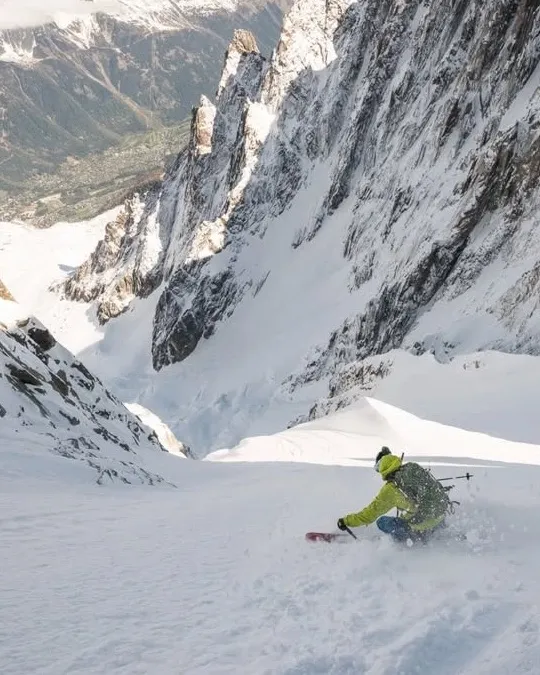
Today's guest is Mountain Guide Tom Grant, a long-time friend of Charlie's, and one of the most accomplished ski mountaineers on the planet. We talk about Tom's life in the mountains and how he got here from East Sussex! It's been an amazing journey so far, and as you'll come to understand when you hear the psyche he has for climbing and skiing, he's not stopping anytime soon.
Key Takeaways & Insights
Tom first skied in Chamonix in 2004, with no avalanche gear or glacier kit.
Tom calls his 2009 move there a game changer: so many people had a similar focus and looked up to guides. It took about a year to become set on the guide scheme. Working 3 days a week, sometimes a bit more in the off-season, left time to climb and ski.
Tom says guiding has to start with a genuine love of climbing and skiing.
In Tom's view it is really hard to get through all the prerequisites for the guide scheme without that passion, and you enjoy the job less. He says a deferral at the assessments can mean a year of retraining.
After qualifying, Tom says, nobody teaches you how to run a guiding business.
It is like passing a driving test: you are certified, but have a lot to learn. Nobody explains accountancy, setting up a business in one country, work permits or marketing to clients. Tom was still working on that side himself.
After 16 years in Chamonix, Tom's risk tolerance has dropped a little.
Tom says steep skiing and alpinism bring close calls, friends dying and accidents of your own, so it would be crazy if his risk tolerance were unchanged. His love of climbing and skiing has not changed.
Tom may not want to work 25 more years depending purely on his body.
Tom's performance has not dropped, but the maintenance has increased and takes a lot of time. He was looking to offer more courses and have more guides working for him, and was considering a book of ski descents in the Alps.
Asked how he stays enthusiastic, Tom thinks he enjoys skiing more than many guides.
Even when guiding, Tom is constantly thinking how to ski or climb better himself. In his view you have to keep things a bit fresh: from Chamonix he could drive 40 minutes with a client to a couloir he has never been to. He also enjoys getting to know people and coaching clients.
Complete podcast transcript
Hello, and welcome back to the Outmap Podcast, a Guide in Life. My name's Charlie Boscoe and today I'm talking to IFMGA Mountain and Ski Guide, a longtime resident of Chamonix, France, Tom Grant. Tom started skiing in his teens. He started climbing at university and ever since, his life has been defined by his passion for those two sports.
0:33 And he's done pretty well at them. Climbing-wise, he's a high-standard rock, ice, and mixed climber. He's done all six of the great Alpine North Faces. He's climbed El Capitan. Ski-wise, Tom is literally one of the best ski mountaineers, in the world. He's, been on expeditions to Baffin Island, to Pakistan, Georgia, remote parts of BC but perhaps most notably in 2017 he and two friends made the first ascent of Mount Cook's Caroline Face in the New Zealand Alps.
1:08 It was considered one of the greatest unskied lines on the planet at the time and their first ascent was a huge deal, in the New Zealand ski community but globally as well. Basically, Tom is the real deal. He trains hard to be exceptionally good at the sports he loves.
1:24 He's an elite mountain guide and all-round great guy. Little disclaimer here, Tom and I go way back. We've done a lot of climbing together. When Tom was gearing up to do his guide's training I was following that path as well and although it didn't end up working out for me, Tom pursued it and has made a fantastic career.
1:42 So we've shivered on a few ledges together, we've shared a few laughs. It was fascinating for me to finally ask Tom some questions I've always, meant to ask him and I actually learned a lot despite having known Tom over 15 years now. If while listening to this interview you are thinking, "Wow, I would really like to go climbing or skiing with Tom Grant," you can find his website at tomgrantguiding.com.
2:08 Enjoy the chat. Tom, welcome along. Where are you joining from this evening, this morning?
Thanks for having me on. I am at my home in Servoz, France at the end of the Chamonix Valley.
I mean, how long ago did you first come to Chamonix? It was a while ago, eh?
Yeah. Moved here in 2009 but I came on a trip. I first skied in Chamonix in 2004.
Wow. Okay. So 22 years ago. Makes you feel old.
Yeah. Certainly does.
And obviously, today we're gonna be talking about your guiding career and obviously you and I know each other really well. You are one of my closest friends and we've done a ton of stuff in the mountains together so I really hope this isn't awkward me, me asking you questions but I'm also aware that when you're friends with someone you don't always ask them questions. You know the person, you know the basic story but I'm actually expecting that I'm gonna learn something today. I didn't even know you skied in Chamonix in 2004 your first time.
3:19 I thought when you came for your first season that was your first time so
No. Well, it was with a friend I grew up with in East Sussex and I did a bit of climbing with him and skiing with him back when I was a teenager and his dad took us on a trip along with his uncle and on the second day I remember going up the Midi and it was a perfect powder day in March and none of us had harnesses, transceivers, any avalanche gear, any glacier kit and then I was so excited. It was amazing. I was so excited to be up there I just started skiing around little, little bits of powder between crevasses. My friend's dad got really freaked out and stressed about it, started yelling at me and thought, he would have to explain how he'd lost, lost their
4:03 To my parents who he also knew well.
Where did you actually end up? This is for people that know the Aiguille du Midi cable car this will be more relevant. Where did you, where do you think you actually ended up?
We're just, we were skiing the normal way down the Vallee Blanche.
Did you go all the way down the Vallee Blanche?
Yeah. Yeah.
That's quite a remarkable achievement with no idea how to navigate glaciers, no gear.
Well, he was meant to be in charge. Yeah.
See, again already what are we two minutes in I'm already learning. I love it. And people listening to this who just heard you say you're Sussex might be thinking, "That doesn't sound like your traditional East Sussex accent." you had a childhood that spanned both sides of the Atlantic.
Yeah. So I was born in the US and moved when I was 11 to the UK from a suburb of Washington, DC.
Did you ski much in the States before you left?
No. I started skiing when I was 13 on a school ski trip to Austria in Salzburg.
Okay. So you'd now-- So 13 was the first time you ever put skis on your feet?
Yeah. Yeah.
Okay. Did you like it straight away?
Yeah. Yeah. I loved it right away. I remember we had a slalom race the end of the week and I actually won out of 50 kids including quite a few of them who'd skied before and I got a little gold star that I hung up on my wall after that at home. And then started finding posters of skiers and putting posters of skiers on my wall when I was 13, 14.
I love it. Your period of being really bad at skiing was what? Four days, five days maximum. For most people it's years if you ever break out of it. I'm just on the cusp of getting out of that phase and you had four days and I love it. Yeah. So you loved it straight away. Where did climbing come in?
I first got a pair of rock shoes, and a harness when I was 16 and I did some climbing on the southern sandstone in East Sussex so I always just loved climbing things and climbing trees and I was just fascinated by climbing. It was always something that I thought I wanted to do and again in a school trip, when I was 14 to North Wales, did some climbing there and beat all the other kids at climbing to the top of this pole yeah, and then I just convinced my parents to buy me some climbing kit and get me a climbing instructor one day.
So as you, as you're going through your teens, you're getting more and more into these sports presumably?
Yeah. Although still football and athletics were my main sports, and it wasn't until I was at university about probably age 20 that I'd say that climbing and skiing took over.
And were you-- So when you were at university, where'd You went to Nottingham, didn't you?
Yeah
Geography, is that right?
Yep.
Pulled that knowledge of what you studied at university somewhere from the back of my mind. I can't believe it's still in there.
That's impressive.
Thanks. Yeah. I won't ask you to name where I went to university and what I studied. I don't wanna put you on the spot. But when did you start thinking it might be a career?
Well, I remember at university looking through career options, and I wanted to do something that was adventurous and where I could test myself, and I was looking at joining the Marines. I applied to MI6. I just wanted some action and adventure really. I do remember when I was at university, I hadn't done any alpine climbing. I'd probably been rock climbing for about a year of trad climbing experience, and I looked at the British Mountain Guide website to see what the requirements were, and it seemed so far off then that I just put it out of my mind. It just seemed miles away at that point.
7:48 And then I did a ski season doing a classic ski seasonaire ski rep job in Tignes. As soon as I left university, I wanted to spend more time skiing. And then I figured I needed to start alpine climbing because I was just so into the mountains and doing as much rock climbing as I could, when I came back. So that's when I first came out to do a summer season of alpine climbing in Chamonix in 2009.
Yeah. It's quite a similar, experience, I think, to what a lot of people have. A lot of that is mirrored in what I did, which is you think, "Okay, I don't want a boring life. I wanna do something cool. I wanna be challenged. I wanna be outside." And I was thinking the same. I was planning to join the military.
8:29 'cause it seems like when you grow up in England, you're not exactly surrounded by role models for how to have a career in the mountains. That is just not really something you're aware of. And I agree. I remember looking at that British Mountain Guide thing and just to give some context, it's 50 E1 multi-pitch rock climbs, so E1's, what, six, 6A plus, 10A in American money. Trad multi-pitch trad climbs, 20 grade five Scottish winter routes, 30 days ski mountaineering, and then a big alpine climbing component, including five grandes courses big routes in the Alps. So when you just basically first got outside a climbing gym and can ski okay on a groomer, that amount of experience at a high level is just so daunting.
Yeah. Yeah, for sure. Yeah.
And I don't know about you. When I was thinking about doing the guide scheme for many years, it is completely daunting, and then you actually get about halfway through it and you think, "God, if I actually just focus, I could do all this stuff." You get into alpine climbing. I remember talking to you about your season in Tignes. How did that evolve into not going back to the UK? 'Cause it's always a bit of a funny thing, right? You do a season, it's got an end. The season ends, I don't know, whatever, third week of April, and then what do you do?
Yeah. Well, I think moving to Chamonix was a game changer 'cause so many people had a similar focus, and that's where I met you and that was a big influence as well. I was like, "Wow, other people are working towards this thing, and maybe that sounds like a cool thing to work towards too." So I think it was being part of this community out here where people had...
10:21 All of a sudden, there were these other motivated young British climbers, skiers, as well as Americans, Swedes, and other people, and a lot of us were looking up to people who were guides and thinking, "Right, actually, it sounds like a cool thing to do and to work towards." And so that changed my perspective on it.
10:41 But for sure, it's not easy to find a way, I think, long term. There's different avenues, but I wasn't really sure at that point exactly what I wanted to do. But I knew that I didn't wanna stay living in Chamonix working, a minimum wage job, whether that was in an office or transfer driving or laboring. I did all sorts of jobs, while I was climbing, skiing as much as I could, and I knew that wasn't something I was gonna continue to do indefinitely.
11:07 But I also knew that I wanted to consolidate as much experience in the big mountains climbing and skiing as I could. Yeah, I think it took about a year or so before I became really set on doing the guide scheme, and then that provided some structure of something to work towards while also doing a lot of climbing, skiing on the way.
11:30 I had different, different jobs. Some, some of them weren't so bad, working in an office doing bits of marketing, admin, scheduling transfers for a company here. Looking back, actually, it really allowed me to just working three days a week in the winter, sometimes a bit more in the off-season, three days a week in the summer, just making enough money to get by, without saving anything. But it did allow me to spend a lot of time climbing and skiing in the first three, four years I was in Chamonix, and actually I packed a lot of experience.
12:04 Looking back, that was really a transformational period where I just gained so much experience and was able to actually apply for the guide scheme pretty quickly off, off the back of that.
Yeah. Well, firstly, I remember some of your dead-end jobs. I think the worst job we had, 'cause, we shared it, was do you remember when we had to dig that cellar out?
That was terrible. Yeah, that was like prison
That was horrible
Moving massive glacial blocks around. No, I had some really yeah, bad jobs. What else did I do?
That felt like a low point for me. So just for there's a friend of a friend came to me and said, "I've got this cellar in my house." And you went down some stone steps in Chamonix, and then there was this very low-ceiling cellar. And he said, "Basically, I want the floor to be..." Was it a foot or two feet or some amount deeper so that you can really walk in it?
12:56 And we spent, I don't know how long. Probably wasn't that long, couple of weeks. But digging dirt and rocks and then putting it in bags, carrying it up the stairs. Do you remember we had to put it in a pickup truck and then drive it to wherever you dispose of these things? It was down in Servoz maybe or Les Houches and.
13:15 Oh, it was
That's right
It was just miserable. It was like working on the railways back in the days or something. It was just digging and carrying. It was miserable. But also it brings me to one of the trickiest elements, I think, of making a life in the mountains, which is it's easy to be a ski bum, much as it's not easy financially. And I know at times both you and I were, on the poverty line but still getting to ski loads, so it was great.
Mm.
I didn't mind being on the poverty line. But the tricky thing in Chamonix, and almost everyone goes through this, is how do you go from having no money, no prospects, bumming around in some dead-end job. I was transfer driving. You were you did all sorts of things. I did a season of delivering linen to hotels.
Oh yeah, I remember that
That was a great... I actually really enjoyed that job 'cause I just got this, I'd be delivering from Chamonix. I'd be going to, like, Meribel. So it's a two-hour drive, so I'd get my music on
That's right
That was great. But the tricky bit is how do you go from that to having a real life? And when you're a ski bum, I don't know about you, I just thought, "Well, I'll just keep being a ski bum." But then you do just get sick of having no money and working for someone else on someone else's terms, doing something that doesn't challenge you, doesn't stimulate you. And you do eventually want to make a real life. And I think going from a ski bum to making real life is the trickiest bit of making a
14:46 In the mountains.
Yeah, totally. No, I would definitely agree with that. For sure. There's different avenues I've seen people take and people set up their own businesses here. Some people maybe go back and get some professional experience working, whether that's in some kind of consultancy or as a financial advisor, all sorts of things, and then end up doing freelance work from Chamonix. So some, some people are able to make it work, make that work.
A popular option.
Offshore, yeah.
A lot of people work offshore.
I think offshore isn't as popular as it used to be, though. Or maybe it's just I had more friends back in the day. I feel like there was a heyday of rope access work that was well paid offshore that doesn't really exist anymore. I might be wrong, but...
I think it's still there. It could just be Social circle. But yeah, it's a logical career for climbers 'cause they're good with ropes, don't mind working hard physically, and then a lot of people are doing two weeks on, two weeks off, so you just come home and you got two weeks off. So that's, I think, still popular in Chamonix. Maybe less so, but certainly when I was there, that was a lot of people worked offshore.
Yeah. People were doing that engineering on wind farms, actually, or maintenance on wind farms, doing two weeks on, two weeks off on some kind of rota.
Which is actually a good lifestyle for someone that wants to climb and ski a lot. Albeit you lose half your year, but half the year you have nothing to think about. So yeah, that's an option. But yeah, for you, I guess, you were always focused on a profession in the mountains, not just living there with another profession.
Yeah. Yeah, exactly. Yeah, and I think I always wanted to try to excel or do my best at what I was doing, and I think at first all that energy was channeled into alpine climbing and skiing. And then being able to morph that into, to have that go into a career and to put those skills to use is really cool because there's not many ways that can happen.
Yeah. Yeah, for sure. And really if you're gonna live in Chamonix, just for context for people here, you can only basically be a guide or a trekking guide. You can't say, "I'm gonna teach a bit of climbing. I'm gonna do a bit of skiing." You're either a mountain guide or hiking guide or you're not.
Or a ski instructor.
A ski instructor. But obviously you've got the elephant in the room is what you do for the other eight months of the year. And I was there for a lot of it, so I know it's weird to talk me through it, but what was it like chasing those, prerequisites? What was that experience like of getting the prerequisite experience to start the guide training?
Well, had to force myself to go to Scotland, which we did a few trips and I had to miss some good skiing, in Chamonix sometimes in January, February, or December. December, January we went. But I loved mixed climbing as well, even though it wasn't my main passion. But there were definitely some of the Scottish trips were pretty grim at times. You were just trying to walk up the Ben in the rain and yeah. But yeah, I think coming from, I think to go, go do the prerequisites, people sometimes have asked me or for advice or I know there's always people coming through Chamonix or people that come across who are interested in doing the guides scheme.
18:22 I think it's really hard to do all the prerequisites if you're not at your core a climber and a skier and you don't really feel passionate about it. 'Cause some people come from a strong climbing background or strong skiing background, and they're still able to have a good enough level.
18:38 But I think if someone is in the UK or the US or wherever this is podcast and they think it sounds like a cool job being a mountain guide and a good idea, it all comes first and foremost from actually being passionate about alpinism, about climbing, about skiing. And I think it would be really hard work and quite difficult actually to go through all the prerequisites if you didn't have-- if you didn't genuinely love it.
Yeah, I agree. I've met mountain guides, who will remain nameless now, but who were pretty open about the fact they didn't like either climbing or skiing that much. And I just think, "Oh my God, it must be so hard to get-- to climb 10A on trad." Okay, it's not an elite level of climbing, but you're not crap. That's a decent climber. If someone can solidly lead 10A trad, they've put some time in. They're pretty solid.
19:32 I can't imagine doing it if I wasn't into it. I mean, I A bit like you, I wasn't into every element of it. Scottish winter climbing, which you and I did a lot of could definitely take or leave. At least you just think, "Okay, I'm doing this 'cause I have to do. It's two weeks. That's fine." but
19:51 If you just actively were not into either climbing or skiing, I think it'd be really hard. And I totally agree. I think it should always come from the fact that you want to do those activities, and then it becomes a career.
Yeah, for sure. And I think also working as a guide. Yeah, I think you're gonna enjoy the job less as well unless you have a genuine excitement and passion that you can retain for both.
Yeah. Yeah, for sure. And what was that process of going through the guide scheme like? 'Cause I would've been nervous and I'm sure you were, but was it all it was cracked up to be? Was it supportive? Did you feel like you were being...
20:32 Were they giving you a hard time? I know it's only the British scheme and other schemes may vary, but I'd imagine it's the same in most places. What's, what's it like training to be a mountain guide?
Yeah. For sure. Coming into the assessments, you feel, there's a lot of pressure 'cause a lot rests on it. You wanna progress with your classmates and also a deferral can mean a year of retraining and redoing tests where you're in a place that you know, might not wanna live. For me, I had to spend some time-- 'cause I was already living in Chamonix, my home and my favorite place to be. So I had to spend time in North Wales and Scotland. So to get back out to the Alps and to start working as an aspirant was my main goal.
21:16 Yeah, it was a very cool process and I think I didn't maybe appreciate as much at the time, and then afterwards, you're like, "Okay, I'm a guide. I've got to build my own business. I've got to see what it's like working as a guide." And I think you have a very clear structure actually going through it where you have a goal of going from A to B.
21:39 And yeah, it's a cool process to be part of. Whoever's on your year with you generally becomes very close friends and you have a real bond, through that. Well, I was lucky that I had a really good, good, good year, good intake. The people that I went through are some of my best friends today and my regular climbing and skiing partners.
Yeah. What happens when you're done? Is it... Is it a bit strange to suddenly lose that goal?
Yeah. Yeah, I think so. Yeah, because you're just out there, working things out a bit. It's like passing your driving test. You're certified that you're good enough, but you still have a lot to learn. And I made some mistakes in my first couple years of guiding that I wouldn't make now and I think, you know, just trying to evolve and be safe and not have accidents as you're consolidating that experience. And also you gotta work things out. Nobody tells you how to run your own accountancy or if you wanna set up a business in one country or how to have a good strategy of marketing yourself to a client base.
22:53 I think some of that would actually be quite useful if, you know, or just setting yourself up to work in a certain country and having all the legal, work, work permits necessary. So yeah, I think some people after that generally just take on work for certain companies and don't wanna necessarily, work independently, so they're just handed work. But I think actually a big part of guiding is just being able to run yourself individually as a bit of a business and that's nothing, not someone, teaches you. It's something I'm still working on growing.
So there's no element of coaching in that regard? Of, "Hey, the day you qualify, guys, this is what's actually gonna happen."
Not really, no.
That's interesting. I feel like that would be a useful addition to it, is to have at least a resource you could access saying, "Hey, here's how you do basic accountancy." 'Cause if you're anything like you and me, we were just ski bums. Basic accountancy was like, "Can I actually eat this month?"
23:58 You mentioned it then. What were the big learnings when you first start guiding then? What was the shock to the system? 'Cause I guess until then you've been an aspirant, you've been shadowing someone, but have you ever been in the position where you've got a real client, not a mock client on an exam, but a real person who's come to you with money in their hand and wants to do something?
24:19 Or it's the first client you get after you pass?
No, I had real paying clients I think from about halfway through the guide scheme or even less, taking on work, some work in North Wales and Scotland. But it ramps up. But for sure the idea is that you gain experience guiding real paying clients when you're a trainee guide, ideally, and definitely as an aspirant, or at a trainee, getting some work as a trainee guide in Scotland is really important.
24:48 But yeah, I naturally wanna push people in the mountains and go on adventures with clients and naturally have a reasonably high risk tolerance, which is a little bit lower than it used to be. So I think one of the big learning curves for me was making sure I didn't sandbag myself or get myself into a bit of trouble or maybe choose something that was a little more involved and gnarly than it needed to be for the given client or the given situation.
25:21 But that being said, because I always resonated more with clients who wanted to push themselves a bit or were already good at the sport and wanted to go on bigger adventures, I did attract, that kind of client base fairly early on. But I think it takes some experience just to sometimes rein yourself in and also not put too much pressure on yourself to always deliver something that's the most you can possibly deliver and re-reminding yourself that just you don't need to try to push it too much each time. That it's.
25:53 Yeah, that something that seems a little average to you could also be the craziest experience they've ever had and you don't need to try to push it too much.
Yeah, 'cause I think you just touched on it then. Your risk tolerance, motivation, whatever, for your personal climbing and skiing, maybe not your risk tolerance but your performance level has been exceptionally high. The level that you operate climbing now as well, but particularly on ski. Always has been on skis and then you've, you've also got really good at climbing which is quite upsetting. But, you've always operated at such a high level. Where does your-- Where do you think that personal drive came from?
I think from a combination of a genuine love for the sport, for both sports and also just for a desire to push myself and being curious about what I could do and just to try to... I think there's value in trying to excel at something and gain a level of mastery at what you're doing and I think I maybe intuitively knew that from an early age or always wanted to try to...
27:02 Whatever sport I was doing I wanted to try to be the best I could be. And then I think I recognized that actually that could, that's, that has a lot of value in your life to try to get as good as you possibly can at what you're doing. But also that that tied into my guiding where I was able to gain some recognition in the mountains and then apply that to guiding. And also using that experience then to teach and coach clients all that hard-won experience which I think is really satisfying to pass on.
Do you think you've, mellowed a little bit over time? 'Cause I feel like when we started climbing and skiing together you would-- You just always wanted to do the biggest, baddest thing you could do that day. You always wanted to do one more lap when we were skiing or one more route if we were out climbing.
27:57 Do you still have that? 'Cause you and I, for people listening to this obviously won't know, but we met up about a month or so ago, in Denver and went climbing in Eldorado Canyon and we did a route that basically you cruised up and I feel like it's 'cause you knew you couldn't get me up anything harder than that but I feel like you actually didn't mind cruising along. Or are you still out there just wanting to Every day it's the biggest, baddest thing you can find. Is that still how you are or do you think that's slightly mellowed?
I think inevitably that's slightly mellowed. I mean, I think it's separate. I don't think my motivation for pushing myself is any less but certainly I think that becomes-- It has to become a little smarter and more strategic as you get older so you know the times when you just...
28:49 The knowledge and experience and wisdom you gain as you get older knowing when and how to get the most out of yourself or when is the right time to push yourself. And when's the right time. You don't need to be in that mode all the time. In fact it'd be quite exhausting to be that all the time or quite selfish and maybe there's times where you wanna prioritize other things and if it's climbing with somebody else or obviously climbing with clients it's about their experience not about me pushing myself.
29:16 But I think my motivation for progressing at the sports I do and gaining more knowledge and technical expertise and experience. Still trying to climb and ski better than I've been able to in the past but also inevitably being in the mountains doing a lot of steep skiing and alpinism over a 16-year period that I've been in Chamonix now so...
29:44 Inevitably you have a lot of close calls and see friends die and have accidents yourself so I think it'd be crazy if my risk tolerance was the same as it was and obviously you gain a lot of experience and knowledge and you see things happen so it inevitably changes.
29:57 My risk tolerance a-and, you know, not necessarily Seeing that it's not wise to push it all the time has changed but now my love for actually climbing and skiing hasn't, hasn't changed.
Can you enjoy a cruisy day though I guess is what I'm getting at? Forget the fact that you had to get me up whatever route you chose to do. Can you go out and enjoy a cruisy day or do you still have that thing that if you've got a day to yourself it's gotta be the biggest thing you can do that day?
Well, I do enjoy cruisy days but I get that through guiding actually. The feeling of flowing over a nice AD arête that's got good granite. Yeah, if I wasn't working as a guide, I could see myself enjoying that with a friend. Same with doing a mellow ski tour and skiing some 25-degree powder in a nice open field. No, I don't do that for myself 'cause I don't... When I'm not guiding, I do not wanna do something that's exactly like that. Of course, I do have guiding days 'cause I have some very strong clients. Quite often my guiding days are very similar to what I probably would do with a friend if I had a day off to ski, which is really fun because I can, you know, think what I'd also have fun skiing and then what the client would enjoy skiing.
31:18 So I do enjoy that. But no, when I have time to myself for my own climbing, skiing projects, I very much wanna focus on my own performance actually and not just cruise. Unless it's a day with a friend or yeah, with a girlfriend. Although certainly not the case for climbing. She's a better climber than so I have to train hard to keep up.
31:42 For skiing maybe, maybe. I can do some easier days with her sometimes.
Yeah. Tom's girlfriend, just for, by the way, is pretty hardcore. Yeah, she's a strong climber. And speaking of motivation and hard days, easy days, we touched on it. You've you have a reputation, well-earned, as being a pretty hardcore guide. You guide, certainly on skis, a lot of things that plenty of British mountain guides would technically just not be able to cover, because of your personal ski level.
32:15 What is it like having really motivated clients who wanna push themselves? That must be tough by the end to have a whole winter like that. Do you try and sprinkle in some easier days?
Yeah, I do. No, I do have some easier days guiding too and for example, a family who are lovely, I've guided for a few years now, and we'll do maybe one day's heli drop, a nice lunch at Vallée Blanche and end at 1:00 p.m. And days like that are nice to intersperse with the hardcore days. But for sure I have to pace. One of the downsides of guiding is it is physically demanding and you're reliant on your body and for sure, old injuries and niggles. Yeah, it takes a lot of my time and attention actually in terms of training, maintenance and staying on top of these things, physio appointments, massages.
33:04 And I think as I've gotten older, my performance hasn't dropped in what I can demand of my body, but the level of maintenance has increased and that takes a lot of time. So I think it's wise as well to longer term, think about maybe I don't wanna actually just purely depend on my body for the next 25 years of work.
33:25 Yeah, that's tricky. And you know, everybody's different. Some people have injuries, some people have more problems. Having a successful, happy, long guiding career isn't, isn't necessarily as easy, I think, as I thought it was when I first started when you don't, you just don't worry about these things at all.
Yeah. Yeah. And you have motivated clients every day, I guess. So you give someone the most outrageously challenging five or six days skiing of their life, and then the next day a fresh, motivated new person turns up. What do you do to maintain yourself through that? What is your regime? What are your recommendations for people?
Yeah, just being, being disciplined. I think how you look after yourself. Sometimes it might mean I just have to be in bed at 9:00 p.m. And my girlfriend Freya's like, "What are you doing? You don't wanna hang out with me in the evening? Why are you going to bed at 9:00 p.m.?" I'm like, "Nope." "That's it. I'm going to bed at 9:00 p.m." yeah. I think getting on top of really being aggressive in how I deal with small injuries and niggles as well, or recovering from more major injuries.
34:31 But for sure just being, not overdoing it, not sandbagging yourself. Sometimes I have done, and I enjoy it in a masochistic way sometimes as well, just seeing how much I can get through. But it's not as much fun when you're exhausted yourself. It definitely, the job doesn't become very fun when you go into a day exhausted.
34:53 So yeah, and I think most of my clients, I have clients, some who are really capable climbers and skiers, but they're also experienced enough to know, to have realistic expectations about the day. I think it's quite unusual that I have someone who's operating at a high level and has totally unrealistic expectations about what they're getting out from the day too.
Okay. And just looking at the future, how do you think your career will evolve to-- 'Cause you said 25 years of basically pounding yourself physically is not realistic, and I agree. What do you have in mind?
Well, I'm looking to, over the next few years, grow things, business-wise and offer more courses and expand that to have more guides, working for me. And yeah, exploring other, other avenues as well and thinking about with a photographer friend working on a coffee table book of selected ski descents in the Alps.
35:58 But for sure, I think, I don't have all the solutions and it's something that I'm think I'm considering more than, than I used to for sure. I think even, even when I was in my early mid-30s, the thought of working hard as a guide all the time didn't really concern me as much as it does now even.
Yeah. I get that. But I mean, a lot of people go into technical consultancy and people are legal experts and film safety There are lots of avenues, right?
Yeah. You can find pretty well-paid, avenues that aren't very physically demanding for sure. And I think also just being smart about the work you take on, and it doesn't all have to be highly physically demanding either.
Yeah. You've, you've made a rod for your own back. If I wanted to come to the Alps and push myself skiing, I'm just, I'm hiring you
Well, I also love it because I love getting after it myself and when conditions are good or when there's a good objective and I have a fit client, we'll have a great time. I think actually that's the difference between me and a lot of guides is how much fun I'm having on the mountain and the way that I look at things. Even though your number one job is to keep the client safe and deliver them a good day, I'll still ski in a playful way myself and jump off things and look for lines, and I wanna have a fun day myself too.
37:17 And I think that also translates to sometimes the clients getting really invested into it and having a fun time skiing with me just 'cause I'm so psyched to ski. And if conditions are good, I wanna, I don't wanna stop skiing. I'm not gonna be like, "Right, it's lunchtime at 1:30. Let's go for an hour and a half lunch." I'll be psyched to keep skiing if it's good skiing.
How do you think you keep that going? 'Cause we all know guides who look like they might not be as into it as they were. How do you keep that going, do you think? What's, what's the solution to maintaining that enthusiasm?
37:54 Have you got any insight into why some people might lose that?
I think I enjoy skiing more than a lot of guides do, just the actual physicality, just being on skis. I feel like it's such a fun, creative way to do something and you can really express yourself and it has never-ending ways to work on your technique and little, little technical things. So even when I'm guiding, I'm constantly thinking how I can ski better or climb better myself or do something better.
38:22 And also you're operating in such a dynamic changing environment that just like the decision-making, you can always operate better with more of a safety margin, make better decisions, go to cool new places. I think I would get pretty burnt out if I was doing the same things all the time. But definitely ski guiding is, being based in Chamonix you have so many options and places to go to. I could drive 40 minutes and do a new, onsight, a new couloir with a client that I-- somewhere I've never been to before.
38:52 So I think it's you gotta keep things a bit fresh for yourself. I also really enjoy interacting with people and just getting to know people. I think if you're not interested in meeting new people and learning something about other people, the job's not gonna be quite as fun. So you have to...
39:10 You know, some of my regular clients become good friends who when they come over it's like hanging out with an old friend, as well as looking after them in the mountains.
Yeah, I get that. And I remember in my expedition leading career, you realize that actually the job is about making people feel a certain way. Albeit I was guiding at a much lower technical level than you are, but the technical element of it is actually not a huge part of delivering for the client.
39:41 It's just assumed that you can do the technical side. You're there to make them feel a certain way and give them a certain experience.
Yeah. Yeah. And I really enjoy just delivering as much knowledge and coaching as possible. And sometimes it's really cool. I get some really strong young skiers who are, they've raced, they're FIS racers or they've been in freeride competitions or someone who you take out climbing and you see that they're gonna really go places with it or they really wanna do things independently, and trying to show them how to do a belay ski cut or how to keep themselves safe on a glacier and things like that's really cool. Yeah.
40:18 I think I really enjoy guiding people who also have a genuine interest in learning themselves. And then some of those come back year after year and you we really progress what we do, and then they gain independent skills and maybe go off and do things with other people as well.
Yeah. No, I agree. It's really great to hear that 'cause I definitely feel like I've watched guides work who are just going through the motions and I don't think it's doing anything for them, I don't think it's doing anything for the client. So, I just love
I think I'd retire at that point.
Well, the tricky thing about guiding, it's pretty hard to retire financially. But yeah. Oh, yeah, it's been a lot of fun hearing about it and yeah, it's so impressive what you've done. It's really impressive and obviously you and I were on that journey together and I decided it wasn't for me. And looking back, that was actually quite a rough time in my life but yeah, you carried
41:19 And you made it work and I think it's awesome to see. I'm so-- I'm full of admiration of the career you've built and the skier and the climber you've turned yourself into, and it's just been through hard work. I've never known anyone who basically works harder at their craft personally and professionally than you. So yeah, kudos. You went and did it and I'm full of admiration. I love hearing about it.
Oh, thanks. Well, I appreciate it. You were definitely a big influence on that. Meeting you and doing some, doing all these, having epics on some big alpine routes together and then working through some of the ticks.
Yeah, I know. That was fun. And yeah, often wonder if I made the right call, but I'm pretty sure I did, but still it was a tough time. Yeah, it's been fun watching you go through with it, so. Yeah. Hats off.
You can't have your cake and eat it and everything in life and there's inevitably there are, there's upsides and downsides. I mean, I love it and I do genuinely love it, but also it comes with a significant amount of risk and impact on your body and having to be smart about how you manage things long-term financially. It's not for everybody.
Yeah. Yeah. No, I get it. But you've done a great job of it and yeah, it's awesome to see. Always a pleasure to see you.
Yeah. Thanks.