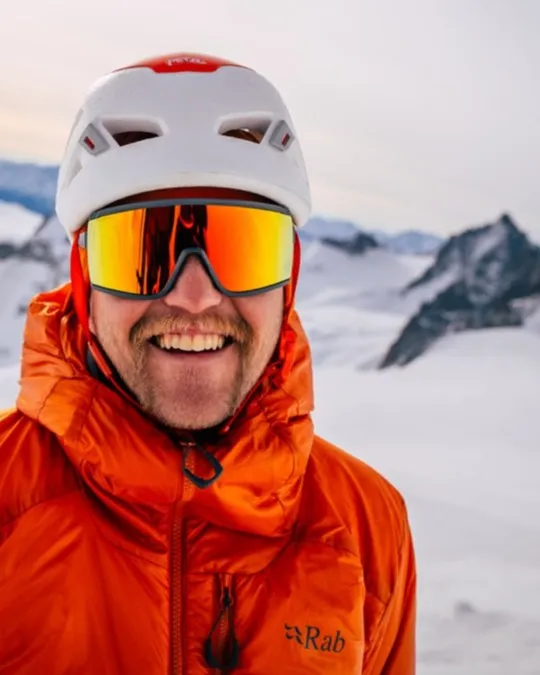
Some guides keep what they know to themselves. Dave Searle has spent years giving it away. Dave grew up in the South West of England and has lived in Chamonix for more than 16 years. He’s an IFMGA mountain guide, so he takes people into the mountains on skis and on foot, and he’s a regular paraglider and mountain biker too. On a good day he’ll fit several of those into one big alpine outing. Away from guiding, Dave makes Instagram and YouTube videos that teach people how to move through the mountains safely. They’ve reached millions of viewers and given a lot of people their start in mountain sports. In this episode we talk about how he left England for a life in the Alps, what it really takes to become an IFMGA guide, how he thinks about risk and decisions in serious terrain, and why he puts so much into teaching people outside his paying clients. We also hear about his next big project, The Grand Ski Tour.
Key Takeaways & Insights
Applying for the guides course, Dave was asked to climb 25 more multi-pitch E1s.
Dave had done 50, but some were small routes in Devonshire. He took 14 days' holiday from Epic TV and spent a week and a bit at Gogarth on Anglesey, doing about 2 a day. A 2-day deferral meant a resit the next year, which he says was the right thing in the end.
Dave ends up repeating the same 5 or 6 Chamonix routes for beginners.
Dave means classic short ridges, such as the Traverse of the Marbrées and the Cosmiques Arete, done maybe 2 or 3 times a season. He tries to limit hut nights to 1 or 2 a week in summer and protect his weekends for family.
Dave won't ski Pas de Chevre now: steep moraine and rockfall in the gully.
Dave says the run was once wide open and not too hard, ending with the train or a ski back to Chamonix. Anyone who goes now has to rappel or, probably better, fly off the bench above, which he has done a few times.
Dave sold his paraglider wing as he had no time to stay current.
Dave says you feel invincible when you start, have a couple of near misses, then have to put in the time slowly to get through the dip. He also says a lot of things cannot be known or learned, and a bad landing could mean a life-changing injury.
Dave calls skiing at the Skyway very dangerous, as skiers above set off avalanches.
Dave has done 10 laps of its upper cable car in a day, 10,000 or 12,000 metres of steep skiing, but skied there less as it got busier. He listens to how he feels and would not drop in if nervous. A friend, one of the best skiers Dave knows, will not ski there again.
Dave links avoiding bad accidents to not rushing to tick things off.
Dave says he was not very good at managing risk when he first arrived. He is a lot better now, though not perfect, and does not think anybody gets there. He is not an adrenaline junkie and prefers to feel in control. He despairs at the young speed riders, so many of whom die.
Complete podcast transcript
Hello, and welcome back to the Outmap Podcast, A Guide in Life. I'm Charlie Boscoe, and today I'm talking to somebody I've known, this makes me feel old, for over 15 years. I first met Dave Searle in Chamonix back in the early days when we were both climbing and skiing bums.
0:31 And since then, Dave has really kicked on. I've known him an awfully long time, but we haven't actually done that much together in the mountains, I think mainly because he operated at a much higher level than me. And as well as some incredibly impressive ascents across the Alps, including the North Face of the Eiger, a solo of the North Face of Les Droites, and some pretty out there ski lines as well, across the Alps and New Zealand, Norway, even a trip to Canada, which we mention.
1:03 Dave has qualified as an IFMGA mountain and ski guide, and made a real career for himself, not only in the mountains, but filming and talking about them as well. We both worked at Epic TV, and he then kicked on to create his own content channels, which are doing really well, and that's great to see.
1:24 He's just an entrepreneurial, interesting, thoughtful guy, who turned a passion for mountain sports into a multifaceted career and a great life out in Chamonix. I really enjoyed catching up with him, and I hope you enjoy the chat. Dave, welcome along. Thank you for joining. And I gotta say, people listening to this won't be able to see it, but behind you I can see your gear which feels like a famous place.
1:56 I've seen it on so many YouTube videos about how to attach yourself to anchors or service your skis. And can just see it behind you. It feels like you're in a legendary place.
Well, that's good that it's achieved legendary status perhaps, but I'm amazed that you watch my videos, Charlie. I didn't realize, I thought you'd probably, like me, have no time for actually consuming things, but...
Well, I don't have any time to put the advice into use by actually doing things, but I store the knowledge for if I ever have free time again.
Right, I see.
No, they're great. You've become a YouTuber. You couldn't really be a YouTuber when I lived in Chamonix. It wasn't really a thing, but it's been great to watch that.
I guess it was kind of one of the things that I wanted to do at some point and I was kind of like aiming towards doing that, and then I kind of got a bit distracted by doing the guides course.
Yeah, it's quite a distraction.
So... 'Cause it was funny 'cause we met at Epic TV, right?
Yeah.
So for those of you who don't know, I took over after Charlie left Epic TV is no more. Did you know that?
Well, I heard Epic TV is semi-more. There's some Of it still in existence, but it's hard to tell.
It got bought by a company called All You Need, which is an Italian company. And they have the Epic TV website, but it just sends people to the stock, their stock. So there's one person from the Epic TV team, who's moved to working with them. And it's a funny one though, because when you started there, it was quite a big thing, and then it slowly shrunk, didn't it, over time, and you were Epic TV climbing daily presenter for, like, three years or something, right?
Two, yeah.
Two.
I'd like to think the shrinkage was not as my time went on, the company got smaller and smaller.
I'm not saying it was anything to do with you.
Increase the views eightfold. It's on my resume. No, I'm only kidding. No, I mean, climbing daily was super fun, but that's not the same as having a successful business. So the show was doing great, but that doesn't support the kind of operation that Epic TV had at that time, so.
Yeah. No, but the show Iconic at the time, and then I had to fill your boots when you left, which was really difficult.
Oh, you've got big feet.
But no, it was. That was really interesting time for me to learn more about this kind of filmmaking stuff, and I think without that background, there's no way that I would have been doing this YouTube channel. Because you just learn so much about production and what makes a good video and I think the sort of videos that I was also doing, 'cause I was also doing the Gear Geek shows. They were very much like the kind of videos that I do now.
5:12 So yeah, it was a natural thing for me to get into and it still does really interest me. And more now doing the kind of adventure videos is way more fun than just chatting about gear at home.
Yeah. It's a lot harder, but it's a lot more rewarding.
There's... Oh, there's so much more to those adventure videos.
Yeah, I know, 'cause I remember with Epic TV, I mean, with joke aside, yeah, we... It was a fun thing, but I'm not sure the show ever made a ton of money. But it was amazing for people like you and me who got exposed to this whole new world and learned this whole new skill set.
5:59 And I think people enjoyed it for a while there. Matt Groom did a pretty admirable job. He took it on from there. But ultimately you gotta pay the bills, I guess.
Yeah. It was good at the time, but I'm happy that I left to do the guides course when I did. I think that was Yeah. So, oh my goodness, that
I mean, when did
That was years ago now
You went... Well... Yeah, I know, it's horrendous, isn't it?
So much has happened.
When someone says to me, "How old are you?" I'm about to say 27, and then I go, "20... Oh, 42. Sorry." Yeah. It's unbelievable. What year did you start the guide scheme?
About 2015, I think. 2014 maybe.
And what was the experience about it like of it like? Because it's one of those things you hear so much about, and so many people in Chamonix are gunning for it. How did you find that period?
It was very challenging. It was very rewarding. At the time it was very... It was a bit frustrating in some ways because you spend the first couple of years spending loads of money and not making any money. And then all of a sudden the tap gets turned on a little bit to like half flow, and you start making a bit of money back, and you're like, "Oh, this is cool. I'm actually going out and doing... I'm climbing and people are paying me to do this." and then you finish and you're like, "Wow, that was quite a thing." but I think as somebody who lived in Chamonix, it was a interesting...
7:49 The interesting thing about that was that I didn't actually have that much experience of climbing in the UK, and one of the things that they really look for in the British Mountain Guides is that you've got a lot of experience of climbing in the UK. So, actually when I submitted my application, they asked me to do another 25 E1s, like multi-pitch
8:10 On top of what I'd already done. So I'd already done 50 multi-pitch E1s, but because some of them were a bit small and only a couple of pitches in, like, Devonshire And stuff like that, they were like "We want you to go and do another 25." And I was like, "Oh my goodness." and I had
That's a lot.
It's a lot, yeah. It is a lot. But I didn't have any choice because at the time I was working for Epic TV, so I took two weeks holiday, 14 days, and I went back to the UK. Luckily, I had good weather for two weeks, and I spent, like, a week and a bit at Gogarth and on Anglesey doing just, like, two multi-pitch E1s a day, more or less.
8:56 You know, like, two big routes a day on those crags. And
Which is quite a lot. Psychologically Gogarth's pretty scary. Just translate it for a North American or a Euro audience. It's like, I guess, 5.10, 6A+, but very trad. Like real, real trad climbing.
On,
So the grade
Loose, tottering Above the sea.
It's pretty out there. The grade doesn't sound super impressive when you say it in French terms, but it's a bit more of an adventure than people who haven't British trad climbed might realize.
Yeah. It was definitely adventurous. So packing all of that into two weeks. So I did a bunch on the sea cliffs, and then I also went to the Lake District and did a few mountain routes, and also some mountain routes in Llanberis as well, which was cool. So I was very lucky to get the weather to do those 25 routes in two weeks, which was like one of my more prouder achievements actually, was doing that many UK trad routes in that space of time.
10:02 So they let me onto the guides course, that year, and then I did the inductions and got on through all that stuff and got started with it. But then you end up spending the first couple of years back in the UK.
10:17 In North Wales, and then in Scotland in winter. And after Scotland in winter I got a two-day deferral, which means that I had to go back the next year and do a two-day resit. And that was frustrating, but it was also a...
10:40 It was also a good opportunity to get better. I think at the time I was really frustrated and pee'd off that I had to go back and do more. But then I came back and I did manage to get actually better conditions in the second winter, and do more climbing and learn more, and actually progress more, and it was the right thing in the end.
11:04 But it's funny, at the time when you're like, "Oh, I don't wanna do this thing," and then actually it ends up being the best thing to do.
Yeah. Yeah, I get that. I'm interested, when they said you have to do... Can you go back and do another 25 E1s, which is, like you say, no joke, did you feel with hindsight that was actually quite beneficial?
I think so. It's just more experience on that type of terrain. More experience in those mountains was really useful to coming to the actual start of the guides course. Yeah. Mostly when I guide these days, I'm guiding alpine climbing and ski mountaineering, so I don't really do much or any kind of trad rock climbing in the UK or anything like that. So in terms of my guiding now, it wasn't that useful. But in terms of doing the guides course, it was very useful,
And I guess the qualification means you could have been doing tons of British trad climbing, so you should be good at it, I guess. So it's probably fair enough. And have you enjoyed the guiding life?
I have. Yeah, I have. There's definitely elements of it that are very challenging. I like being at home and A lot of guiding that requires you to be away. Don't get me wrong, I like going away and going away for a couple of weeks to somewhere like Norway or Georgia or something like that is a really, nice thing to do.
12:49 But going away every week for two or three nights a week into mountain huts isn't necessarily my idea of fun. So I generally limit that kind of guiding where I'm maybe doing, like, one or two nights a week through the summer in huts, and then trying to do more day routes.
13:13 And I try and protect the weekends a little bit so I can spend time with the family. And yeah, in the winter I'll mostly be doing day routes around Chamonix. So yeah, that's the kind of element for me that I don't love. But the rest of it, yeah, I really like taking people out and showing them around, and helping them work on skills and teaching and trying to find the best snow and trying to find the best terrain for them. It's like, it's all super rewarding, I think.
13:44 Yeah.
Yeah. Yeah, that's good to hear. And you live in one of, if not the only place in the world where guiding can be a nine-to-five job. Summer and winter.
Yeah. Yeah, it is very easy to do a lot of day routes around Chamonix. You do end up doing the same, like, five or six routes, maybe two or three times, a season because they're just so perfect normally for people. I'm thinking about, like, Traverse of the Marbrées or the Cosmiques Arete, things like, oh, like really classic kind of easy short ridges.
14:24 They're just so perfect for most beginners that you end up doing, doing them loads, so. But apart from that, you can, even if you drive for a couple of hours, there's loads of options for even things to do in a day. It ends up being a long day if you add four hours of driving. But if you're going for an overnighter, Zermatt, Saas-Fee, all those kind of places have got loads of really good stuff.
14:51 And then there's some good single day ridge routes down in the Aravis and stuff like that. And then ski touring, there's loads of good things you can do in one day, ski touring. And you don't necessarily have to use the lifts as well. I think a lot of the time people get sucked into using the lift in Chamonix for skiing, but actually you could very easily not use the lifts or go and use some other lifts, and get away from people a little bit more.
Yeah. 'cause you've been... How long have you been in Chamonix now? It must be nearly 20 years.
It's coming up to 20 years, yeah. I moved here when I was 19, I think I did my first winter. And I'm 38 at the moment. I'm 39 in February, so 19, yeah, 19 years.
Wow. Yeah, I didn't realize you were that young when you came.
Mm.
So you must have been here, must have been there a little while when I arrived, 'cause I got there 2000 and... I think my first winter was 2008-9. I think I met you via Tom Who's also been on this podcast, and you were living in that house in Les
16:09 With Gav And Tom and James Clapham.
Yeah. All that crew, yeah.
They were
No, it was,
That was a while ago
Yeah, it was a while ago. Yeah. But that was my second season in Chamonix, so I'd been there, like, one more year before that. But... Or One season 'cause I didn't do the summer, I just did the winter. Yeah.
How's it changed since you arrived?
It's changed loads, but it's like everything, it's kind of small increments so it doesn't... You know, you just kinda get used to it. But the top of the Grands Montets burned down, so it's very different, skiing at the Grands Montets these days. The highest lift is the Bochard. So every time you tour across, you go from the Bochard around to get onto the back face.
17:02 Whereas there was, like, several years where that lift was open and I was at that point getting better at alpine climbing and ski mountaineering. And there were some amazing days that you could do with that lift, where you could do things in one day from that top lift, and now you just can't do that. But they're reopening that lift, I think next winter, so I'm super excited about that.
17:31 But that's, I think the biggest change. And then you also see how the glaciers have changed. So, we, you and I probably were doing the Pas de Chevre quite a lot when you were around,
Yeah, loved Pas de Chevre
Yeah, Pas de Chevre was like an amazing run, wasn't it? 'Cause it wasn't too hard. It was big big wide open thing and then you come down and then you either take the train back or ski back to Chamonix. You just can't do that anymore. The moraine at the bottom is so big and steep that it's just impossible.
18:05 So
Wow, 'cause I remember there was always a bit of, like, tomfoolery to get out of It was a bit of messing around, but It was doable in anything like a good winter.
Yeah. Yeah. No, it's... And it slowly got to the point where, you know, you might be able to get, like, it for a week or two, and then it was like maybe there was a day that it was okay, and now I won't go there. It's too dangerous. There's too much... It's too steep, and there's too much rock fall that comes down the gully that you have to ski.
18:38 So unless something drastically changes, like there's a big collapse on that moraine bench that makes like a nice ramp of moraine, for example, I won't be going back there. So if you do go there, you end up having to rappel or the best thing to do is probably to fly off from the bench above, and I've done that a few times.
With a little wing.
Yeah, with a little paraglider. Where I was doing loads of paragliding, and I was really enjoying that, and I had a lightweight wing that was like 1.4 kilos with a little harness, and I was doing loads of that, and then I got to a point where I was like, "I don't have time for this.
19:17 I don't have time to stay current with it." So I sold the wing, and I took a step back, but part of me misses having that option to fly off things. It's pretty cool.
I think everyone goes through that phase. I remember getting one, but then same thing. If you don't do it regularly, the terror feels quite and the chances of something going wrong feels quite high 'cause you're not that current, and you can't figure out what's going on and why the wing's moving the way it is.
19:50 And I totally get that. Feels like everyone goes through that phase Of the flying in Chamonix. Not many people seem to stick with it, though. Has it calmed down a bit? People aren't going around with a wing everywhere anymore?
There's quite a few people who do still fly. But yeah, not loads.
Go on.
Yeah. I would say there are people who have got more into it, and they've kind of got to... 'Cause I feel like it's like that classic Dunning-Kruger effect. When you start out doing something, you sort of feel invincible, and then you have a couple of, like, near misses or something, and then you feel a little bit more or a little bit less invincible.
20:34 And then to get through that dip afterwards, you have to really put in the time slowly to understand everything. And then you start to realize how much there is to learn. But for me, I think I was on that trajectory of learning those things.
20:53 But I also came to the realization that there's a lot of things that you just can't know or learn. You just make a judgment based on the weather forecast and what you can see and what it's like, but you can still mess it up.
21:07 You know, you're coming into land. If you mess that up, you could really hurt yourself. You could really have a life-changing injury.
You're coming in pretty hot. Yeah, you're coming in pretty hot with those little wings. I was super into skydiving for a while. And so when I got my little wing, I thought, "Oh, yeah, well, like I've landed a big skydiving rig a million times, and it's..." But you got a ton of parachute above you when you're skydiving. And I remember when that first wing coming into land, I thought, "Oh my God, it's like everything's on fast-forward."
21:42 I still luckily never managed to fluff a landing, but I could absolutely see that if I did it enough, eventually I was gonna blow a landing. It leads me on, actually. How do you cope with the kind of psychological side of Chamonix? 'Cause it is so extreme, and I lived there, for a little while, and it's so full on, and there's so much. The standard of everything is so high.
22:13 Most people are just really good at what they do. And I found that quite a strain, actually. And it's quite competitive. No one says it, but I do feel it's pretty competitive. Although it's a completely unspoken competition, but it definitely is there. It's bubbling away. How do you deal with it? 'Cause you seem pretty zen with it now. You're just doing your thing, and you're fine with it. Have you found it a challenge psychologically living there?
Yeah, certainly a little bit. I think I can see where you're coming from. But also, I think I've very much just been, over the years, just not in a rush to do things. You know, I've got things that I wanna do, and I've done some fairly out there things over the years.
23:13 But I very much listen to my feelings and what I wanna do and my risk tolerance, and I don't let other people cloud or change my risk tolerance. A classic example really is skiing up at the Skyway, right?
Which is on the... Used to be called the Helbronner for people above Courmayeur on the other side of the Massif in Chamonix.
Yeah. There was an old lift system there that was there when I first arrived. It was this old rustic three-part cable car that went up to the top. And they replaced it with this high-speed rotating cable car, which is amazing because you can see out of the lift. You can see almost the grains of snow that are on the face underneath. And you can see where the tracks are, you can see where people are skiing. You're taking the lift up, it's super high speed.
24:16 And there's probably 10, 15 lines that you can do from there that are all variants of each other. And if the conditions are good, I've had days where I've skied there where I've done, like, 10 laps of that upper cable car, which is amazing. That's 10,000 or, like, 12,000 meters of skiing, of steep freeride skiing in a day.
24:48 You know, how often can you do that? It's amazing.
Yeah. I mean, you can't even do that in a
No
In a
No
In most places in North America.
No. Even if you had the most motivated heli ski guide and the unlimited budget, doing 12 laps on a heli of that length would be next to impossible.
I'm not sure you could do it, actually.
And Not in that terrain where it's steep and glacier and exposed and all that kind of stuff. So it's very cool. It's very cool. Yeah. Skiing at Skyway is very cool. But it's very, very, very dangerous. You're skiing these With people above you who are cutting off avalanches. Not only are you managing your bubble and what you're doing and where you're stopping and where you're skiing and which bit of snow you ski onto, et cetera, but you've got all these other people that are skiing above you, and there's no control over that whatsoever.
25:51 And I did a bunch of skiing there and I really enjoyed it. And then it got busier and I just kind of was like, "I don't really need to do this as much." You know? Like, this
Yeah, 100%
This is insane, you know? But I'm also not closed off to being kind of, like, to going and doing it if it feels right. I think that's the key point I'm trying to make, is that if I woke up one day and I felt like taking on a bit more risk and skiing those lines again, I wouldn't have any issues doing It's not like it's gone for me.
26:32 It's more about, I listen to how I feel and if I was there and I felt really nervous, I wouldn't drop in. Whereas if I was there and I felt really happy and confident being there, then that's okay. 'Cause I think at the end of the day with, with skiing or climbing or any of these things, you have to take on some risk.
26:57 Because if you're not taking on
Yeah, you, yeah
You're not really... I don't know. You're never gonna grow, and also you're never... It would just be all kind of the same. I don't know. I'm trying to explain it better.
Well, risk is an important part of life.
Mm.
And you can't avoid it. And nobody ski mountaineering is avoiding risk. I totally get that. And equally, the only two injuries I've had skiing, touch wood, have been on green groomers. So maybe there's something to be said for when you're feeling complacent, you get injured more than when you're absolutely terrified but on high alert. But I think that's really interesting to hear you say that, 'cause it just gave me the woolies, the skiing on that part of the world.
27:46 I just felt like it just wasn't worth it. And it's amazing that, like you say, but it's a 38-degree south-facing slope that's, I guess including the bottom, 2,000 meters high. So it's about as out there as it gets. But I think you need to have quite a strength of character in Chamonix.
28:06 And strength of character doesn't mean just going for everything, which I think is what a lot of people mistake strength of character for. They think the strength of character just means being the bravest guy on the hill. Which in Chamonix would make you a very brave individual. Bold is probably the better word rather than brave. But you need a real strength of character to be able to say, "You know what? All the cool cats are doing that, but that's not for me."
Yeah. Yeah. And I also had a friend, Stian, who's got a couple of kids, and he just said he's never gonna ski there again, even though he's, like, one of the best skiers that I know. You know, he's been
He's a very good skier
Yeah, he's been a professional skier for, like, 25 years or something I don't know, like, maybe longer. He's, he's an incredible skier and he's just like, "I don't, don't need to do that anymore." And I'm like, "Yeah, I pretty much agree." I haven't been necessarily as firm as that, like I'm never gonna do it. Because, like I said, I do see that occasionally, you know, I wake up and I feel really good and I think that the conditions are gonna be good and I've got a strong team and I'm in the right frame of mind, like, I would be willing to go and do a... I'd be psyched to go and do a couple of runs, right?
29:31 It's not like I'm willing to do it and I'm like, "Oh, fine. I'll do it if I have to." I wanna be willing to do it and willing to be there. So yeah.
Yeah. Yeah. That's really good to hear, 'cause I do worry about a lot of people in Chamonix. And we both know quite a few people who've been wiped out
Mm
At the well, I still call it the Skyway. And it, yeah, it sounds... I mean, do you feel your approach to risk has changed a lot in 19 years in Chamonix?
Yeah. Yeah, definitely. To start with, when I first arrived, I was not very good at managing risks.
I'm not sure anyone is when they arrive, are they?
Yeah. And now I'm a lot better. But I'm still not perfect at doing it. And I don't think anybody ever gets to perfection. But it's like we can always improve our risk management and our decision-making process, et cetera. But yeah, I think also spending this much time here and doing things, and not being in a major rush to tick things off and do things, has kind of like...
30:58 I've actually, when I look back, I've not really, touch wood, had any like bad, accidents or situations in the mountains where I've really lost control or I really came very close. There's a few things that were like a few little freak things maybe, but yeah, I know a lot of people who've got into loads and loads of trouble with various different things over the years, and you're just kind of like, "How..." You know, "How have you defied these odds?" I don't know.
31:40 It's kinda crazy when you see. But yeah. And,
Yeah. Some go on
I was just gonna say it's going back to what we were saying about paragliding, is that you see a lot of these, like, young guys doing like speed riding, and so many of them die. It's
Full on
Full on. And they like these young guys dying and I just despair that people that have got such little development in their prefrontal cortex are allowed to do these things that are like that dangerous.
Yeah, but equally that was us
But yeah, it was us, but we didn't... I mean, if, maybe if I had speed riding, if speed riding was accessible as it is now, maybe I would've done that as well. But I'm not really like an adrenaline junkie.
32:34 I'm not out there to get adrenaline hits. I'm like out To feel like control I don't like that spike in adrenaline. I actually like to have that good feeling of skiing without it being like that was an amazing hit of adrenaline, you know? Anyway
Yeah, I totally get that. It always amazed me in Chamonix, some people I'm sure, me and you would probably have the same people on this list are just willing to play with all the marbles every time and really chase that high, and I don't get it. I'm with you. I like the feeling of mastery.
33:20 I like moving through the mountains and thinking, "I kind of feel like I'm good enough at this. I can do this with a pretty good margin of safety." And that's really satisfying 'cause it's complex and there are multiple elements to it, but I can do it at a good level, and that's satisfying.
Mm.
And that's enough for me. It sounds like it's enough for you.
Yeah. Yeah, no, there's always that natural like growing up as well, where you have kids or just get a bit older, and you just realize that you can't keep doing these things forever. I totally respect your decision to move away and there's parts of me that would love to go and live in other parts of the world. I really actually miss or I have a yearning for like wide-open spaces and no people, that you can never scratch that itch around here.
34:25 Like, you know? You...
Well, yeah, I guess so
There's always some French dude on some rando skis that pops up from somewhere on massive tour that you've thought that you would never see anybody. He's like, "Well, bonjour." And you're like, "What the hell?" Like, "What are you doing back here?" "I came here to be alone." So I'm sure it's not as easy as I imagine, but I have been up to like the Yukon and things like that where there is places that you can, you can get to where there's nobody around. And I really yearn for that sometimes.
35:03 But at the same time, I do love the how easy things are around here. The lift's right there. It's not far to get into Chamonix from where I live. It's all very like plug and play, easygoing. So it's like, am I gonna uproot my whole life to go somewhere else? I'm not sure, but we'll see. Maybe in the future we'll move somewhere else, but yeah.
Yeah. But I mean, since I lived in Chamonix, I've lived in three
Mm
And I'd lived in a couple of places before Chamonix, and nowhere's perfect is my conclusion about the world. I miss the convenience of the Alps. If I go on a ski tour here, a couple of years ago we did the Bugaboos to Rogers ski traverse, and we were gone 10 days.
35:50 Didn't see a skin track, didn't see a ski track. Nothing. No, didn't see anyone. We found some dug out tent holes one night next to a creek, and we were so happy that someone had dug our tent holes for us. But equally it's quite a big mission to fly in a heli and get dropped off and carry 10 days' gear and suffer through that in a way.
36:13 And I miss the convenience of the Alps. From our house I can drive 15 minutes and I will not see anyone. I know I won't see anyone.
Mm.
And I can start a fire, and my friend brings his shotgun and we can be rednecks. And definitely won't see anyone. But equally, if I wanna do a day ski tour, it's pretty challenging.
Mm.
If I wanna go and do a multi-pitch rock climb, probably gonna have to go and camp at the bottom of it the night before and
Maybe we should do a house swap, Charlie
I wish we could have the... I wish
You
I've done a few house swaps actually on... There's a platform for doing it, but That would be great to do that.
You can spend some time in my gear cave, and you can look after my giant ginger cat, and I can have a go on your drums.
Oh, yeah, you can have a go on the drums. Got a quad bike as well. We've got a full redneck here. Don't worry. Although you're the one with the handlebar mustache.
No, I'd fit right in. Yeah.
Oh, people would think you're a local the day you arrived. No, but it's true, like nowhere's perfect. And what you have there, we don't have here, and vice versa. And yeah, I think n-no-nowhere wins on every front. Although I do like it here.
Yeah. I still like it here.
Yeah, exactly, and I would still like it there, and if I'd lived in Chamonix my whole life, I bet I'd be absolutely loving it.
Yeah. I would say, though, like we live in So it's just out the valley, but honestly it's such a different vibe. It's literally
Oh, yeah. So it's like a different universe, isn't it?
You feel the weight of the mountains in Servoz. I don't know if that's a good way of putting it, but you feel the closeness of them and you run into these people at the bar, and there's always people wandering around with gear and coming back from missions and whatever. Whereas Servoz is quiet village family life.
38:17 So I can To Chamonix and get a hit of that, like insanity. And quite often we sit on our balcony and we watch the storms roll across Mont Blanc, and we're in the sunshine as well, which is also a nice thing about being slightly further away from Mont Blanc. But the,
You don't get the same violence of weather.
Yeah, it's just slightly better. It's bit more sun. And also it's a little bit lower than the snow line often as well, whereas we might get a little 10, 15 centimeters of snow down here. When I lived in Argentiere before, it was like meters of snow. I've got pictures of my car, like digging my car out when I lived in Argentiere, and it's like two and a half hours of digging to get your car out. And people are on the phone like, "Oh, do you wanna go skiing?" I'm like, "Yeah, I'm just trying to get my car out," like...
39:14 Whereas down here I'm like, "Oh, I've got, you know, I've got a garage." Drive
Yeah, no. How about a
Drive out of my garage and drive up to the snow and go for a ski tour, right. Yeah. Great. Yeah. So it's definitely for me, being just a little bit away is much better. So anyway, yeah.
Yeah. I absolutely get that. And speaking of the gear room, I consider it the famous gear room. How did the YouTube thing come about? After Epic TV, did you... How did that come to be?
Yeah. It was a bit of a slow burn really. I did, like, a few YouTube videos over the years and just kind of like did bits and pieces. And then probably about two, two years ago, something like that, I was like, "Right, I'm gonna make a bit more of a concerted effort." and it...
40:11 And then the sort of economics of it didn't really work because, you know, the more time you put in, you need a way of paying for that time, you know. I kind of hit this crossover point where I was like, "Oh, I've got enough kind of brands now that I can get some money off them," and that kind of pays for these videos and. But I would say the economics is still not quite there with my Grand Ski Tour project, but it's coming together this winter.
40:41 I basically had a full year of losing money on that project, which is hard 'cause it's a lot of work, to not be making any money. But now it's... I think it's at the point now where it's gonna pay, at least my time and if not a bit more.
41:04 And hopefully I can get a bit more traction with the videos and get things kind of rolling a little bit more. But yeah, but then I also was at the same time doing quite a lot on Instagram, and that actually grew a lot.
41:18 And that was way easier because it was just I could make a video, like a three-minute Instagram reel, in, like, 20 minutes after work. Pick a topic and make a video about it, and they would get, like, hundreds of thousands of views often. And I got, like, loads and loads of followers from that, and it was really good. But it's been a funny one.
41:47 I'm still really enjoying it, and I'm hoping to get some more growth, but yeah. I don't know.
Yeah. But I've spent three years on a project before I got paid for it. Spent five years trying to make Pro Climbing League happen. Outmap, everyone started Outmap with no guarantee of a return, I think increasingly in the gig economy and today's world where not many or fewer and fewer people, it feels like, have 9:00 to 5:00 jobs. I think part of it is just picking something and going for it.
Yeah. Don't get me wrong, like I'm well aware of how things take time and it... I think I have to keep reminding myself I have to treat it like that because it... But the funny thing is 'cause like I have this kind of other career that I could just go and do.
42:41 I could just go and guide and make reasonably Money. Like why would I give that up to do the YouTube thing? But I like to do various different things and I like to feel like... I like to be creative, I like to do stuff with my hands, I like to be in the mountains, I like to do various different things. And I think doing a bit of guiding, doing a bit of YouTube, doing bit of this, that and the other is like perfect for me, like doing various things. So yeah.
Well, you've always been quite entrepreneurial from my memory.
Mm. It's funny yeah.
Yeah. I never had
I guess so.
Go on.
Yeah. My dad's got a very funny definition of entrepreneur. Like he's got a very high bar for entrepreneurial-ness. But I would say that I'm entrepreneurial, but maybe a failed one. I haven't like made like millions of euros, you know.
Come on. What's your dad's definition?
I don't know. He's thinking about like people like Alan Sugar and, you know, people like that who are just like you know, the top-end entrepreneurs, right? That's what his like definition of it is. But I see an entrepreneur as somebody who just sees an opportunity somewhere, and they give it a go with that, and they kind of like maybe they do something else at the same time and they, you know. But I'm definitely like that. I'm not kind of like...
44:21 I don't like just doing the same thing. Like if I see an opportunity I'll give that a go. So there's been various things like guiding, and then, the Oak app has been another, another thing that I worked a bunch on that for like nearly a year, and that's got to a point now where it's starting to really take off, which is awesome.
44:44 And then this YouTube channel. Before this studio was my studio, it was a bike workshop. So we bought this house and it had this room downstairs. There's a concrete slab on the floor which is not insulated, so it would be difficult to convert it into a apartment or something like that, or a bedroom or another part of the house.
45:14 And there's not enough headroom to add in a fake ceiling, so it was stuck with these terracotta tiles. And you know, it's just not an ideal space for anything other than a workshop. So when we moved in, I was like, "I wanna start a bike workshop." And I had a friend who was a mechanic and we started this bike workshop and for various reasons it didn't work.
45:38 But it was a good learning experience of why it didn't work. Like I didn't put enough into it. And then when folded I switched to using it as my studio. And now, I love this space. It's so cool to have a studio workshop like this that I can work on my bike, I can make videos, I can pack my stuff, and I can lock myself in here when the kids are being noisy as well.
But no, the thing about being an entrepreneur is that if you can do something you like doing, that to me is the ultimate entrepreneur. I read about some American billionaire the other day, and he'd made his fortune in like packaging, and I thought, "Well, great, you got a billion bucks, but you spent your life thinking about packaging." You know? It's...
46:36 What you're doing is doing things you enjoy and you're passionate about, which hopefully end up paying you of it in, down the road. That's the real challenge, is doing something you love that pays you. And you're doing that.
Not sure I'll ever make a billion, though.
I don't need a billion. I don't need a billion dollars.
No, I don't need a billion either.
But no. But guiding's hard as well, hey. And I think, the guides I always thought were super smart were the ones who found another way to make a living.
Mm.
I think seemed to me like being just a guide, not that it's a high-level job, but if that's your only source of You know, people talk about passive income. There's nothing less passive than being a mountain guide. If you wanna make 500 bucks, you gotta go and do something physical.
Yeah. Yeah, there's not really Easy days. And it doesn't... If you don't do it, you don't make it, you know? So it's like, yeah. No, that was part of the whole idea with this kind of like YouTube thing, was having, was trying to get like a passive income.
47:44 So I've been working a little bit on some online courses as well and I've got an idea for an online course which I think is gonna be pretty cool. I just don't have the time to do it right now, but I'm gonna create the time at some point.
Well, it's the middle of November. It's a pretty good time, I guess.
Oh, I'm so busy right now, Charlie. I've got like seven... I was doing, what? I've got five adventure videos plus three or four at other videos that I'm working on. So there's like a lot of editing. I have editors helping me, but it's still gotta feed back. And then each one of those videos needs a blog post, and then, cover images descriptions, social media posts, all that kind of stuff. And then I'm also trying to get out and do loads of exercise and stay fit and strong, 'cause I've got some big projects this winter.
48:44 So I don't have time for the online course right now, but I will probably have time in late December or early January, because that's not really Grand Ski Tour season. I will probably do a little bit of trying to film at that time. But yeah, that'll be my time to get that online course done. I know it'll only take a couple of weeks. I've done one before, so I know what it's like, which is good.
Yeah, but I so respect the hustle. Life is full of people who go, "Well, I wanna make a video series, but no one paid me," or, "I wanna have a successful blog or a successful Instagram or YouTube, but well, no, no sponsors came along."
Mm.
Or they're too busy doing something else, or they just haven't got the drive to do it.
Mm.
And I really respect your hustle doing that. And it's the same with the Outmap guys. FATMAP disappeared and they go, "Oh, that was great. I really like FATMAP, so unpaid in my free time I'm gonna A new one." That kind of hustle I think is great.
Do you wanna know my secret for how I got,
I was
So, like, hustled?
How'd you get hustle? What do
Or,
How did you get infused with the hustle?
So on a trip to the Yukon for the trip that I was mentioning before, we didn't talk about it, but I did a trip with filming with TGR with some athletes out, out on the Yukon for, like, two or three weeks.
50:20 And it was a great trip. There's a movie coming out at the moment called The Lost Cache. So it's worth checking that one out. I actually haven't seen it yet, but I've heard it's good anyway. I might have a small cameo in it, but,
Heard the safety guy was good.
Yeah, yeah. Well, nobody got hurt or died, so the safety guy must've been great.
He must've done a good job, yeah
Yeah, anyway, did that trip. But the point of the story is, on the way out there, I got flown business class. Oh.
That's a game changer.
It ruins you. Honestly, if you wanna get motivated to make some more money, and you wanna also stay true to who you are, that is an important part of it. If you wanna get motivated to make some more money, just fly business class once.
51:17 Because all your
Oh, tell me about it
Ever does is go, "You gotta fly business class again, 'cause that was amazing."
I always say if I had the money, that's the one thing I'd do. I don't need a watch. I wouldn't buy a bigger house. Definitely wouldn't buy a Ferrari.
I don't need any of that.
But I would fly business. No, I'm with you. And for the last since I left Chamonix, I've been flying long haul about six, seven times a year. Still doing it now. Do it, come to Europe about once every six weeks right now. And every time I fold myself into that little seat, it's a first world problem, isn't it? Oh, I get to fly to the other side of the
51:58 And with a TV to But my seat's not comfortable enough. But no, the only time I flew business, I got on a flight and I'd been told to try it one time. Got on a flight, it was flying, Munich, Detroit, and got on. I thought, "I'm turning left." Turned left, sat down, just owned it, and they never asked. I flew business.
Oh. You rubbernecked it.
I just claimed it. It was absolutely fantastic. But then I got... 'Cause I was so excited, I didn't sleep, and then also just drank, 'cause it's champagne on taps. I just drank tons of champagne. Got to Detroit and then realized I was in no fit state to drive, and I was picking up a rental car. So then I had to have a sleep on a bench in Detroit Airport. So I went from champagne in business class to trying to sleep off the
That's funny
In Detroit Airport. So yeah, and then I had to pick up this rental car, by which stage I was hungover rather than drunk, 'cause I'd been asleep for four hours, and I was late for the rental car. Anyway. Hey ho. It was amazing, though. Absolutely ridiculous.
But that's my top tip for getting motivated to do a bit of hustling. If you're like, "I wanna make a bit more money," you need something to inspire you to make some more money if that's, you 'cause otherwise, you might end up just doing the same job or the same thing, or you don't kind of open yourself up to being a bit more entrepreneurial or whatever. So that was... That's a weird one. That is such a weird... It's like a sickness. You're like, "I need that again."
Yeah, 100%. Now, what I haven't done is gone private. I suspect if you go private, then you really are addicted. Sadly, I don't think either of us will ever be in a position where private's an option. But no, I'm totally with you. It... That is a big motivator, but when in November in Chamonix, most people are just going on sport climbing holidays in Spain and training for the winter and relaxing, servicing their gear, and not doing a ton. To hear that your workload, is pretty impressive.
Mm.
I think you'll be just fine. I think you'll be flying business before you know it.
We'll see. Yeah. But yeah.
Hey. Well, Dave, I know you gotta go, but hey, it's nice to catch up.
Yeah, it's been really fun chatting. Yeah. We should organize that house swap one day. And if you're ever in Europe, you should, come, come back to Chamonix and see how it's changed.
I know. You know what the crazy thing is? I haven't skied a day in Chamonix since I left. 'Cause when I came back to visit, it was always for work with the Climbing
Mm
Or just passing through. But I'm in Fontainebleau about once every six weeks right now. But sadly, we're pretty, pretty busy. So I haven't made it down. But I'm gonna try and make it down in the new year, so I'll definitely give you a shout.
Awesome. Great.
All right. Great to catch up.
Cheers, Charlie. Yeah.